Tire Track Eel Care Guide
A Complete Care Guide for Mastacembelus armatus
Introduction
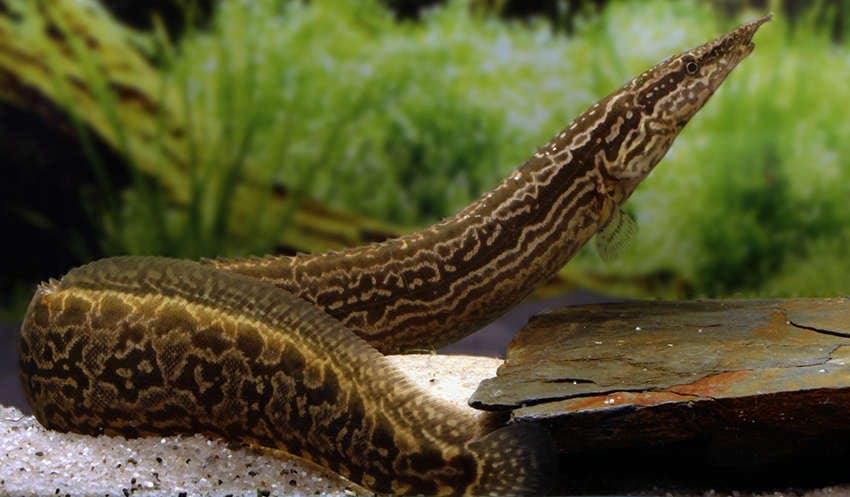
Mastacembelus armatus, the tire track eel (also called the zigzag eel or marbled spiny eel), is the largest commonly available spiny eel species. Their distinctive pattern of dark zigzag or reticulated markings on a tan or brown body resembles a tire track, giving the species its vivid common name. They are powerful, large spiny eels that require substantial aquariums.
Native to South and Southeast Asia across India, Sri Lanka, Thailand, and Indonesia, tire track eels inhabit large rivers, lakes, and estuaries with sandy or muddy substrates. They are primarily nocturnal predators that ambush prey from buried or sheltered positions.
Tire track eel care is rated intermediate to advanced due to their adult size of 24-30 inches, requirement for deep sand substrate, nocturnal feeding requirements, and large tank needs. They are long-lived, fascinating fish for committed intermediate to advanced fishkeepers.
Basic Overview
Common Misconceptions
"Juveniles can be kept in a 40-gallon tank." While juveniles start small, tire track eels grow rapidly. A 6-inch juvenile will reach 18+ inches within 2 years. Planning for a 125+ gallon adult tank from the start is essential; moving a large established eel is difficult and stressful.
"Any substrate is adequate." Tire track eels require a deep (4-6 inch) layer of fine sand to burrow properly. Without it, they cannot express natural behavior and suffer chronic stress. This is the single most critical aspect of their setup.
"They can be caught in a net." Never use a net with spiny eels. Their sharp locking spines tangle catastrophically in net mesh, causing serious injury. Use a large container or bowl to move them.
"They eat dry food." Tire track eels strongly prefer live and frozen meaty foods and most individuals never fully accept pellets. A reliable supply of frozen bloodworms, blackworms, and meaty foods is essential.
Recommended Setup
- 125+ gallon tank for an adult
- 4-6 inches of fine sand substrate
- Very large hiding spots: large PVC pipes, caves formed from large rocks
- Dense planting in pots (to survive burrowing activity)
- Gentle to moderate flow
- Heavy filtration
- Completely sealed lid - no gaps
Diet
Tire track eels are large carnivores requiring substantial meaty foods:
- Frozen bloodworms (primary)
- Frozen whole shrimp
- Frozen fish pieces (smelt, lance fish)
- Live or frozen large earthworms
- Live feeder shrimp
Feed after lights-out near their burrow. Tire track eels are reliable nocturnal feeders when fully settled. Feed every other day for adults; juveniles can be fed daily. Remove uneaten food the next morning. They grow rapidly on a meaty diet and their substantial size means feeding quantities increase significantly with age.
Personality
Tire track eels are impressive, characterful fish that become the undisputed centerpiece of any large tank they inhabit. Their large size, distinctive patterning, and powerful, sinuous movements make them commanding presences.
Despite their predatory nature toward smaller fish, they are completely peaceful toward fish too large to eat. In a large tank with appropriately sized tank mates, tire track eels are model community inhabitants.
Over time, tire track eels develop familiarity with their keeper and may emerge for feeding before lights-out when they recognize their owner's approach. Long-term keepers describe strong attachments to their tire track eels over years of care.
Water Parameters
Tire track eels come from the warm, soft to moderately hard rivers of South and Southeast Asia:
- pH: 6.5-7.5
- Hardness (gH): 5-15 dGH
- Temperature: 75-82 degrees F
- Ammonia and Nitrite: 0 ppm
- Nitrate: below 20 ppm
Here are some top tips to deal with unwanted parameters:
- Tire track eels are sensitive to poor water quality. Their thin-skinned body is vulnerable to bacterial infection when nitrate rises. Weekly 30% water changes are essential for large specimens.
- Avoid copper-based medications. Spiny eels are highly sensitive to copper.
- Deep sand substrate can accumulate anaerobic pockets; gently stir the substrate near the eel's burrow area monthly.
- Standard community tank water chemistry is adequate. Neutral pH and soft to moderate hardness suits them well.