Peacock Eel Care Guide
A Complete Care Guide for Macrognathus siamensis
Introduction
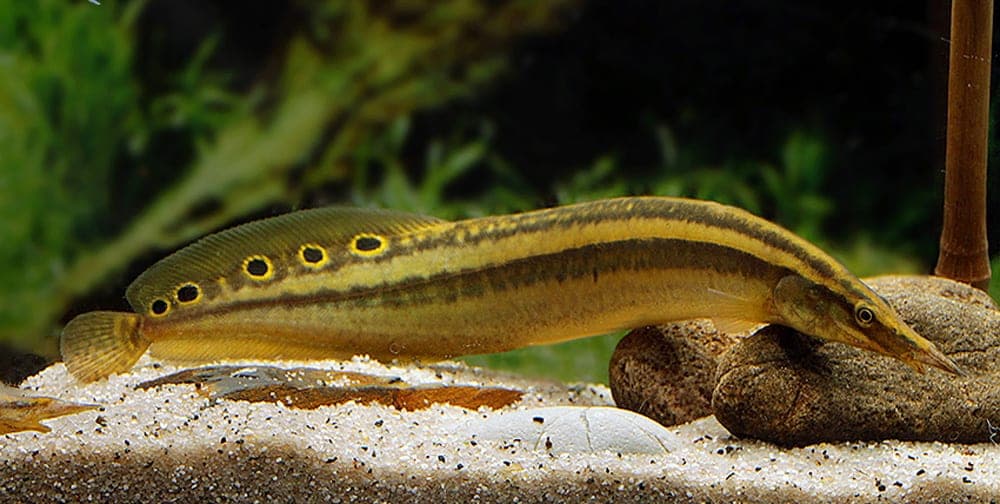
Macrognathus siamensis, the peacock eel (also called the spot-fin spiny eel), is a slender, elongated fish from Southeast Asia notable for its distinctive pattern of eyespots near the dorsal fin and its characteristic burrowing behavior. Despite the common name, peacock eels are not true eels but spiny eels (family Mastacembelidae), more closely related to perch than to true eels.
Native to the Mekong basin and other river systems of Thailand, Laos, Cambodia, and Vietnam, peacock eels inhabit slow-moving rivers, floodplains, and rice paddies with soft substrates and abundant vegetation. They spend much of their time partially or completely buried in soft substrate, with only their head exposed.
Their care requires a deep sand substrate for burrowing, good water quality, and a diet primarily of live and frozen meaty foods. They are nocturnal and often invisible during the day, emerging at night to hunt. Their peaceful temperament with fish too large to eat makes them interesting additions to larger community tanks.
Basic Overview
Common Misconceptions
"They are eels." Peacock eels are spiny eels (family Mastacembelidae), not true eels (order Anguilliformes). True eels have smooth, scaleless bodies; spiny eels have small scales, are not related to true eels, and have different care requirements.
"They do not need sand." A deep sand substrate is essential for peacock eel welfare. They burrow completely in sand as a natural behavior. Gravel prevents this, causing chronic stress. 3-4 inches of fine sand is the minimum.
"They are safe with small fish." Peacock eels are nocturnal hunters that eat any fish small enough to swallow. Small tetras, rasboras, and nano fish will be taken. Tank mates should be 2+ inches and appropriately robust.
"A lid gap is fine." Peacock eels are exceptional escape artists that can squeeze through very small lid gaps and will explore the entire rim of the tank. Any gap wide enough to fit their body is a potential exit. A completely sealed lid with no gaps is essential.
Recommended Setup
- 40+ gallon tank
- 3-4 inch deep fine sand substrate (essential for burrowing)
- Hiding spots: dense plants, driftwood, caves, PVC pipes
- Dense planting to provide cover and security
- Gentle to moderate flow
- Good filtration, but intake tube protected (they can get stuck in filter intakes)
- Completely sealed lid with no gaps larger than 5mm
Diet
Peacock eels are carnivores that strongly prefer live and frozen meaty foods:
- Live or frozen bloodworms (primary food)
- Live or frozen blackworms (highly preferred)
- Frozen brine shrimp
- Small earthworms
- Live ghost shrimp or small feeder invertebrates
Feed after lights-out when the eel is most active. Drop food near the substrate where it naturally hunts. Many peacock eels require live food initially and must be patiently trained to accept frozen. Do not rely on pellets or flake; most specimens refuse dry food. A consistent supply of frozen bloodworms and blackworms is the practical staple diet.
Personality
Peacock eels are secretive, nocturnal fish that spend most daylight hours completely buried in substrate with only their head (and sometimes not even that) visible. This behavior is entirely natural and not a sign of poor health.
At night, they emerge to hunt, moving sinuously through the tank with fluid, undulating body movements. They investigate every surface, corner, and piece of decor systematically. Over time, keepers who observe their tanks after lights-out are rewarded with surprisingly active and graceful behavior.
Long-term keepers report that peacock eels develop familiarity with the feeding routine and emerge at feeding time even when lights are on. A well-established peacock eel in a tank it knows will appear more during the day than a newly introduced specimen.
Burrowing and Substrate Care
The burrowing behavior of peacock eels is not simply hiding - it is a fundamental aspect of their biology. In the wild, they spend daylight hours buried in soft substrate to avoid predators and regulate body temperature. Preventing this behavior through the use of gravel or shallow substrate causes chronic stress and significantly reduces lifespan.
The ideal peacock eel setup has 3-4 inches of fine play sand or pool filter sand. This depth allows full body burrowing. The substrate should be rinsed before use to remove dust and should be free of sharp particles that could damage their delicate skin.
Peacock eels frequently rearrange the substrate as they burrow, which can disturb plant roots. Planting in small clay pots buried in the substrate, or using robust, deep-rooted plants, helps maintain the planted setup despite burrowing activity.
Water Parameters
Peacock eels come from the slow, warm rivers and floodplains of Southeast Asia:
- pH: 6.5-7.5
- Hardness (gH): 5-15 dGH
- Temperature: 73-82 degrees F
- Ammonia and Nitrite: 0 ppm
- Nitrate: below 20 ppm
Here are some top tips to deal with unwanted parameters:
- Peacock eels are sensitive to poor water quality. Their scaleless or thin-scaled bodies absorb waterborne toxins more readily than scaled fish. Weekly 25-30% water changes and efficient filtration are important.
- Avoid copper-based medications. Spiny eels are sensitive to copper at concentrations safe for scaled fish.
- Neutral pH and soft to moderate hardness suits them well. Standard community tank parameters are adequate in most tap water areas.
- Temperature stability is important. Fluctuations cause immune suppression. Use a reliable heater and check temperature regularly.