Freshwater Moray Eel Care Guide
A Complete Care Guide for Gymnothorax tile
Introduction
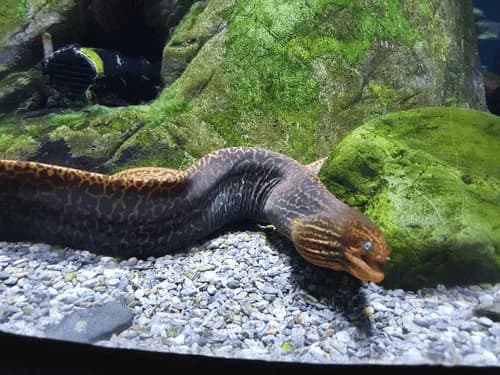
Gymnothorax tile, the freshwater moray eel (also called the Indian mud moray or snowflake moray), is one of the few moray eels capable of living in fresh and brackish water environments. Their elongated, snake-like body with a mottled brown and cream pattern, continuous dorsal fin, and distinctive moray eel face with visible, sharp teeth make them one of the most exotic and unusual fish available.
Native to estuaries, rivers, and coastal areas from India and Sri Lanka through Southeast Asia, G. tile tolerates a wide range of salinities from near-freshwater to full marine. In the aquarium hobby, they are most successfully maintained in brackish to lightly marine conditions.
Freshwater moray eel care is intermediate to advanced. Their specific feeding habits (they may initially refuse non-live food), tendency to escape, predatory nature, and water chemistry requirements make them specialist fish. In appropriate conditions, they are extraordinary, long-lived animals.
Basic Overview
Common Misconceptions
"They can be kept in freshwater permanently." While G. tile can tolerate freshwater for periods, their long-term health is best in brackish conditions (SG 1.005-1.015). Permanent freshwater keeping leads to chronic stress and disease.
"They are safe with any fish." Freshwater morays will eat any fish small enough to fit in their mouth. Tankmates must be substantially larger than the moray's head. Even fish approaching the moray's size are at risk from ambush.
"They will eat frozen food easily." Freshwater morays often require live or scented fresh food initially before transitioning to frozen or dead food. Patience and feeding with tongs using fresh marine fish or shrimp is typically required before they accept frozen food reliably.
"A tight lid is optional." Morays are exceptional escape artists that can squeeze through any opening large enough for their head. Every opening in the tank lid must be secured. Escaped morays die quickly outside water.
Recommended Setup
- 75+ gallon tank
- Secure lid with all gaps covered (absolutely essential)
- Large caves and PVC pipe burrows (morays need to feel enclosed)
- Brackish water (SG 1.005-1.015)
- Sand or bare bottom substrate
- Good filtration with protected intakes
- No small fish -- compatible only with large, similarly sized robust fish
Diet
Freshwater morays are carnivores that require meaty marine-protein foods:
- Fresh or frozen marine shrimp (fed with tongs)
- Frozen lance fish or silversides
- Fresh squid pieces
- Frozen krill
- Live ghost shrimp for initial feeding training
Feed 2-3 times per week with substantial protein. Freshwater morays have slow metabolisms and do not need daily feeding. Use long feeding tongs as they bite reflexively. Once conditioned to frozen food, they become reliable eaters. Remove uneaten food promptly.
Personality
Freshwater morays are among the most captivating and alien-looking freshwater animals available. Their sinuous movement, constant slow undulation of the dorsal fin, and habit of poking their head from cave entrances creates an endlessly watchable presence in a large brackish aquarium.
Over time, they recognize feeding time and their keeper. A conditioned freshwater moray that reliably accepts frozen food from tongs, emerging from its cave at the approach of the feeding tool, is a rewarding interaction with a genuinely extraordinary animal.
Their extraordinary longevity (10-15 years or more) means a well-kept freshwater moray becomes a true long-term companion. The commitment to appropriate housing, feeding management, and water chemistry is repaid in an animal unlike anything else in freshwater fishkeeping.
Water Parameters
Freshwater morays are best kept in brackish conditions reflecting their estuarine native range:
- pH: 7.5-8.5
- Hardness (gH): 12-20 dGH
- Temperature: 72-82 degrees F
- Salinity: 1.005-1.015 specific gravity
- Ammonia and Nitrite: 0 ppm
- Nitrate: below 20 ppm
Here are some top tips to deal with unwanted parameters:
- Brackish conditions are strongly recommended over freshwater for long-term health.
- Use marine salt for a complete mineral profile.
- Top off evaporation with fresh water; add replacement salt only during actual water changes.
- Large, robust filtration to handle the waste of a large predatory fish.