Red Fire Eel Care Guide
A Complete Care Guide for Mastacembelus erythrotaenia
Introduction
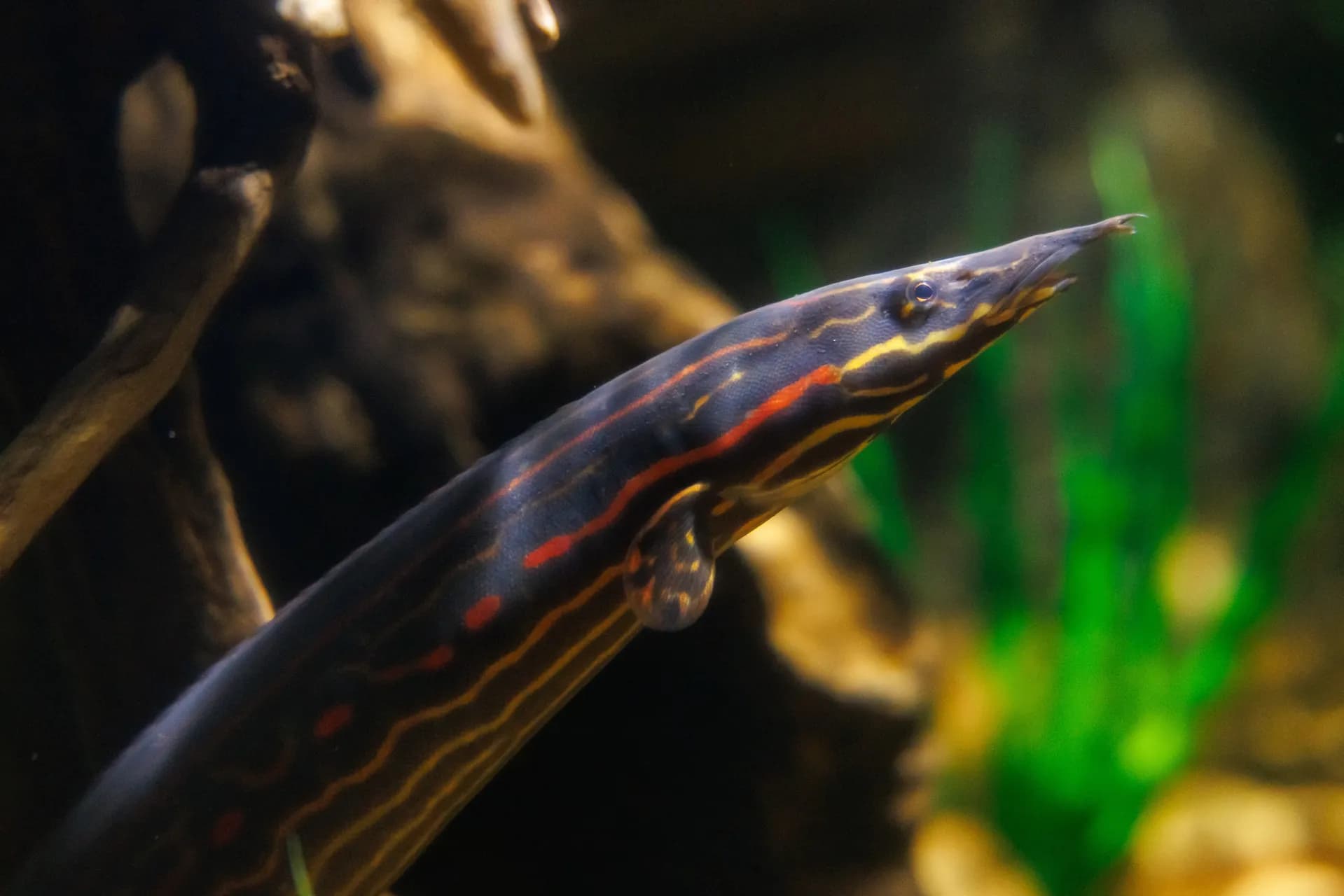
Mastacembelus erythrotaenia, the red fire eel (also called the fire eel), is one of the most spectacular spiny eel species available. Their jet-black body is decorated with vivid red to orange-red spots, bars, and a stripe along the flanks that intensifies dramatically with age and good nutrition. They are among the largest spiny eels available, reaching 36-40 inches in large aquariums.
Native to Southeast Asia across Thailand, Myanmar, Laos, Cambodia, Vietnam, and the Malay Peninsula, fire eels inhabit large, slow-moving rivers and floodplains with muddy substrate and dense vegetation. They are powerful, nocturnal predators.
Red fire eel care is advanced. Their potential adult length of 36-40 inches demands very large tanks (200+ gallons), they require deep sand for burrowing, accept only live and frozen meaty foods initially, and are extreme escape artists. For committed, experienced fishkeepers, they are among the most extraordinary freshwater fish available.
Basic Overview
Common Misconceptions
"They stay small." Fire eels are among the largest spiny eels and grow continuously given good conditions. A 12-inch juvenile will potentially reach 3 feet. Plan for a 200+ gallon tank from the beginning.
"Any substrate works." Fire eels must have 4-6 inches of fine sand for burrowing. This is non-negotiable for their welfare and health.
"The vivid red pattern is always present." Young fire eels often show faint or brownish coloration. The vivid red pattern intensifies dramatically with age, good diet, and excellent water quality. Full coloration in a mature adult in pristine water is extraordinary.
"They are manageable escape artists." Fire eels are exceptional escape artists that can push through very small gaps with considerable force. Every gap on the tank lid must be sealed. Multiple escapes and deaths from drying out are reported by keepers who underestimated their determination.
Recommended Setup
- 200+ gallon tank for an adult
- 4-6 inches of fine sand substrate
- Very large hiding spots: large diameter PVC pipe, rock caves
- Dense planted areas in pots
- Gentle to moderate flow
- Heavy filtration
- Completely sealed, secured lid - no exceptions
Diet
Red fire eels are carnivores requiring large, meaty foods:
- Frozen large bloodworms and tubifex (primary)
- Frozen whole shrimp
- Frozen fish pieces
- Large live earthworms (highly stimulating)
- Frozen mussel, squid
Feed every other day after lights-out. Drop food directly near the eel's burrow. Fire eels may take weeks to begin feeding after introduction; this is normal. Start with live foods if frozen is refused. Once settled, they become reliable and enthusiastic nocturnal feeders. Their large adult size means significant quantities of food are needed; adjust feeding amounts as the fish grows.
Personality
Red fire eels are magnificent, long-lived fish that develop deep familiarity with their keeper over years of keeping. Experienced fire eel keepers report fish that recognize them personally, approach at feeding time, and accept hand-feeding of worms.
The vivid red pattern on a mature specimen in excellent condition under good lighting is genuinely extraordinary - one of the most spectacular color patterns available in freshwater fish. Seeing a 30-inch fire eel emerge from its burrow at feeding time and display its full coloration is an unforgettable experience.
Despite their large size, they are gentle toward fish too large to eat. In appropriately sized tanks with appropriate tank mates, fire eels are model community inhabitants.
Water Parameters
Red fire eels come from the warm, soft to moderately hard rivers of Southeast Asia:
- pH: 6.5-7.5
- Hardness (gH): 5-15 dGH
- Temperature: 75-82 degrees F
- Ammonia and Nitrite: 0 ppm
- Nitrate: below 15 ppm
Here are some top tips to deal with unwanted parameters:
- Low nitrate is important for fire eel skin and color health. In very large tanks with large fish, achieving low nitrate requires significant water changes (30-40% weekly).
- Avoid copper-based medications absolutely. Fire eels are extremely sensitive to copper.
- Good water quality produces increasingly vivid coloration. Poor water quality causes color fading.
- Stable temperature in the 77-80 degree F range is optimal.