Spiny Eel Care Guide
A Complete Care Guide for Macrognathus aculeatus
Introduction
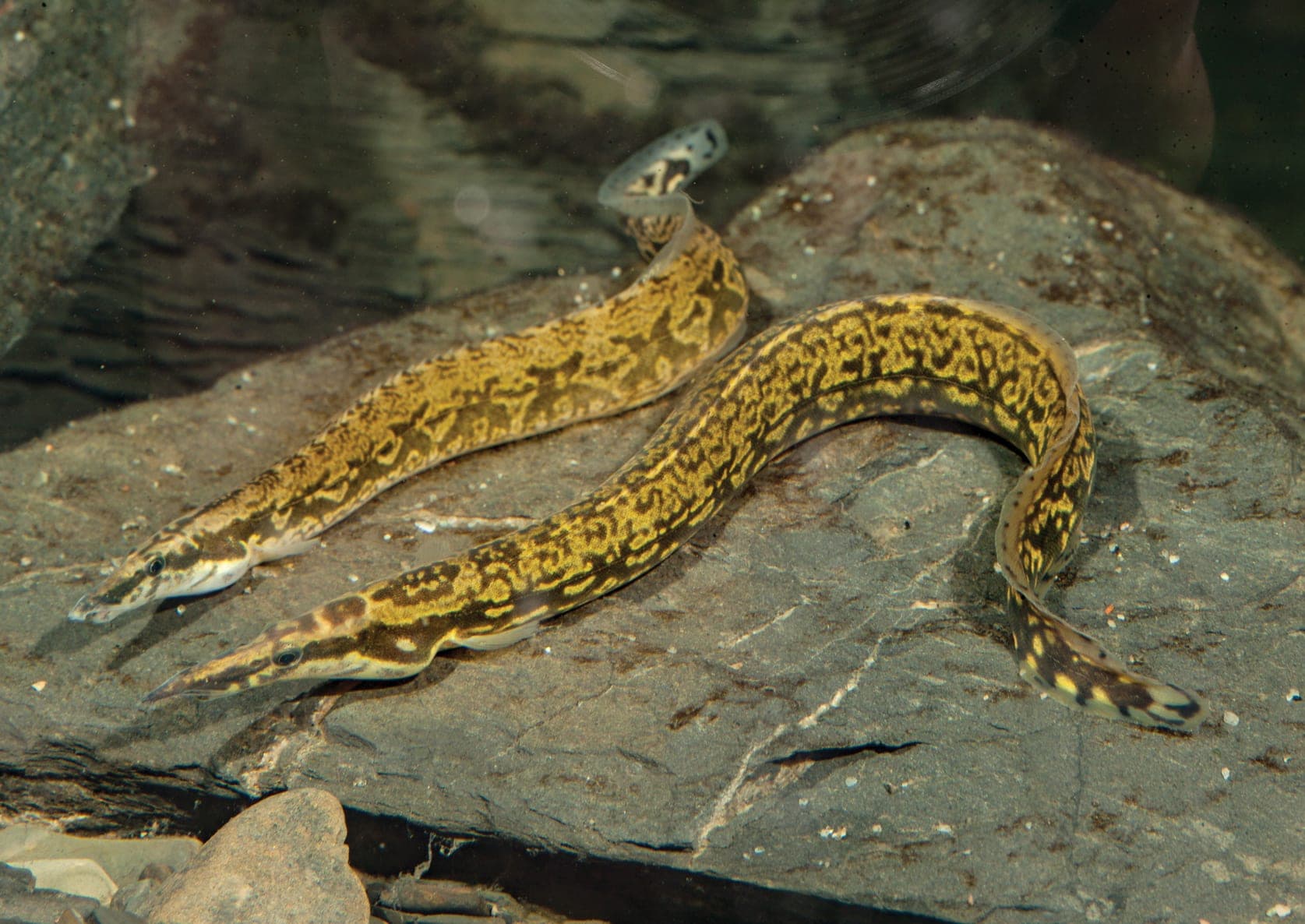
Macrognathus aculeatus, the spiny eel (also called the lesser spiny eel or multiple-spot spiny eel), is one of the most commonly available spiny eel species. Like all spiny eels (family Mastacembelidae), it is not a true eel but a fish that has convergently evolved an eel-like elongated body. Their row of small dorsal spines gives the family its common name.
Native to South and Southeast Asia across a wide range from India to Indonesia, spiny eels inhabit slow-moving rivers, ponds, and flooded fields with muddy or sandy substrates and abundant vegetation. They are burrowing fish that spend daylight hours hidden in substrate or dense vegetation.
Spiny eels are intermediate-care fish that require a deep sand substrate for burrowing, a diet of live or frozen meaty foods, and secure lids to prevent escape. Their nocturnal nature means they are rarely seen during the day but emerge actively at night.
Basic Overview
Common Misconceptions
"They are true eels." Spiny eels are not related to true eels (order Anguilliformes). They are perciform fish that independently evolved an elongated body. Their care needs and biology differ significantly from true eels.
"Gravel is fine for substrate." Spiny eels must be able to burrow into soft substrate. Gravel or coarse substrate prevents this natural behavior, causing chronic stress. A minimum of 3 inches of fine sand is essential.
"They are safe with small fish." Spiny eels are nocturnal predators that will eat fish small enough to swallow overnight. Tank mates should be 2+ inches and appropriately robust.
"The lid does not need to be fully sealed." Spiny eels are exceptional escape artists that can squeeze through very small gaps and actively explore tank rims at night. A completely sealed lid with no openings wider than 5mm is essential.
Recommended Setup
- 40+ gallon tank
- 3-4 inches of fine sand substrate (essential)
- Dense planting: floating plants, mid-ground stems
- Hiding spots: driftwood, caves, dense vegetation
- Gentle to moderate flow
- Secure lid with no gaps
- Filter intake protection (they can become trapped in intakes)
Diet
Spiny eels are carnivores requiring live or frozen meaty foods:
- Frozen bloodworms (primary staple)
- Live or frozen blackworms
- Frozen brine shrimp
- Small earthworms
- Live ghost shrimp
Feed after lights-out near the substrate. Many spiny eels must be started on live food and transitioned gradually to frozen. Do not rely on pellets or flake. Consistent frozen bloodworm and blackworm feeding is the practical approach for most specimens.
Personality
Spiny eels are secretive, nocturnal fish that spend most of their daytime hours completely buried or wedged under driftwood. This is entirely natural behavior and not a sign of illness. A keeper who observes the tank after lights-out will discover a very different, active fish.
With time, spiny eels may emerge briefly during the day, particularly at feeding time. An established, well-fed specimen in a secure, mature tank gradually becomes bolder.
Multiple spiny eels of the same species can generally be kept together in adequately sized tanks, as they are more tolerant of conspecifics than peacock eels. Providing multiple burrow sites prevents competition.
Water Parameters
Spiny eels come from the warm, soft to moderately hard waters of South and Southeast Asia:
- pH: 6.5-7.5
- Hardness (gH): 5-15 dGH
- Temperature: 73-82 degrees F
- Ammonia and Nitrite: 0 ppm
- Nitrate: below 20 ppm
Here are some top tips to deal with unwanted parameters:
- Spiny eels are sensitive to poor water quality. Their partially scaleless bodies are vulnerable to bacterial and fungal infections when water quality declines.
- Avoid copper-based medications. Spiny eels are sensitive to copper at concentrations safe for scaled fish.
- Weekly 25-30% water changes maintain good conditions. Disturb the sand gently during changes to prevent anaerobic buildup in deep sand layers.
- Gentle filtration output is preferred. Strong direct current causes stress and interferes with their sedentary hunting style.