Tiger Loach Care Guide
A Complete Care Guide for Syncrossus hymenophysa
Introduction
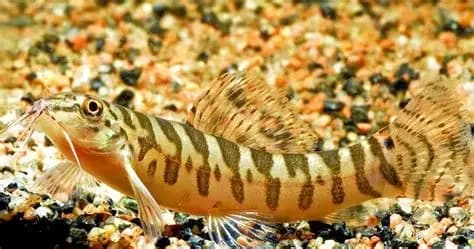
Syncrossus hymenophysa, the tiger loach (or banded loach), is a large, boldly patterned Botia-relative from Southeast Asia. Their pale cream to yellow body is crossed by bold, irregular blue-black vertical bands -- the tiger-stripe pattern that gives them their common name. Their large adult size and striking markings make them one of the most visually impressive loaches in the hobby.
Native to rivers and streams across Borneo, Sumatra, Thailand, and Malaysia, tiger loaches inhabit moderately flowing to fast rivers with rocky and sandy substrates. Like other large Botia-group loaches, they are social, active, and territorial within their species.
Tiger loach care is intermediate. Their large adult size (8-10 inches), strong personality, and tendency to be nippy toward other fish require careful tank mate selection and appropriate housing. In appropriate setups they are spectacular, long-lived display fish.
Basic Overview
Common Misconceptions
"They are safe with all community fish." Tiger loaches are fin-nippers and may harass long-finned or slow-moving fish. They should be kept with robust, similarly active fish that can hold their own. Small, delicate fish are unsuitable tank mates.
"They can be kept in 55-gallon tanks as adults." At 8-10 inches with high activity levels, tiger loaches require 125+ gallon tanks for a group. Insufficient space leads to increased aggression and stress.
"A single tiger loach is fine." Like other large Botia-group loaches, they are social and do better in groups of 4-5. Solo individuals are more aggressive toward other tank inhabitants.
Recommended Setup
- 125+ gallon tank for a group of 4-5
- Fine sand substrate
- Large caves and smooth rock structures
- Strong filtration and good flow
- Robust, active tank mates of appropriate size
- Secure lid
Diet
Tiger loaches are omnivores with strong carnivore tendencies:
- Large sinking pellets
- Frozen bloodworms
- Frozen brine shrimp
- Earthworms
- Blanched vegetables
Feed once daily. Tiger loaches are enthusiastic, competitive feeders. In groups, ensure food is distributed throughout the tank to prevent dominant individuals monopolizing feeding spots.
Personality
Tiger loaches in an appropriate large group setup are impressive, dynamic fish. Their bold blue-black tiger stripes against pale body create a dramatic visual in motion. Their strong personalities, clicking communication, group social dynamics, and occasional boisterous play make them engaging inhabitants.
Their nipping tendency is their primary management challenge. With appropriate large, robust tank mates -- large catfish, large barbs, medium to large cichlids -- this becomes manageable. The combination of their vivid patterning, large size, and active group behavior makes them one of the most dramatic large loaches available.
Their 10-15 year lifespan means a well-maintained tiger loach becomes an impressive, deeply familiar long-term tank inhabitant.
Water Parameters
Tiger loaches come from the flowing rivers of Southeast Asia:
- pH: 6.0-7.5
- Hardness (gH): 3-12 dGH
- Temperature: 72-82 degrees F
- Ammonia and Nitrite: 0 ppm
- Nitrate: below 20 ppm
Here are some top tips to deal with unwanted parameters:
- Good filtration is critical in tanks with large, active, high-waste-producing fish.
- Moderate flow and good oxygenation.
- Weekly 25-30% water changes.
- Avoid copper-based medications.