Red Tail Shark Care Guide
A Complete Care Guide for Epalzeorhynchos bicolor
Introduction
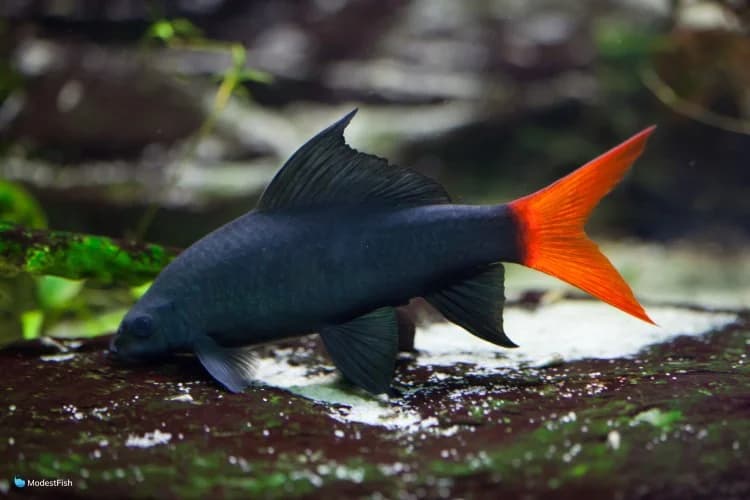
Epalzeorhynchos bicolor, the red tail shark (also called the red-tailed black shark), is one of the most visually striking freshwater fish available. Their velvety jet-black body contrasted with a vivid red tail fin makes them immediately recognizable and enduringly popular in the hobby.
Despite the "shark" name, red tail sharks are cyprinids related to barbs and danios, native to Thailand. They are bottom-dwellers and territory-holders rather than open-water predators. Wild populations are now critically endangered, making captive-bred specimens the only ethical choice in the trade.
Red tail sharks have a significant aggression issue that must be understood before purchasing: they are territorial and will bully other fish, particularly those of similar body shape and color. They are best kept one per tank, as two males will fight relentlessly.
Basic Overview
Common Misconceptions
"Two red tail sharks can be kept together." In almost all cases, two red tail sharks in the same tank will result in persistent aggression, with the dominant fish harassing the subordinate until it dies. One per tank is the only reliable rule.
"They are reef-safe or good community fish." Red tail sharks are territorial bottom dwellers that will chase and harass similar-looking fish (rainbow sharks, other loach species) and can bully slower community fish. They work in communities with fast, robust mid-to-upper water fish.
"They stay small." While juveniles sold in stores are 1–2 inches, healthy adults reach 4–6 inches and need appropriate tank space to establish a territory and thrive.
"They eat algae and do not need to be fed." While red tail sharks do graze on algae and biofilm, they are omnivores that need a varied diet including sinking foods. Relying on them as an algae control solution leads to nutritional deficiency.
Recommended Setup
- 55+ gallon tank with clear territorial boundaries
- Plenty of caves, driftwood, and dense planting; the red tail shark needs a defined territory
- Smooth gravel or sand substrate
- Open areas at the front combined with complex hardscape at the back and sides
- Strong filtration; red tail sharks prefer clean, well-oxygenated water
- Moderate to strong flow; they come from flowing river environments
- Secure lid; they can jump when startled
Diet
Red tail sharks are omnivores that graze heavily on algae and biofilm in the wild but also consume insect larvae, small crustaceans, and plant matter. In the aquarium:
- High-quality sinking pellets or wafers as a staple
- Algae wafers and spirulina-based foods
- Blanched vegetables: zucchini, cucumber, spinach, peas
- Frozen or freeze-dried bloodworms and brine shrimp as occasional treats
- They will also graze on natural algae and biofilm in the tank
Feed once daily in the evening, when they are most active. Place food near their established territory so they do not need to venture into areas claimed by other bottom fish. A varied diet with plenty of plant matter produces the best color and health.
Personality
Red tail sharks are bold, curious, and entertaining fish that quickly learn to recognize their keeper. They patrol their territory constantly, darting out to investigate anything new and retreating to their favorite cave or driftwood piece when startled.
Their aggression is directed almost entirely at fish they perceive as competition for their territory: other bottom dwellers of similar shape, particularly rainbow sharks, other Epalzeorhynchos species, and fish with red coloration. Fast-moving mid-water schooling fish are generally ignored after an initial territorial display.
A red tail shark that is settled and confident will display beautifully, with deep black coloration and an intensely vivid red tail. A stressed or unhealthy specimen will be pale and tend to hide constantly.
Compatible Tank Mates
The key to successful red tail shark community tanks is choosing fish that occupy different water levels and do not resemble the shark in shape or coloration. Excellent companions include tiger barbs, giant danios, rainbowfish, and swordtails in the mid-to-upper water column.
Avoid rainbow sharks, bala sharks, other Epalzeorhynchos species, and any loach or bottom-dwelling fish that might be bullied out of the bottom layer. Corydoras catfish can sometimes coexist if the tank is large enough and the red tail shark has an established territory away from the cory zone.
Adding the red tail shark last, after all other fish are established, helps prevent it from treating the entire tank as its territory. Rearranging decorations at the time of introduction also disrupts any established territorial claims.
Water Parameters
Red tail sharks come from the flowing rivers of Thailand and prefer clean, well-oxygenated conditions:
- pH: 6.5–7.5
- Hardness (gH): 5–15 dGH
- Temperature: 72–82°F
- Ammonia and Nitrite: 0 ppm
- Nitrate: below 20 ppm
Here are some top tips to deal with unwanted parameters:
- Weekly 25–30% water changes are essential. Red tail sharks are sensitive to nitrate buildup and will show stress coloration (fading black, less vivid red) when water quality declines.
- Maintain good surface agitation for oxygenation. They come from flowing, well-oxygenated streams and do best with adequate oxygen levels.
- Avoid extremes of pH. While they are adaptable within the 6.5–7.5 range, sudden swings in either direction cause significant stress.
- Driftwood creates a natural look that suits them well and gently acidifies and softens water over time, which is beneficial in harder tap water areas.