Bolivian Ram Care Guide
The Ultimate Care Guide for Bolivian Rams
Introduction
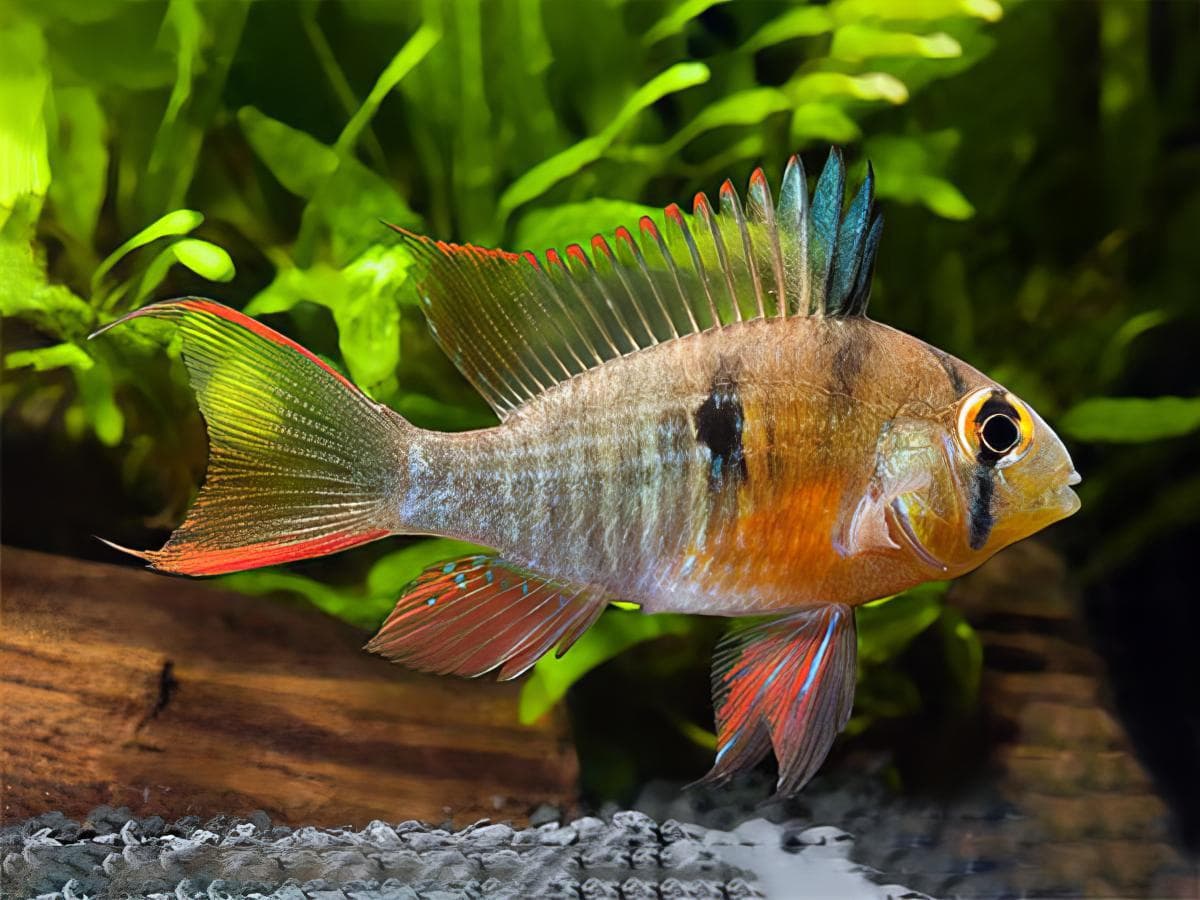
Mikrogeophagus altispinosus, commonly known as the Bolivian ram or Bolivian butterfly cichlid, is a beautiful and hardy dwarf cichlid that is often recommended as a more beginner-friendly alternative to the German blue ram. They live roughly 4-6 years in captivity and prefer temperatures of 72-79 degrees Fahrenheit. They commonly reach 3-4 inches in size, making them slightly larger than their German cousin.
Bolivian rams are native to the rivers and floodplains of Bolivia and Brazil. Their coloration is more subtle than the German blue ram, featuring warm golden and red tones with black markings, but in good health and lighting they are genuinely beautiful fish with a distinctive charm all their own.
Their greater temperature flexibility, hardier constitution, and tolerance for a broader range of water conditions make them an excellent choice for hobbyists who want the dwarf cichlid experience without the exacting demands of the German blue ram.
Basic Overview
Common Misconceptions
"Bolivian rams are just dull, lesser German blue rams!" Bolivian rams have their own distinct beauty. Their warm golden and red tones, combined with the black trailing rays on their dorsal and tail fins, give them an elegant, understated look that many hobbyists prefer to the flashier German blue ram.
"Bolivian rams have the same care needs as German blue rams!" Bolivian rams are significantly more forgiving. They tolerate cooler temperatures (72-79 degrees Fahrenheit versus 78-85 degrees for German blues), harder water, and less pristine water conditions. They are a meaningfully easier fish to keep.
"Bolivian rams are always peaceful and never territorial!" Breeding pairs become territorial and will defend their spawning site actively. This is cichlid behavior and completely normal. In a community tank, providing enough space and visual breaks manages this effectively.
"Bolivian rams do not need live plants!" While they can technically survive without plants, Bolivian rams are noticeably more comfortable, more colorful, and more active in a planted tank. Dense vegetation mimics their natural habitat and makes them feel secure.
Recommended Setup
- 30+ gallon tank, cycled, with a lid, heater, and gentle filter
- Live plants for cover and security
- Flat stones, broad leaves, or a small cave for potential spawning sites
- Fine sand substrate (they like to sift and dig through the bottom)
- Driftwood and Indian almond leaves for a natural feel
- Gentle to moderate flow
- Aquarium siphon
Diet
Bolivian rams are carnivore-leaning omnivores that prefer meaty foods. They are good eaters and less finicky than German blue rams. They enjoy:
- High-quality micro pellets or small cichlid pellets as a staple
- Frozen or live baby brine shrimp
- Frozen or live daphnia
- Frozen or live bloodworms
- Frozen or live micro worms
Feed small amounts twice daily. Bolivian rams are good, reliable eaters. They sift through the substrate looking for food, so sinking foods that reach the bottom are especially appreciated.
Personality
Bolivian rams are curious, confident fish that explore the lower and middle levels of the tank with an unhurried, methodical quality. They sift through the substrate, inspect every cave and piece of driftwood, and generally go about their business with a calm assurance that is lovely to watch.
Pairs form strong bonds and are wonderful to observe together, swimming in close proximity and displaying to each other. When spawning, both parents actively guard the eggs and later the fry with a fierce protectiveness that is impressive for such small fish.
Outside of breeding periods, Bolivian rams are remarkably peaceful for cichlids. They typically only show aggression toward fish that directly intrude on their territory, and even then it is usually more posturing than actual violence in a well-sized tank.
Compatible Tankmates
Bolivian rams are well-suited to community tanks with peaceful mid-water and surface fish. Excellent options include small tetras like rummy nose or neon tetras, rasboras, corydoras catfish, peaceful gouramis, and small danios.
They are generally safe with snails and most shrimp outside of breeding periods, though during active spawning the pair may chase everything in the tank. Providing enough space and visual breaks in the tank layout minimizes conflict.
Avoid large, aggressive fish that will bully them, and avoid other bottom-dwelling cichlids that will compete for territory. One pair per tank, or one male with two females in a larger setup, works well.
Water Parameters
Bolivian rams are flexible with water parameters and considerably more forgiving than German blue rams. They do best in soft to moderately hard, slightly acidic to neutral water. Target:
- pH: 6.5-7.5
- gH: 50-150 PPM
- Temperature: 72-79 degrees Fahrenheit
Here are some top tips to deal with unwanted parameters:
- To lower pH and soften water, use driftwood and Indian almond leaves. For harder tap water areas, these natural methods go a long way without requiring RO water.
- Do weekly 25-30% water changes matched to tank temperature to keep water quality high.
- Unlike German blue rams, Bolivian rams handle moderate temperature fluctuations reasonably well, but stable conditions are always better than fluctuating ones.
- Remember, using random chemicals is not recommended, since they can cause more problems through sudden, drastic changes.