Siamese Algae Eater Care Guide
A Complete Care Guide for Crossocheilus oblongus
Introduction
Crossocheilus oblongus, the Siamese algae eater (SAE), holds a special place in the planted tank hobby as one of the very few fish that will effectively consume black beard algae (BBA), one of the most stubborn and difficult algae types to eradicate. This single trait has made the SAE a sought-after species among serious planted tank keepers.
Native to Thailand and the Malay Peninsula, Siamese algae eaters inhabit fast-flowing, well-oxygenated streams and rivers. They are active, energetic bottom and midwater dwellers that grow to 5–6 inches and become considerably less algae-focused as they mature.
Important note: the SAE is frequently confused with the Chinese algae eater (Gyrinocheilus aymonieri) and the flying fox (Epalzeorhynchos kalopterus), both of which are poorer algae eaters and have more challenging temperaments. Learning to identify the true SAE is worth the effort.
Basic Overview
Common Misconceptions
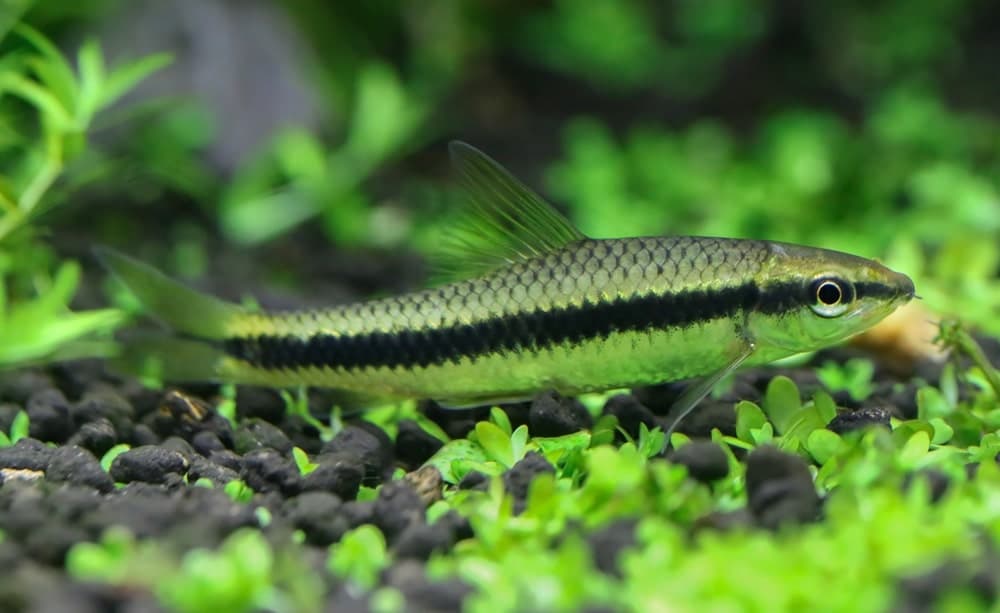
"Any fish sold as an algae eater is the same." The SAE is frequently mislabeled. True SAEs (Crossocheilus oblongus) have a black stripe that extends through the tail fin onto the lower lobe. The similar-looking flying fox has a gold stripe above the black one. Chinese algae eaters are completely different and become aggressive as adults.
"SAEs eat all algae forever." Juvenile and young adult SAEs are excellent algae consumers, including BBA. As they mature and grow, they become less focused on algae and more interested in regular fish food. Older SAEs may barely touch algae.
"They can be kept alone." SAEs are more comfortable and less territorial when kept in groups of 3–5 as juveniles. A single SAE in a tank becomes territorial and may bother other bottom dwellers.
"They stay small." SAEs reach 5–6 inches and are active, fast-swimming fish. A 30-gallon minimum is needed; 55+ gallons is better for a group.
Recommended Setup
- 30+ gallon tank for one or two; 55+ gallons for a group of 3–5
- Fine gravel or sand substrate
- Driftwood and rocks with algae growth provide natural grazing surfaces
- Well-planted tank with good growth to support active fish
- Strong filtration and good oxygenation; they come from fast-flowing streams
- Moderate to strong current appreciated
- Secure lid; SAEs are accomplished jumpers, especially when startled
Diet
Siamese algae eaters are omnivores with a strong inclination toward algae and biofilm when young. They accept a wide variety of foods:
- Algae wafers and spirulina-based sinking foods
- High-quality tropical flakes and sinking pellets
- Frozen bloodworms and brine shrimp
- Blanched vegetables: zucchini, cucumber, spinach
- Natural algae growth in the tank, especially BBA when available
Feed once daily. As SAEs age and grow, they shift away from algae toward more varied omnivore feeding. Provide a balanced diet to ensure good health regardless of algae availability in the tank.
Personality
Young Siamese algae eaters are energetic, social fish that school loosely and are in near-constant motion. They dart across the substrate, swim into the current, and investigate every surface for algae and biofilm. Their activity level makes them entertaining tank inhabitants even apart from their algae-eating utility.
As they mature, SAEs may become more territorial with members of their own species and other bottom-dwelling fish. Providing enough space and visual barriers reduces conflict in adult groups.
They have a distinctive resting posture, using their pelvic fins to prop themselves up on the substrate or on a plant leaf, often at a slight angle. This "tripod" resting pose is characteristic and completely normal.
Identifying the True SAE
Learning to identify the true Siamese algae eater before purchasing is important, as mislabeled fish are extremely common. Key identification points for Crossocheilus oblongus: a continuous, unbroken black horizontal stripe that extends from the tip of the snout through the entire tail fin, including the lower lobe. The stripe has slightly irregular, ragged edges. There is no gold stripe above the black.
The flying fox (Epalzeorhynchos kalopterus) looks similar but has a distinct gold stripe above the black, a brighter overall appearance, and becomes aggressive as an adult. It also eats less algae.
The Chinese algae eater (Gyrinocheilus aymonieri) is completely different in body shape: rounder, more sucker-bodied, with an inferior mouth designed for clinging rather than grazing. It becomes aggressive with age and will attack other fish, sometimes rasping slime coats. It is often sold as an algae eater but is a poor choice for most tanks.
Water Parameters
Siamese algae eaters come from the fast-moving, clean, well-oxygenated streams of Southeast Asia:
- pH: 6.5–8.0 (adaptable)
- Hardness (gH): 5–15 dGH
- Temperature: 72–82°F
- Ammonia and Nitrite: 0 ppm
- Nitrate: below 20 ppm
Here are some top tips to deal with unwanted parameters:
- Good surface agitation is particularly important for SAEs, which come from fast, well-oxygenated rivers. A powerhead or spray bar directed across the surface improves oxygenation and suits their natural preferences.
- Weekly 25–30% water changes maintain the clean conditions they need. In a heavily planted tank, the plants help maintain water quality between changes.
- Avoid very soft, very acidic conditions. While they tolerate a range, the clean, moderately hard water of their native streams is closer to ideal than extreme blackwater conditions.
- SAEs are generally hardy and disease-resistant in clean, well-oxygenated water. Ich and bacterial infections are the most common issues, typically arising from poor water quality or stress during introduction.