Amano Shrimp Care Guide
A Complete Care Guide for Caridina multidentata
Introduction
Caridina multidentata, the Amano shrimp, is the most widely kept freshwater shrimp in the planted aquarium hobby. Named for legendary aquarist Takashi Amano, who popularized their use as natural algae cleaners in his iconic Nature Aquarium layouts, Amano shrimp are significantly larger and more effective algae grazers than most other freshwater shrimp.
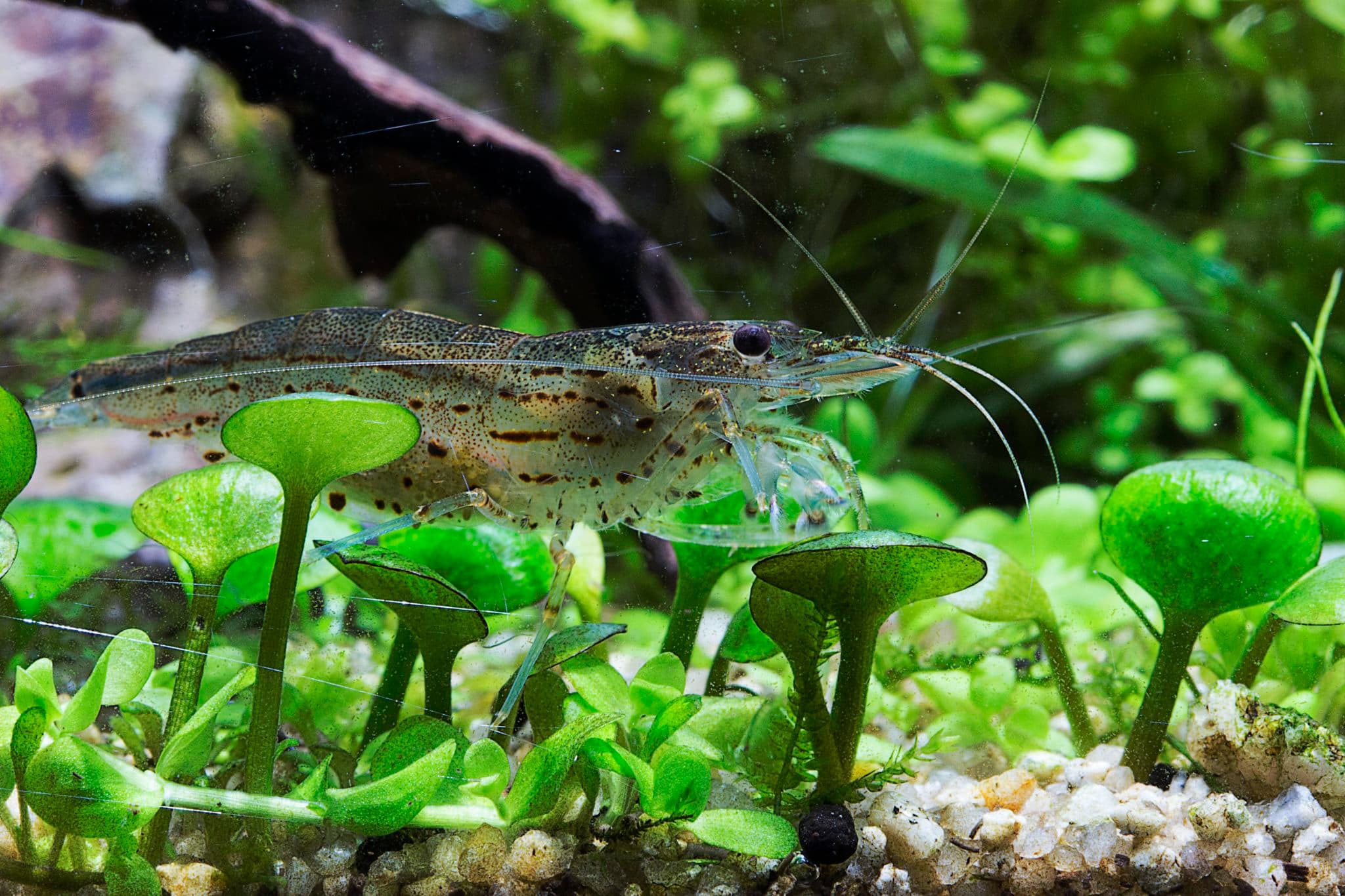
Native to Japan, Taiwan, and Korea, Amano shrimp inhabit cool, clear, fast-moving rivers. They are transparent to translucent in color with rows of dots and dashes along their sides, and they grow to 1.5–2 inches, making them the largest of the commonly kept Caridina species.
Their reputation as algae-eating workhorses is well-earned: a group of Amano shrimp will rapidly clear soft algae types from plants, substrate, and decor that would otherwise require manual cleaning. They are peaceful, interesting to observe, and one of the most practically useful animals in a planted tank.
Basic Overview
Common Misconceptions
"Amano shrimp will eat all algae." They are excellent at soft algae types (green dust algae, thread algae, hair algae, green film algae), but they will not eat black beard algae (BBA), staghorn algae, or hard spot algae. They complement a balanced tank but do not replace proper algae management.
"They breed easily in freshwater." Amano shrimp have a complex brackish-water larval stage. Females carry eggs in freshwater, but the larvae must be transferred to brackish water to survive. Breeding them in a home aquarium is very challenging; most shrimp in the trade are wild-caught.
"A couple of shrimp will clean a whole tank." For meaningful algae control, keep at least 1–2 Amano shrimp per 5 gallons of water, or more in heavily planted, high-light tanks that produce significant algae.
"Fish will not eat them because they are large." Many fish will attempt to eat Amano shrimp. Avoid keeping them with cichlids, large gouramis, pea puffers, or any predatory fish. They are safe with small tetras, rasboras, corydoras, and similarly peaceful species.
Recommended Setup
- 10+ gallon planted tank with stable, well-cycled water
- Smooth fine gravel or sand substrate
- Live plants provide algae for grazing and hiding spots from potential predators
- Dense plant cover (Java moss, hornwort, and fine-leaved plants where they can hide and graze)
- Gentle to moderate filtration; cover filter intakes with a pre-filter sponge to prevent shrimp from being sucked in
- Stable water parameters; shrimp are sensitive to sudden changes
- A tight-fitting lid; Amano shrimp will climb and escape through gaps
Diet
Amano shrimp are algae specialists but also consume biofilm, decaying plant matter, and soft detritus. Supplement their natural grazing with:
- Algae wafers placed on the substrate near their grazing areas
- Blanched vegetables: zucchini, cucumber, spinach
- Shrimp-specific sinking pellets
- Snowflake pellets (made from soy hulls; a popular shrimp food that does not foul water quickly)
- Leaf litter (Indian almond leaves, mulberry leaves) as a biofilm food source
In a tank with healthy algae growth, Amano shrimp largely feed themselves. Supplemental feeding once every 2–3 days is adequate. In a low-algae, immaculate tank, daily supplemental feeding ensures they receive adequate nutrition.
Personality
Amano shrimp are busy, purposeful animals that are in constant motion. They methodically work across plant leaves, glass, substrate, and any surface that might harbor algae or biofilm, using their small front claws to scrape food into their mouths with impressive speed.
They are bold for shrimp and are less prone to hiding than cherry shrimp or other smaller Neocaridina species. In a tank without predators, they are visible and active throughout the day, making them engaging inhabitants rather than hidden background workers.
When startled, Amano shrimp are capable of impressive burst swimming. They will sometimes leap partially out of the water when frightened, which is why a lid is important. In a safe, predator-free tank they are relaxed and approachable.
Identifying Males and Females
Female Amano shrimp are notably larger than males and display a row of elongated dashes along their sides, while males have rows of dots. Gravid (egg-carrying) females develop a visible clutch of small green eggs under their abdomen, which they fan regularly.
In the wild and in captivity, females carry the eggs for several weeks until larvae hatch. The larvae are tiny and require the transition to brackish water to complete their development. Without this, all larvae perish, which is why natural tank breeding is essentially impossible.
Commercial breeding of Amano shrimp is done in specialized facilities. The significant effort required means that most Amano shrimp in the hobby are wild-caught from Japan and Taiwan.
Water Parameters
Amano shrimp are more tolerant of a range of water conditions than many other shrimp species, but still require stable, clean water:
- pH: 6.5–8.0
- Hardness (gH): 6–8 dGH (moderately soft to moderate)
- Temperature: 65–80°F (they prefer the cooler end of the range)
- Ammonia and Nitrite: 0 ppm
- Nitrate: below 20 ppm
Here are some top tips to deal with unwanted parameters:
- Never add Amano shrimp to an uncycled tank. Like all invertebrates, they are extremely sensitive to ammonia and nitrite and will die rapidly in uncycled conditions.
- Drip acclimate shrimp when transferring to a new tank. Abrupt changes in water chemistry, even within safe parameter ranges, cause osmotic shock. Drip acclimation over 30–60 minutes greatly reduces mortality.
- Avoid copper in any form. Copper is toxic to all invertebrates at very low concentrations. Many medications contain copper; check labels carefully before treating any tank with shrimp.
- A well-planted tank with stable parameters is the best environment. The plants help buffer chemistry and provide continuous food sources for the shrimp.