Chili Rasbora Care Guide
A Complete Care Guide for Boraras brigittae
Introduction
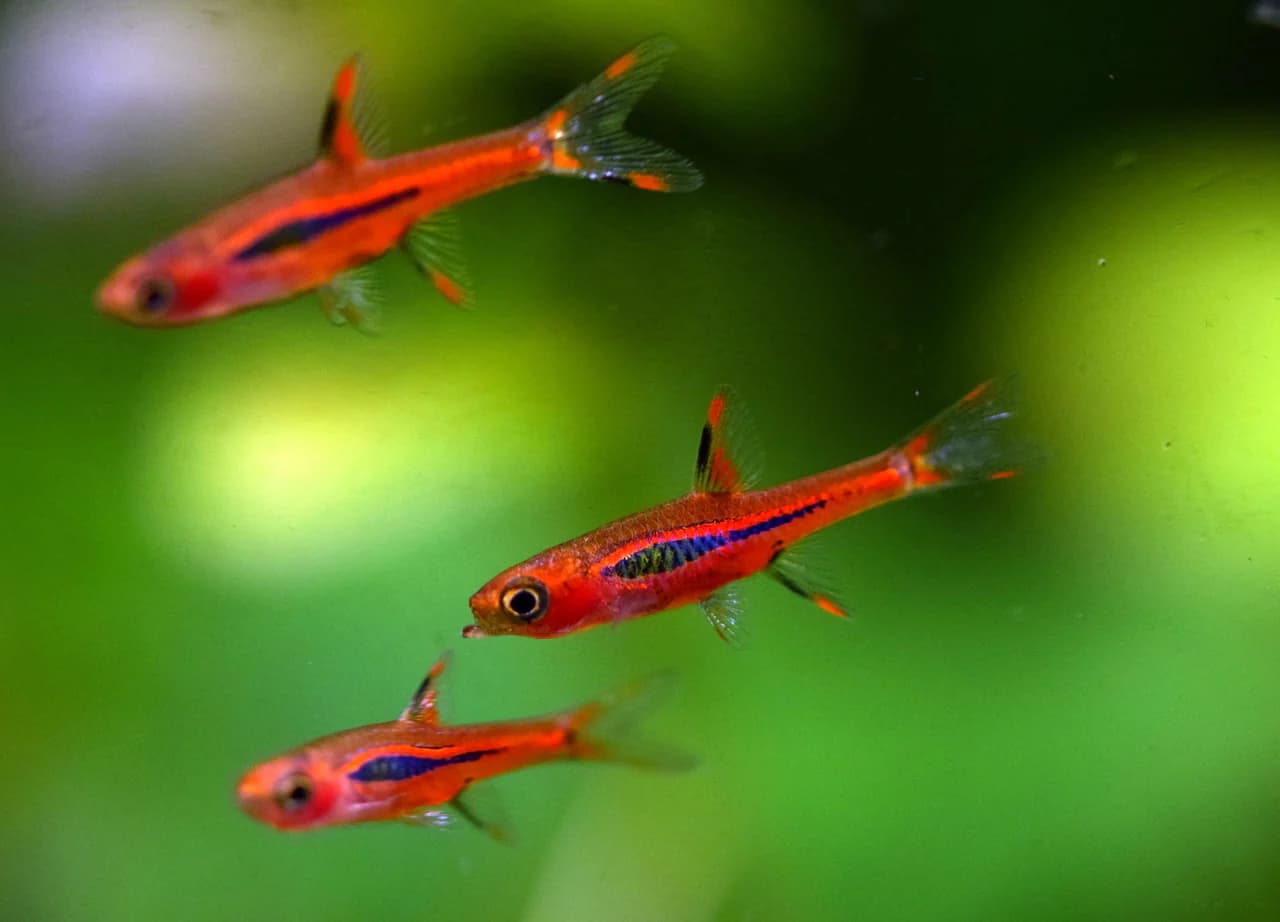
Boraras brigittae, the chili rasbora (also called the mosquito rasbora), is one of the smallest fish available in the aquarium hobby, reaching only 0.6–0.8 inches at full size. Despite their minuscule dimensions, male chili rasboras are extraordinarily vibrant, with deep red bodies and a bold black horizontal stripe edged in vivid red. They look like tiny flames darting through a planted tank.
They are native to blackwater peat swamp forests in Southwestern Borneo, Indonesia, where the water is exceptionally soft, acidic, and tea-colored with tannins. They are adapted to one of the most extreme aquatic environments in the world, which has implications for their care requirements.
Chili rasboras are ideal inhabitants for blackwater nano aquariums. Their tiny size, peaceful nature, and stunning coloration make them a favorite among planted tank enthusiasts worldwide.
Basic Overview
Common Misconceptions
"Tiny fish need tiny tanks." While chili rasboras do well in nano tanks, a 10-gallon planted tank allows a larger school (20+) that produces spectacular display behavior and reduces individual stress significantly more than a 5-gallon.
"They can live in any tap water." Chili rasboras come from extremely soft, acidic blackwater. Hard, alkaline tap water causes chronic stress and shortened lifespan. Soft water (low GH) with a pH below 7 is required for long-term health.
"A group of 3 or 4 is enough." In small numbers, chili rasboras are perpetually stressed and spend most of their time hiding. A group of at least 10, ideally 20+, transforms them into confident, actively displaying fish.
"They are too fragile for beginners." In a well-established, soft-water planted nano tank, chili rasboras are actually quite resilient. The challenge lies in setting up appropriate water chemistry, not in the daily care itself.
Recommended Setup
- 10 gallon blackwater nano tank; heavily planted with fine-leaved plants
- Soft, acidic water: target pH 5.5–6.8 and hardness below 8 dGH
- Dark fine sand or Aquasoil substrate
- Indian almond leaves, driftwood, and dried botanicals for tannins and natural buffering
- Floating plants (frogbit, salvinia) to dim light and create a natural canopy
- Sponge filter or very gentle hang-on-back filter; no strong flow
- Dim lighting; chili rasboras are most vivid and confident in subdued light
Diet
Chili rasboras are micro-predators with very small mouths. All food must be appropriately sized:
- Micro pellets or crushed nano flakes as a staple
- Frozen baby brine shrimp (ideal: nutritious and the right size)
- Frozen cyclops and daphnia
- Infusoria or liquid fry food for very young fish or as a supplement
- Micro worms (live) for excellent conditioning and color enhancement
Feed small amounts 1–2 times daily. Standard-sized flakes must be crushed to powder before feeding. Chili rasboras compete poorly with larger or faster fish for food, so they are best kept in a species-appropriate nano community.
Personality
In adequate numbers and a well-planted, dim environment, chili rasboras are active, bold, and strikingly beautiful. Males display to each other constantly, swimming parallel and intensifying their red coloration in an ongoing competition for female attention.
Without sufficient group size or plant cover, they become timid, pale, and hide continuously. The transformation that occurs when you move from a group of 5 to a group of 20 in a blackwater tank is dramatic.
Watching a school of 20+ chili rasboras moving through a planted blackwater tank is one of the most visually stunning sights in the nano aquarium hobby. Their combination of flame-red color against dark tannin-stained water is unmatched.
Tank Mates
Due to their tiny size, chili rasboras must only be kept with other micro fish or invertebrates. Excellent companions include other Boraras species, exclamation point rasboras, ember tetras, sparkling gouramis, and celestial pearl danios.
Dwarf shrimp (Neocaridina and Caridina) make excellent companions, adding color and activity at different levels of the tank. Adult shrimp are safe, but juvenile shrimp and shrimp fry may occasionally be eaten by the rasboras.
Avoid any fish over 1 inch in length, as virtually any larger fish will view chili rasboras as food. Also avoid any fish that prefer hard, alkaline conditions, as the water chemistry requirements are incompatible.
Water Parameters
Chili rasboras require soft, acidic, tannin-rich water to truly thrive. This is the most important aspect of their care:
- pH: 4.0–7.0 (5.5–6.8 ideal; they come from some of the most acidic water in the world)
- Hardness (gH): 0–8 dGH (very soft)
- Temperature: 72–82°F
- Ammonia and Nitrite: 0 ppm
- Nitrate: below 10 ppm
Here are some top tips to deal with unwanted parameters:
- In hard tap water areas, use RO water (80–100% RO) remineralized minimally with a soft water remineralizer. This is the most reliable way to achieve the water chemistry chili rasboras need.
- Indian almond leaves, catappa bark, and alder cones all naturally lower pH and add tannins. They also have mild antibacterial properties that benefit fish in soft acidic conditions.
- Do small, frequent water changes (10–15% twice weekly) rather than large infrequent ones, to avoid parameter swings in the sensitive soft water environment.
- Never use hard water or alkaline tap water directly in a chili rasbora tank. Even brief exposure to hard water causes visible stress and long-term exposure leads to early death.