Neon Tetra Care Guide
The Ultimate Care Guide for Neon Tetras
Introduction
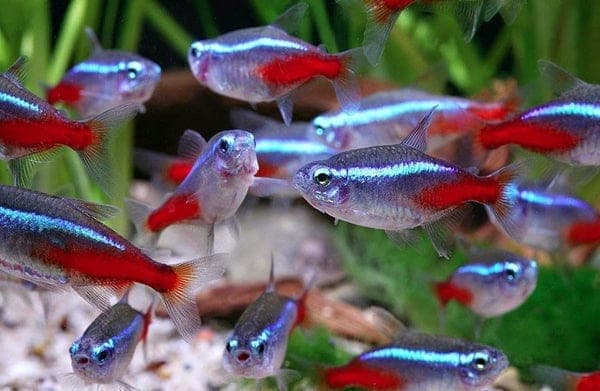
Paracheirodon innesi, commonly known as the neon tetra, is arguably the most recognizable freshwater fish in the world. They live roughly 5-10 years in optimal conditions and prefer temperatures of 70-77 degrees Fahrenheit. They commonly reach 1.5 inches in size, with their iconic bright blue horizontal stripe and vivid red tail making them instantly identifiable from across the room.
Neon tetras are schooling fish that should always be kept in groups of at least 6, though 10+ is where they truly shine. A large school moving together through a planted tank, their iridescent stripes flashing in unison, is one of the most visually stunning sights the freshwater hobby has to offer.
Despite their reputation for being fragile, neon tetras are quite hardy in a mature, well-maintained tank. Their small mouths and preference for softer, slightly acidic water are the main care considerations to keep in mind.
Basic Overview
Common Misconceptions
"Neon tetras are delicate fish that always die quickly!" Their fragile reputation comes almost entirely from being added to uncycled tanks or kept in poor water conditions. In a mature, stable tank they are genuinely hardy and can live close to a decade.
"One or two neon tetras is fine!" Neon tetras are schooling fish and become visibly stressed in small groups. Fewer than 6 leads to stress, faded color, and greater disease susceptibility. A school of 10+ is ideal.
"Neon tetras and cardinal tetras are the same fish!" They look nearly identical but are different species. The cardinal tetras red stripe runs the full length of the body, while the neons red only covers the back half. Cardinals also prefer warmer, more acidic water.
"Neon tetras need a warm tropical tank!" Neon tetras actually prefer cooler temperatures than many tropical fish, around 70-77 degrees Fahrenheit. Very warm tanks above 80 degrees can stress them and shorten their lifespan.
Recommended Setup
- 10+ gallon tank, cycled, with a lid, heater, and gentle filter
- Heavy planting to provide cover and a natural feel
- Dark substrate to enhance their iridescent colors
- Low to moderate flow
- Floating plants or dim lighting to soften the light
- Aquarium siphon
Diet
Neon tetras are omnivores that eat a variety of small foods. Their mouths are tiny, so food size is crucial. They enjoy:
- High-quality micro pellets or finely crushed flake food as a staple
- Frozen or live baby brine shrimp
- Frozen or live daphnia
- Micro worms
- Cyclops
Feed small amounts once or twice daily. Any food not eaten in 2-3 minutes is too much. Overfeeding in a tank with small fish is a fast way to cause water quality problems.
Personality
Neon tetras are quintessential schooling fish. In a large group, they move together with a coordination that looks almost choreographed, the flashing of their blue stripes as they turn in unison genuinely mesmerizing to watch.
They are shy fish that can be easily stressed by aggressive or boisterous tankmates. When frightened, they bunch tightly near the bottom or into dense planting. A well-planted tank with plenty of cover makes them far more confident and active.
When comfortable and healthy, their colors are vivid and bright. Faded or pale coloration is often one of the first signs that something is off with the tank or the fish's health.
Compatible Tankmates
Neon tetras are peaceful fish that do well with most small, similarly peaceful community fish. Good options include other small tetras, rasboras, corydoras catfish, small loaches, honey gouramis, and small danios.
Avoid keeping them with larger fish that might eat them. Angelfish are a classic risky pairing, as adult angelfish readily eat neon tetras. Avoid any aggressive or nippy species.
Neon tetras are generally compatible with snails and larger shrimp, though very small shrimp may occasionally be picked at by a hungry school.
Water Parameters
Neon tetras prefer soft, slightly acidic water that mirrors their Amazon origin. A cycled, mature tank is essential, as they are sensitive to ammonia and nitrites. Target:
- pH: 6.0-7.0
- gH: 50-150 PPM (soft water preferred)
- Temperature: 70-77 degrees Fahrenheit
Here are some top tips to deal with unwanted parameters:
- To soften water and lower pH, use driftwood, Indian almond leaves, or a small bag of peat moss in the filter. This naturally mimics Amazonian water conditions.
- Neon tetras are susceptible to neon tetra disease (Pleistophora hyphessobryconis), a parasitic infection with no cure. Buy from reputable sources and quarantine all new fish.
- Do weekly 20-25% water changes to keep ammonia and nitrates in check.
- Remember, using random chemicals is not recommended, since they can cause more problems through sudden, drastic changes.