Celestial Pearl Danio Care Guide
A Complete Care Guide for Danio margaritatus
Introduction
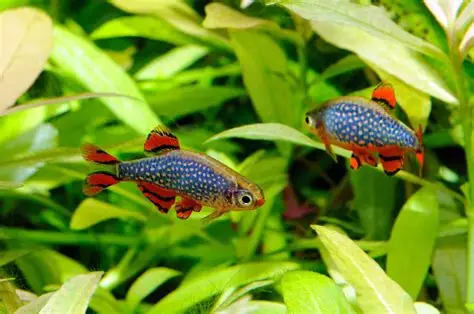
Danio margaritatus, the celestial pearl danio (also sold as the galaxy rasbora), was first described by science in 2006 and caused an immediate sensation in the aquarium hobby. Their deep blue-black bodies are covered with gold and white spots reminiscent of a starry night sky, with vivid red and black striped fins on the males. It is difficult to believe such a fish is real.
They are native to small, shallow, heavily vegetated ponds in Shan State, Myanmar, at altitudes of around 1000 meters. Their discovery location was overexploited almost immediately after their description, leading to conservation concerns. All fish available today should be captive-bred.
At only 1 inch in size, celestial pearl danios are micro fish that need a planted nano tank to show their best. They are more shy than most danios and benefit from dense planting and a calm environment.
Basic Overview
Common Misconceptions
"Galaxy rasboras and celestial pearl danios are different fish." They are the same species, Danio margaritatus. "Galaxy rasbora" was the original trade name before the scientific description was published. Both names refer to identical fish.
"They are as bold as other danios." Unlike zebra danios and giant danios, CPDs are relatively shy and will hide in sparse tanks. Dense planting and a calm environment are essential for them to display their colors confidently.
"A pair is fine." CPDs kept in small numbers are stressed and spend most of their time hiding. A group of 8–10 minimum brings out natural schooling behavior and encourages the males to display to each other and to females.
"They need a large tank." Their small size makes a 10-gallon well-planted nano tank genuinely suitable for a group of 8–10. They are one of the few species where a smaller tank is not a compromise.
Recommended Setup
- 10 gallon planted nano tank for a group of 8–10
- Dense planting, especially fine-leaved plants like Java moss, hornwort, and Rotala
- Fine sand or dark fine gravel substrate
- Gentle filtration; sponge filter is ideal (no suction risk, provides grazing surface)
- Dim to moderate lighting; they are more vibrant and confident in softer light
- Floating plants help reduce surface light and increase their comfort
- A calm, quiet location away from vibrations and heavy foot traffic
Diet
Celestial pearl danios are micro-predators in the wild, feeding on small invertebrates, zooplankton, and algae. Their small mouths require appropriately sized foods:
- Micro pellets or crushed high-quality flakes as a staple
- Frozen baby brine shrimp (a favorite; excellent for color and conditioning)
- Frozen cyclops and daphnia
- Infusoria or liquid fry food for very young fish
- Micro worms as a live food option
Feed small amounts 1–2 times daily. Their tiny mouths cannot handle standard-sized flakes without crushing. Regular live and frozen food feedings produce dramatically better color in males and encourage spawning behavior.
Personality
Male celestial pearl danios are remarkably interactive with each other. They engage in elaborate display behaviors, swimming alongside rivals with fins spread and colors intensified, looking like tiny jewels competing for female attention. This display behavior is harmless but visually stunning.
With adequate plant cover and group size, CPDs become increasingly confident over time and will venture into open water regularly. A tank that is too sparse or too brightly lit will result in fish that hide permanently and never show their colors.
Spawning behavior is observable in a well-set-up tank. Males chase females into fine-leaved plants where eggs are scattered. The fry are very small but can be raised in the main tank if there is enough plant cover.
Tank Mates
Due to their tiny size and shy nature, celestial pearl danios do best with other peaceful nano fish. Good companions include chili rasboras, ember tetras, pygmy corydoras, and small otocinclus. Snails and dwarf shrimp also make excellent tank mates and add activity to different levels of the tank.
Avoid any fish large enough to eat them, any aggressive or nippy species, and fast, boisterous fish like standard danios that will stress them and outcompete them for food.
A nano tank dedicated entirely to CPDs and their ideal companions (small shrimp, snails, and perhaps a single species of micro tetra) is often more rewarding than mixing them into a larger general community.
Water Parameters
Celestial pearl danios come from cool, clear, heavily vegetated mountain ponds in Myanmar:
- pH: 6.5–7.5
- Hardness (gH): 2–10 dGH (soft to moderately soft)
- Temperature: 73–79°F
- Ammonia and Nitrite: 0 ppm
- Nitrate: below 10–20 ppm
Here are some top tips to deal with unwanted parameters:
- Weekly water changes of 20–25% are essential in a nano tank, where waste builds up faster relative to volume.
- Avoid strong flow. Sponge filters or very gentle hang-on-back filters set to low flow best replicate their calm pond environment.
- Driftwood and Java moss create a natural look that also slightly softens and acidifies water, which suits CPDs well.
- Test water weekly in a nano tank setup. Small volumes mean parameters can shift quickly, and CPDs are sensitive to water quality decline.