Congo Tetra Care Guide
A Complete Care Guide for Phenacogrammus interruptus
Introduction
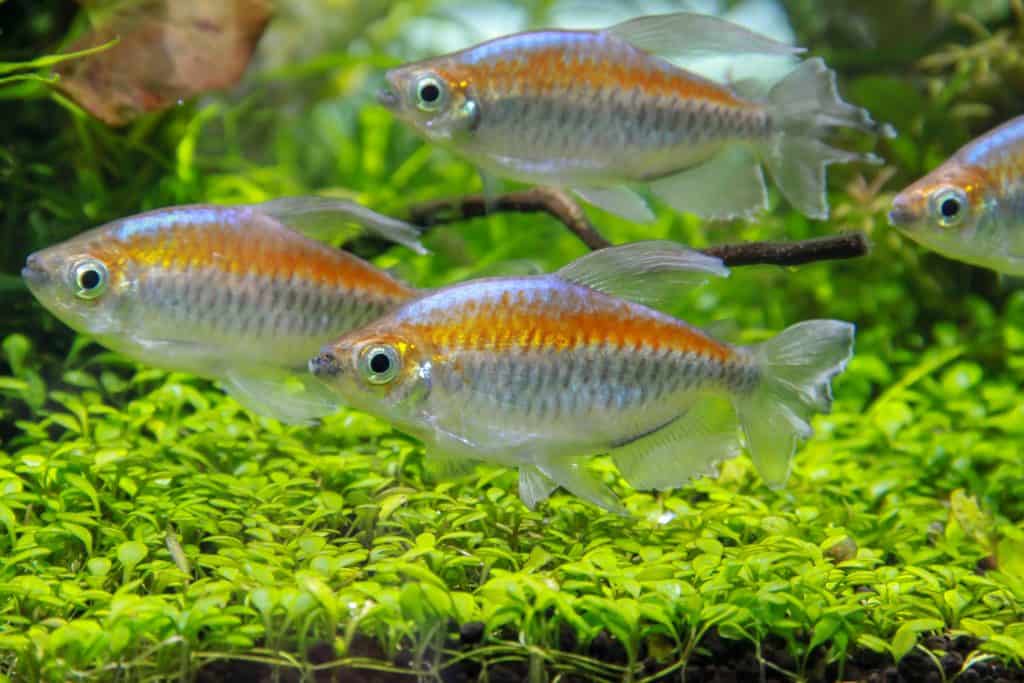
Phenacogrammus interruptus, the Congo tetra, is the jewel of African freshwater fish. Native to the Congo River basin in central Africa, males develop spectacular iridescent scales in shades of blue, gold, orange, and violet, combined with flowing extensions on their central tail fin that give them an almost otherworldly appearance.
Congo tetras are significantly larger than most tetra species, growing to 3–3.5 inches for males (females are slightly smaller and less colorful). Their size and dramatic coloration make them suitable centerpiece fish for a larger community tank, rather than background schooling fish.
They are peaceful, adaptable, and surprisingly hardy once established. A group of 6–8 in a well-planted 40+ gallon tank makes a genuinely breathtaking display.
Basic Overview
Common Misconceptions
"Congo tetras are just big neon tetras." They are entirely unrelated, coming from Africa rather than South America. Congo tetras are much larger and have a completely different temperament, diet preference, and appearance.
"Their fins are naturally flowing." Male fin extensions only develop fully in healthy fish with excellent nutrition and water quality. A Congo tetra with small, ragged fins is a stressed or nutritionally deficient fish.
"They can go in small tanks." Congo tetras are active, large-bodied fish that need space to school and swim. A 40-gallon long tank is a minimum; 55–75 gallons allows a properly sized school to display their natural behavior.
"They are aggressive." Congo tetras are entirely peaceful with any fish they cannot eat. Males may display to each other with spread fins, but this is display behavior, not genuine aggression.
Recommended Setup
- 40+ gallon long tank for a group of 6
- Soft, slightly acidic water preferred but adaptable to neutral conditions
- Dark substrate to make their iridescent colors pop
- Dense planting along sides and back, with open swimming space in front
- Floating plants to dim surface light; Congo tetras prefer subdued lighting
- Moderate filtration with gentle to moderate flow
- A secure lid; Congo tetras are active jumpers
Diet
Congo tetras are omnivores that eat a wide range of foods in the wild, including insects, small invertebrates, algae, and plant matter. They accept virtually any aquarium food:
- High-quality tropical flakes or small pellets as a staple
- Frozen bloodworms, brine shrimp, and daphnia
- Freeze-dried tubifex or spirulina flakes for variety
- Live foods for conditioning: brine shrimp, daphnia, mosquito larvae
Feed once or twice daily. Congo tetras have larger mouths than most tetras and can accept standard-sized flakes without issue. A varied diet rich in protein and plant matter produces the best fin development and most vivid coloration in males.
Personality
Congo tetras are active, confident fish that school loosely in the middle and upper water column. Males regularly display to each other by swimming side by side with fins spread, showing off their colors in a non-aggressive competition for social standing.
They are bold enough to be seen at all times rather than hiding, and peaceful enough to coexist with virtually any community fish of appropriate size. This combination makes them one of the best display fish available for larger community tanks.
Their iridescence is strongly dependent on lighting angle. Under the right light, they shift between gold, blue, violet, and orange as they turn. Positioning your light to catch them at different angles reveals why they have been such a beloved species since their introduction to the hobby.
Tank Mates
Congo tetras pair beautifully with other large African species: African butterfly fish, African knife fish, and synodontis catfish all share similar geographic origins. For a pure African biotope, add a school of Congo tetras, a group of synodontis catfish on the bottom, and perhaps a pair of kribs (kribensis cichlids) for a complete West/Central African display.
They also work well in mixed community tanks with other peaceful mid-to-large fish. Angelfish are a good size match and are geographically mismatched but visually stunning companions. Corydoras catfish and larger plecos work well on the bottom layer.
Avoid small fish that Congo tetras might eat, including fish under 1 inch. Also avoid very slow-moving or long-finned fish that might invite fin nipping, though Congo tetras are far less likely to nip than most semi-aggressive species.
Water Parameters
Congo tetras come from the soft, slightly acidic waters of the Congo basin but are more adaptable than many blackwater species:
- pH: 6.0–7.5
- Hardness (gH): 3–18 dGH (adaptable to moderate hardness)
- Temperature: 73–82°F
- Ammonia and Nitrite: 0 ppm
- Nitrate: below 20 ppm
Here are some top tips to deal with unwanted parameters:
- Congo tetras are more forgiving of harder water than cardinal or neon tetras. Standard tap water in most areas is suitable without modification.
- For best coloration and fin development in males, aim for slightly soft, slightly acidic conditions. Driftwood and Indian almond leaves are helpful.
- Weekly 25% water changes keep nitrates in check and maintain the water clarity that makes their iridescence most visible.
- Avoid sudden temperature changes. Congo tetras handle a wide temperature range but are sensitive to rapid fluctuations. Match replacement water temperature carefully during water changes.