Cardinal Tetra Care Guide
A Complete Care Guide for Paracheirodon axelrodi
Introduction
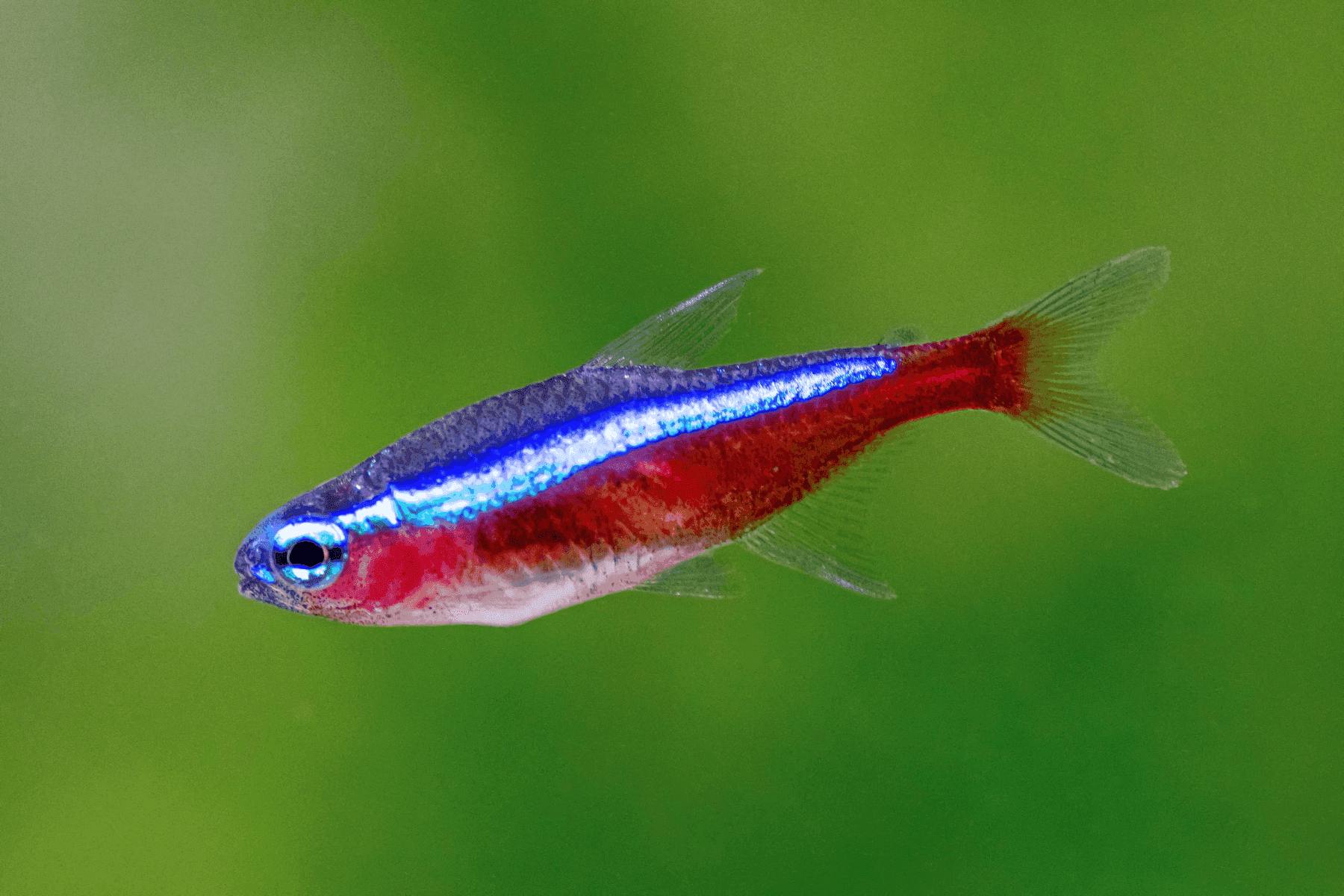
Paracheirodon axelrodi, the cardinal tetra, is one of the most stunning schooling fish in the freshwater hobby. Where neon tetras display red coloration only on the lower half of their body, cardinal tetras are blazing red from nose to tail with a brilliant electric blue stripe along their back, making them visibly more dramatic in a school.
Cardinals are native to the blackwater tributaries of the Rio Negro and Orinoco basins in South America, where the water is exceptionally soft, acidic, and stained dark with tannins from decaying organic matter. While they have become somewhat more adaptable through generations of captive breeding, they still prefer softer, more acidic conditions than many popular community fish.
In a proper blackwater setup with a large school and appropriate tank mates, cardinal tetras create a display that rivals anything in the freshwater hobby.
Basic Overview
Common Misconceptions
"Cardinal tetras and neon tetras are the same fish." They are close relatives but distinct species. Cardinals are larger, have a full red stripe from head to tail, and generally prefer softer, more acidic water than neons. Cardinals are also more delicate in hard water.
"A school of 3 or 4 is sufficient." Cardinal tetras are safety-in-numbers fish. Small groups are perpetually stressed and hide constantly. A school of 10 is a minimum; 20–30 in a suitably sized tank creates the breathtaking horizontal shimmer they are known for.
"Cardinals are difficult to keep." Captive-bred cardinals are quite hardy if placed in a cycled, stable tank with appropriate water parameters. The reputation for difficulty largely comes from placing them in uncycled tanks or very hard, alkaline water.
"They can go in any community tank." Cardinal tetras are small and peaceful. Avoid any fish large enough to eat them (angelfish will eat adult cardinals, and most cichlids pose a threat). Choose similarly peaceful, small community fish as companions.
Recommended Setup
- 20+ gallon tank, well-established and cycled
- Soft, slightly acidic water; use RO water or add driftwood and leaf litter to soften
- Dark substrate (black sand looks stunning with cardinal tetras)
- Tannin-rich environment: Indian almond leaves, driftwood, dried botanicals
- Dense planting with open swimming space in the middle
- Dim to moderate lighting; cardinals are most vibrant under subdued light
- Gentle filtration with low flow; use a sponge filter or spray bar to reduce current
Diet
Cardinal tetras are micro-predators in the wild, feeding on small invertebrates, zooplankton, and occasionally plant matter. In the aquarium they readily accept:
- High-quality micro pellets or small tropical flakes as a staple
- Frozen micro foods: daphnia, cyclops, baby brine shrimp
- Frozen bloodworms (finely chopped or small grade)
- Live baby brine shrimp for conditioning and color enhancement
Feed once or twice daily in amounts they can consume in 2–3 minutes. Because of their small mouths, ensure food particle size is appropriate. Overfeeding fouls the soft-water environment they need, so err on the side of underfeeding rather than overfeeding.
Personality
Cardinal tetras are quintessential schooling fish. As individuals they are shy and unremarkable; as a large group they are transformed into a synchronized, shimmering spectacle. Watch how the school moves as a single fluid entity, splitting around obstacles and reforming instantly.
They are completely peaceful and will not bother any fish they share a tank with. They occupy the middle water column and rarely venture to the surface or bottom. Combining them with corydoras on the bottom and a surface-dwelling species creates a beautifully layered display.
Cardinals are sensitive to stress and will show it through pale, washed-out coloration. A school that is consistently pale is signaling that something in their environment is not right, usually water quality, temperature, or insufficient group size.
Compatible Tank Mates
The classic pairing is cardinal tetras with discus. Both species come from the same blackwater habitats, share identical water parameter preferences, and the tetras add movement and color to the mid-water while discus command the full tank.
Other excellent companions include corydoras sterbai, German blue rams, dwarf cichlids like apistogrammas, small plecos, and other soft-water tetras. Avoid any fish large enough to view the cardinals as food.
Angelfish are a popular but risky pairing. Small cardinal tetras will be eaten by adult angelfish. If combining the two, ensure both species are introduced simultaneously when young, so the angels associate the tetras with companions rather than food.
Water Parameters
Cardinal tetras come from some of the softest, most acidic water in the world. They are most vibrant and longest-lived in:
- pH: 5.5–7.0 (6.0–6.5 is ideal)
- Hardness (gH): 1–8 dGH (soft water strongly preferred)
- Temperature: 73–81°F
- Ammonia and Nitrite: 0 ppm
- Nitrate: below 10–20 ppm
Here are some top tips to deal with unwanted parameters:
- Driftwood, Indian almond leaves, and peat filtration naturally lower pH and add tannins without causing harmful pH swings.
- In hard tap water areas, blending with RO water (50–70% RO) brings hardness into range. Cardinal tetras in very hard water are chronically stressed and short-lived.
- Never use pH-adjusting chemicals in a tank with fish. These cause rapid, dangerous swings. Use natural buffering methods only.
- Blackwater environments look dark but are actually very clean. The dark color comes from tannins, not from waste. Regular water changes remain essential.