Rummy Nose Tetra Care Guide
The Ultimate Care Guide for Rummy Nose Tetras
Introduction
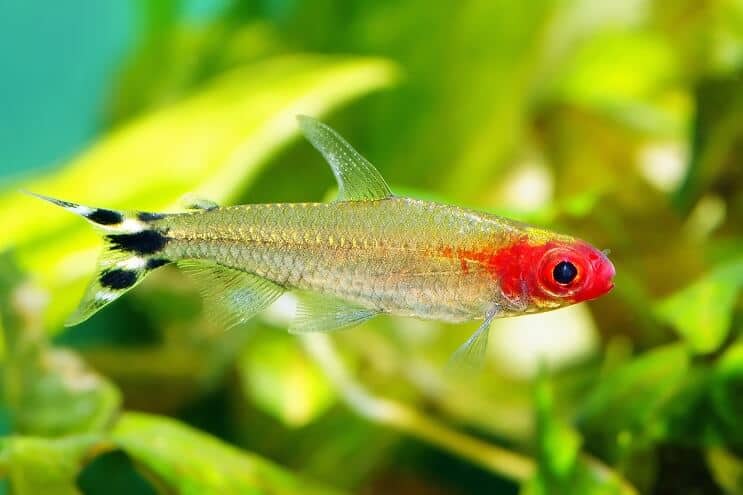
Hemigrammus bleheri, commonly known as the rummy nose tetra, is one of the most elegant schooling fish in the freshwater hobby. They live roughly 5-8 years in captivity and prefer temperatures of 75-81 degrees Fahrenheit. They commonly reach 2 inches in size, with their brilliant red head, silver body, and black-and-white striped tail making them one of the most distinctive tetras available.
Rummy nose tetras are native to the warm, soft, acidic rivers of the Amazon Basin. They are known for being exceptionally tight schoolers, moving in coordinated formations that are mesmerizing in a large, planted tank. Unlike many other schooling fish that only school tightly when threatened, rummies school cohesively even when completely relaxed.
They are somewhat more demanding than other common tetras in terms of water quality and parameter stability, but for the hobbyist who can meet their needs, a large school of rummy nose tetras is one of the most visually spectacular things a freshwater aquarium can offer.
Basic Overview
Common Misconceptions
"Rummy nose tetras are the same as cardinal tetras!" They are different species with different appearances and care needs. Rummy nose tetras are identified by their red nose and striped tail. Cardinals have the full-length red stripe. Both prefer soft, warm water, but they are distinct species.
"The red nose color always looks that vivid!" The intensity of the red nose is actually a health and stress indicator. A vivid, bright red nose is a sign of a healthy, happy fish in good water conditions. A faded or pale nose is often one of the first signs of stress or poor water quality.
"A small group of 4-5 is enough!" Rummy nose tetras are among the most committed schooling fish in the hobby. In small groups they are noticeably stressed and school tightly from fear. A group of at least 10, ideally 15-20, is where their natural schooling behavior truly shines.
"Rummy nose tetras are the same as false rummy nose tetras!" Several species are sold under the rummy nose name. The true rummy nose (Hemigrammus bleheri) and the false rummy nose (Petitella georgiae) look very similar but are different species. Care requirements are nearly identical, so the distinction matters more for species accuracy than for keeping purposes.
Recommended Setup
- 20+ gallon tank, cycled and mature, with a lid, heater, and gentle filter
- Heavy planting with open swimming space in the middle for schooling
- Dim lighting or floating plants (they come from shaded Amazonian waters)
- Driftwood and Indian almond leaves to naturally acidify and tint the water
- Fine dark substrate to enhance their colors
- Gentle flow
- Aquarium siphon
Diet
Rummy nose tetras are omnivores that eat a variety of small foods. Their mouths are small, so food size matters. They enjoy:
- High-quality micro pellets or finely crushed flake food as a staple
- Frozen or live baby brine shrimp
- Frozen or live daphnia
- Micro worms
- Frozen bloodworms in small pieces (treat)
Feed small amounts once or twice daily. They are active feeders that compete well for food in a community setting.
Personality
Rummy nose tetras are the gold standard for schooling behavior in the freshwater hobby. A large school moves together in tight, synchronized formations, turning and flowing as one. The coordinated flash of red noses and striped tails as the school turns is genuinely one of the most beautiful sights in fishkeeping.
They are peaceful and unobtrusive tankmates that spend most of their time in the mid-level of the tank. Unlike some active schooling fish, they have a relatively calm energy that complements rather than overwhelms a planted aquarium.
Use the color of their nose as a health barometer. In a tank with excellent water quality and ideal conditions, the red is vivid and extends brightly across the full snout. Any fading is a prompt to check your parameters and make a water change.
Compatible Tankmates
Rummy nose tetras are peaceful and compatible with most small, non-aggressive community fish. They pair beautifully with corydoras on the bottom, discus or angelfish in the upper levels (with the caveat that angelfish may eat them if large enough), and other peaceful tetras in the mid-level.
They are safe with snails and larger shrimp, though very small shrimp may occasionally be at risk from a feeding school. Their soft-water requirements make them natural companions for other Amazonian species.
Avoid aggressive fish, fin nippers, and anything large enough to eat them. Their tight schooling behavior makes them look like a snack to predatory fish.
Water Parameters
Rummy nose tetras require warm, soft, slightly acidic water. This is not a fish for hard, alkaline tap water without some treatment. Their nose color itself tells you how well the water conditions are matching their needs. Target:
- pH: 6.0-7.0 (soft, acidic strongly preferred)
- gH: 50-100 PPM (soft water)
- Temperature: 75-81 degrees Fahrenheit
Here are some top tips to deal with unwanted parameters:
- Indian almond leaves, driftwood, and peat moss in the filter are the most natural ways to soften water and lower pH for rummy nose tetras.
In hard tap water areas, mixing RO water with tap water is the most reliable long-term solution for achieving soft water.
- Do weekly 20-25% water changes. Elevated nitrates are a common cause of faded nose color and lethargy.
- Remember, using random chemicals is not recommended, since they can cause more problems through sudden, drastic changes.