Cherry Barb Care Guide
A Complete Care Guide for Puntius titteya
Introduction
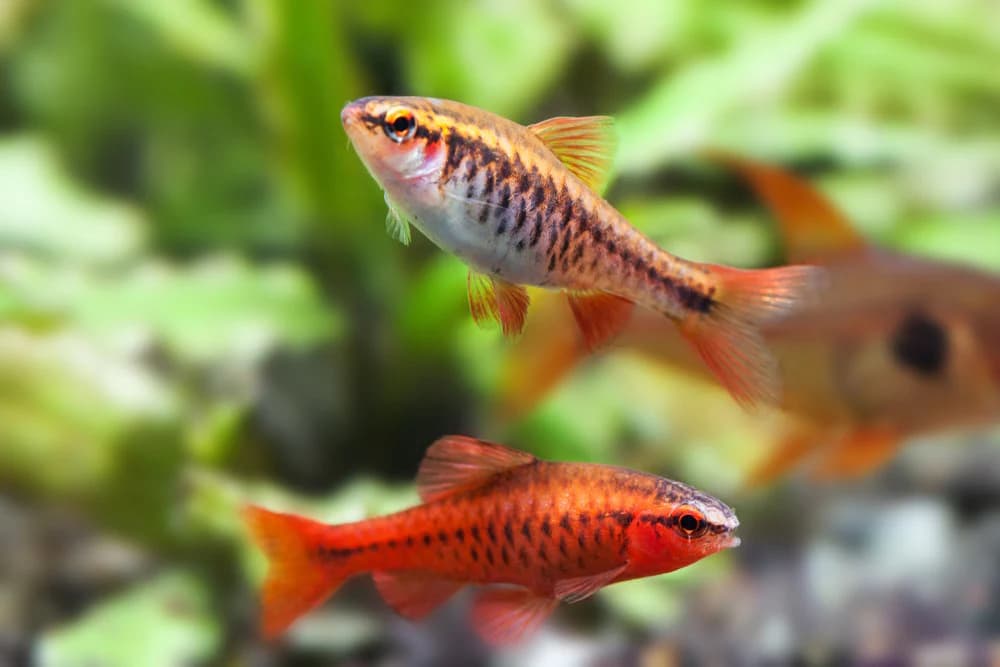
Puntius titteya, the cherry barb, is one of the most peaceful and visually appealing small barbs available. Males develop an intense cherry-red coloration, particularly when displaying or during breeding condition, while females are a subtler golden-olive brown with a dark lateral stripe. They are endemic to Sri Lanka and classified as vulnerable in the wild due to habitat loss.
Native to the shaded, slow-moving streams and rivers of Sri Lanka's wet zone, cherry barbs inhabit heavily vegetated, tannin-stained waters with leaf litter and overhanging forest cover. They are adapted to relatively low light and soft to moderately hard water.
Cherry barbs are among the most reliably peaceful barb species. Unlike tiger barbs or rosy barbs, they show no fin-nipping tendency and can be kept safely with slow-moving, long-finned fish. They are an excellent choice for planted community tanks with bettas, guppies, and other fish that are often stressed by more active barbs.
Basic Overview
Common Misconceptions
"All barbs are fin nippers." Cherry barbs are an exception. Their gentle temperament makes them one of the few barb species safe with long-finned bettas, angelfish, and guppies.
"Males are always bright red." Male cherry barbs intensify to their deepest red during displays, spawning condition, and when well-fed in optimal water. In poor conditions or stress, the red becomes dull. A pale male cherry barb is a sign something needs improvement.
"A group of 4 is sufficient." Cherry barbs are more confident and colorful in groups of 8 or more. In small groups, males may stress females through constant chasing. In larger groups, attention is distributed.
"They need tropical temperatures." Cherry barbs prefer the lower end of the tropical range (73-77 degrees F) and do well in moderately cool setups. They are hardy across a range but not suited for cold unheated tanks.
Recommended Setup
- 20+ gallon planted tank for a school of 8-12
- Dark fine sand or planted substrate
- Dense planting with shaded areas: crypts, Java fern, Vallisneria, Amazon swords
- Floating plants or tall stem plants to reduce surface light
- Driftwood and leaf litter for natural appearance and tannins
- Gentle filtration; sponge filter or low-flow HOB
- Warm-spectrum lighting at low to moderate intensity
Diet
Cherry barbs are omnivores that accept a wide range of foods:
- High-quality small flakes or micro pellets as a staple
- Frozen bloodworms, baby brine shrimp, and daphnia
- Live foods for breeding conditioning
- Blanched vegetables: zucchini, peas, spinach
- Spirulina flakes for plant component
Feed once or twice daily. A varied diet including regular live or frozen protein foods brings out the deepest red in males. Cherry barbs are not competitive feeders; ensure they receive adequate food in tanks with faster species.
Personality
Cherry barbs are active, curious, and relatively bold fish for their size. Males display constantly to each other and to females: spreading fins, deepening their red coloration, and performing short lateral displays. This behavior is entirely harmless and produces a beautiful continuous visual display.
Females are the less celebrated half of a cherry barb school but are attractive fish in their own right: the golden-olive body with the dark lateral stripe glows warmly under appropriate lighting. A mixed-sex school of 8 or more is significantly more interesting than a single-sex group.
They occupy the middle water column and are compatible with virtually any peaceful community fish. Their calm demeanor makes them ideal for setups that mix delicate or slow-moving species.
Breeding Cherry Barbs
Cherry barbs breed readily in captivity and are a good introduction to egg-scattering breeding. A conditioning period of 2-3 weeks with live and frozen foods brings both sexes into breeding condition. The male intensifies to deep ruby red when ready.
Spawning occurs over fine-leaved plants or a spawning mop. The female scatters eggs and both parents show no parental care and will eat eggs if given the opportunity. Separating the eggs to a separate container with a gentle sponge filter gives the best survival.
Fry hatch in 24-48 hours and become free-swimming in another 24-48 hours. First foods are infusoria or liquid fry food, followed by baby brine shrimp after the first week.
Water Parameters
Cherry barbs come from the soft, slightly acidic streams of Sri Lanka:
- pH: 6.0-7.5
- Hardness (gH): 2-12 dGH
- Temperature: 73-81 degrees F
- Ammonia and Nitrite: 0 ppm
- Nitrate: below 20 ppm
Here are some top tips to deal with unwanted parameters:
- Soft, slightly acidic water with driftwood or leaf litter produces the deepest male coloration. Standard neutral tap water is acceptable but reduces color intensity.
- Weekly 25% water changes in a well-planted tank. Cherry barbs are not particularly sensitive to water chemistry but clean water is important for best coloration.
- Temperature in the 74-78 degree F range is optimal. They tolerate cooler conditions but thrive and breed most readily at moderate tropical temperatures.
- Avoid bright, harsh lighting. Cherry barbs are adapted to shaded forest streams and are more comfortable and more colorful in lower-light conditions with floating plant cover.