Crystal Red Shrimp Care Guide
A Complete Care Guide for Caridina cf. cantonensis
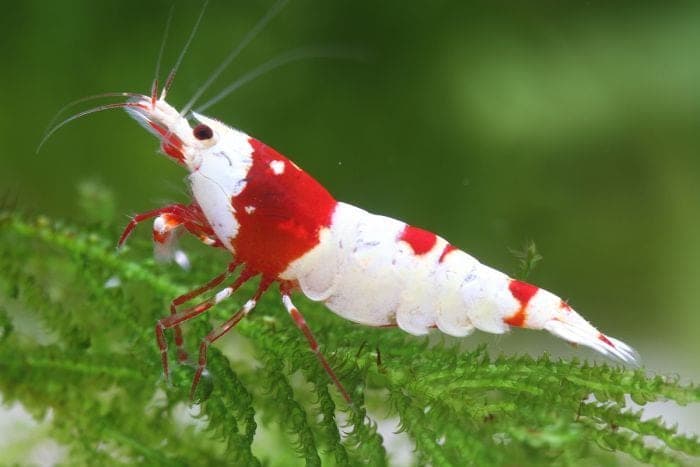
Introduction
Crystal red shrimp (CRS) are selectively bred color forms of Caridina cf. cantonensis, originally developed in Japan in the 1990s from a naturally occurring mutation in the bee shrimp. Their vivid red and white banding pattern and small size make them among the most visually striking freshwater invertebrates available.
CRS are graded by the intensity and pattern of their white and red bands, from the lower grades (sparse white) through to high grades (SSS, crystal-clear white bands, solid red or white head). Higher-grade specimens command significantly higher prices but have the same care requirements as lower grades.
Their care is advanced relative to other aquarium shrimp. Crystal red shrimp require soft, slightly acidic water with very specific parameters and are highly sensitive to water quality fluctuations and contaminants. They are not suitable for beginners or for standard tap water in hard-water areas without significant water treatment.
Basic Overview
Common Misconceptions
"They are like cherry shrimp with different colors." Crystal red shrimp are Caridina, not Neocaridina (the genus of cherry shrimp). Their water parameter requirements are dramatically different. Cherry shrimp thrive in standard tap water; CRS require soft, acidic, carefully managed conditions.
"Warmer water is better." CRS require cool water (62-74 degrees F). Temperatures above 76 degrees F stress them significantly and increase mortality. A cooling fan or chiller may be necessary in warm climates.
"Standard tap water works if slightly diluted." Standard tap water in hard-water areas cannot be diluted to the very soft, slightly acidic conditions CRS require. RO water remineralized with a shrimp-specific mineral supplement is the standard approach.
"They can be kept with most fish." CRS are very small and will be eaten by virtually any fish. They should be kept in species-only tanks or with very small, peaceful fish that cannot fit the shrimp in their mouth.
Recommended Setup
- 10-20 gallon dedicated shrimp tank
- Active substrate (ADA Amazonia or similar): essential for buffering pH to the required acidic range
- Dense planting, Java moss, and biomedia for biofilm growth
- Sponge filter: gentle, safe for shrimp, promotes biofilm
- Temperature 65-72 degrees F; cooling fan or chiller if ambient temperature is high
- No fish that could eat the shrimp; Malaysian trumpet snails and nerites are good tank mates
- Tight lid; shrimp can escape through small gaps
Diet
CRS are omnivorous grazers that feed primarily on biofilm, algae, and decaying organic matter:
- Biofilm grazed from surfaces (primary natural food in a mature tank)
- Shrimp-specific granular foods (Shrimp King Complete, Bacter AE)
- Blanched vegetables: spinach, zucchini, nettle leaves
- Snowflake food (dried soybean hulls) for fiber
- Dried leaf litter (Indian almond, mulberry) for biofilm growth
Feed small amounts every 1-2 days. Overfeeding is a serious risk: uneaten food quickly pollutes the carefully managed water. Remove uneaten food after 24 hours. The goal is supplementing the natural biofilm, not replacing it.
Personality
Crystal red shrimp are busy, social invertebrates that graze continuously across every surface in the tank. A healthy, established colony of 30-50 CRS in a well-planted tank is an extraordinary display: vivid red-and-white dots moving across green plants, driftwood, and substrate.
During molting, females can trigger a mass swimming behavior in males, who will frantically swim through the tank searching for the freshly molted female. This "shrimp tornado" is a sign of a healthy, actively breeding colony.
Juvenile shrimp (young of the month) are tiny copies of the adults, visible in a mature colony among the moss and plants. Watching a colony grow from a founding group of 20 to a thriving population of 200 is one of the most satisfying experiences in nano aquarium keeping.
Water Chemistry Management
CRS water chemistry is the most demanding aspect of their care. The target parameters are very specific: pH 6.0-6.8, TDS 100-150 ppm, gH 4-6, kH 0-1. These parameters require RO water remineralized with a shrimp-specific product like Salty Shrimp GH+.
Active substrate (such as ADA Amazonia) automatically buffers the pH to the acidic range and is the standard foundation for CRS setups. It exhausts after 12-18 months and must be replaced, which requires moving the colony temporarily.
Never do large water changes in a CRS tank. 10% per week is the standard approach. Large volume changes cause parameter swings that trigger mass molting and deaths. Consistency and stability are more important than hitting precise targets.
Water Parameters
Crystal red shrimp require very specific soft, acidic, cool conditions:
- pH: 6.0-6.8
- TDS: 100-150 ppm
- Hardness (gH): 4-6 dGH
- KH: 0-1 (near zero alkalinity)
- Temperature: 62-74 degrees F
- Ammonia and Nitrite: 0 ppm
- Nitrate: below 10 ppm
Here are some top tips to deal with unwanted parameters:
- Use RO water remineralized with Salty Shrimp GH+ or equivalent shrimp-specific mineral supplement. Never use standard tap water in hard-water areas.
- Active substrate (ADA Amazonia or equivalent) provides the pH buffering. Without it, maintaining pH 6.0-6.8 requires constant adjustment.
- Never dose copper-based medications, aquarium salt, or most standard fish medications in a CRS tank. All are lethal to invertebrates.
- Small weekly water changes (10%) with RO water matched to tank TDS are the standard maintenance approach. Consistency is critical.