Ember Tetra Care Guide
A Complete Care Guide for Hyphessobrycon amandae
Introduction
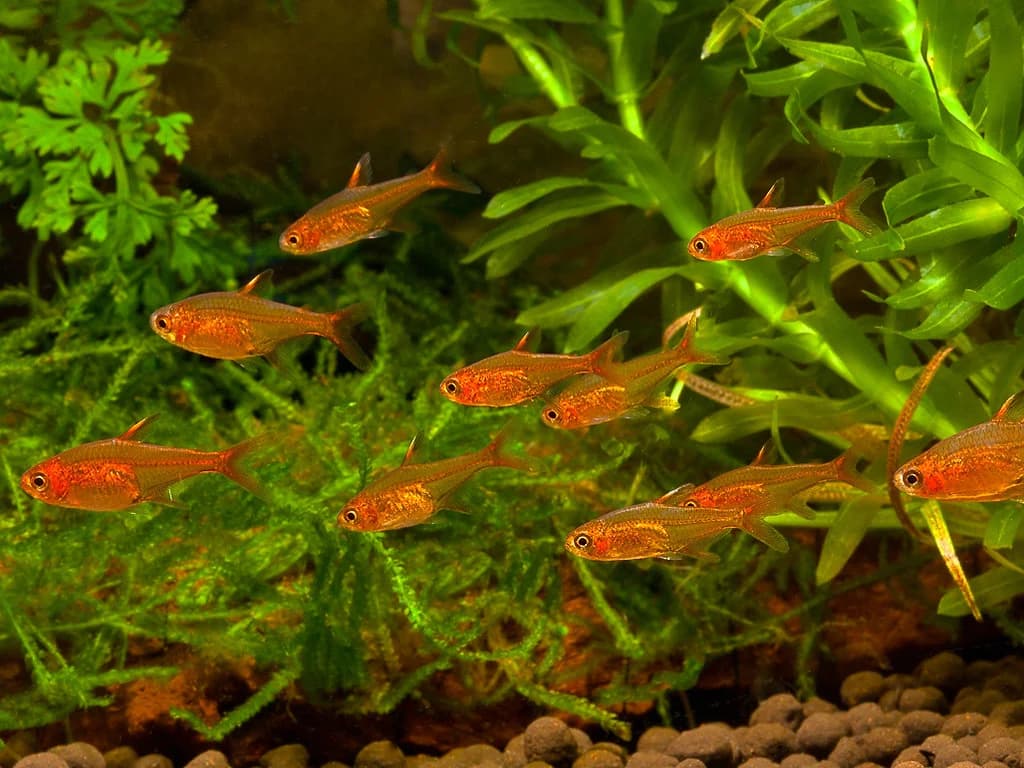
Hyphessobrycon amandae, the ember tetra, is one of the most popular nano aquarium fish available. Their vivid orange-to-red coloration, tiny adult size of under one inch, and peaceful temperament make them perfect for small planted tanks and nano biotope setups. A dense school of ember tetras moving through a heavily planted aquascape is one of the most visually striking displays a small tank can produce.
Native to the Araguaia River basin in Brazil, ember tetras inhabit slow-moving, heavily vegetated blackwater rivers with soft, acidic water stained dark with tannins. They are found in dense aquatic vegetation near the surface and in mid-water.
Their care is easy, making them one of the most recommended starter fish for planted tanks. They are undemanding about food, peaceful with all tank mates, and their small size and bioload make them ideal for tanks as small as 5-10 gallons.
Basic Overview
Common Misconceptions
"A school of 6 is sufficient." Ember tetras display their best behavior and most vibrant coloration in groups of 10 or more. In smaller groups they are shyer and less active. A school of 15-20 in a densely planted 10-gallon tank is the classic showcase setup.
"They need a large tank." Ember tetras are one of the few fish genuinely suited to nano tanks of 5-10 gallons. Their tiny bioload and small size mean a 10-gallon heavily planted tank can comfortably house 15-20 individuals with proper filtration.
"Bright lighting is fine." While ember tetras tolerate a range of lighting, their natural habitat is heavily shaded blackwater. Floating plants, dense mid-ground planting, and areas of shadow make them bolder and more active.
"Any water is fine for easy fish." While ember tetras are hardy compared to many nano fish, they come from soft, slightly acidic water and do not thrive long-term in very hard, alkaline tap water. Soft to moderately hard water between pH 6.0 and 7.5 is optimal.
Recommended Setup
- 5-10+ gallon tank for a school of 10-20
- Dense planted setup: carpeting plants, mid-ground stems, floating plants
- Dark substrate (dark sand or soil) enhances color contrast
- Gentle filtration only; ember tetras cannot handle strong current
- Soft, diffused lighting or heavy plant cover for shade
- Indian almond leaves or driftwood to add tannins and replicate blackwater
- Tight-fitting lid; ember tetras can jump through very small gaps
Diet
Ember tetras are micro-predators that accept a wide range of small foods:
- High-quality micro pellets or nano flake (crushed small if needed)
- Frozen baby brine shrimp (highly preferred)
- Frozen micro worms or grindal worms
- Daphnia (small enough for their tiny mouths)
- Infusoria or micro foods for fry
Feed twice daily in small amounts. Ember tetras have tiny mouths and cannot eat standard-sized flake or pellets without the food being crushed first. Micro pellets designed for nano fish are ideal. Their small size means even a tiny amount of food goes a long way.
Personality
Ember tetras are sociable, active mid-water fish that spend most of their time in loose schools moving through the planted tank. Their vivid orange-red coloration is most intense in males displaying to each other or to females, and under warm-spectrum lighting against a dark substrate.
They are completely peaceful with all similarly sized or smaller tank mates. They coexist perfectly with dwarf shrimp, including tiny neocaridina and caridina shrimp, and will not harm shrimp of any size. This makes them ideal companions for shrimp-focused planted tanks.
A group of ember tetras develops comfortable familiarity with their environment quickly. They investigate new additions to the tank, approach feeding spots predictably, and develop recognizable patterns of movement through their planted space.
Nano Tank Planted Setup
The classic ember tetra setup is a Walstad-style or aquasoil-based nano planted tank of 5-10 gallons. Dense carpeting plants (Monte Carlo, dwarf hairgrass), floating plants (frogbit, salvinia), and mid-ground stems create a lush, shaded environment that perfectly replicates their natural habitat.
Indian almond leaves release tannins that lightly stain the water amber, lowering pH slightly and replicating blackwater chemistry. This is not strictly necessary but enhances color and comfort. The antibacterial properties of tannins also support fish immune function.
A school of 15-20 ember tetras in a 10-gallon heavily planted tank under warm lighting is one of the most striking nano displays in the hobby. The combination of tiny vivid fish, rich green plants, and warm amber water is frequently featured in aquascaping photography.
Water Parameters
Ember tetras come from the soft, warm, slightly acidic blackwaters of the Brazilian Cerrado:
- pH: 5.5-7.5 (optimal 6.0-7.0)
- Hardness (gH): 1-12 dGH (prefer soft water)
- Temperature: 73-84 degrees F
- Ammonia and Nitrite: 0 ppm
- Nitrate: below 20 ppm
Here are some top tips to deal with unwanted parameters:
- Soft water between pH 6.0-7.0 produces the most vibrant coloration. In very hard alkaline tap water, consider mixing with RO water to soften.
- Gentle filtration with minimal current is important. A sponge filter or low-flow hang-on-back filter is ideal. Strong flow stresses tiny fish.
- Weekly small water changes (15-20%) maintain stable parameters. In a nano planted tank, large water changes can disturb the biological balance.
- Avoid medications containing copper or salt in ember tetra tanks. Their small size makes them more sensitive to chemical treatments than larger fish.