Columbian Tetra Care Guide
A Complete Care Guide for Hyphessobrycon columbianus
Introduction
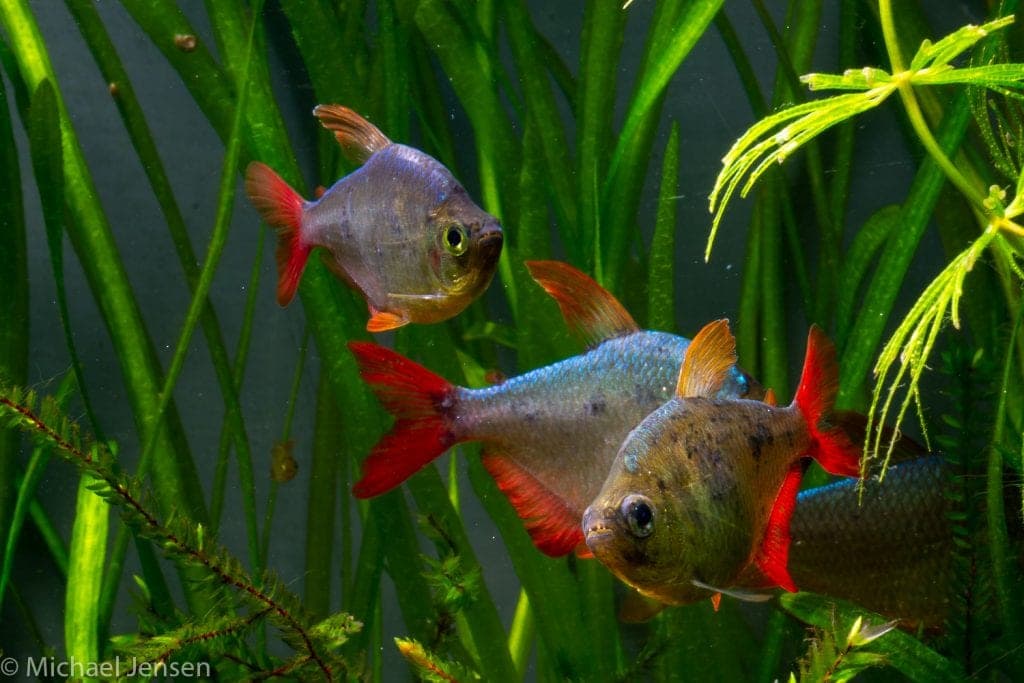
Hyphessobrycon columbianus, the Columbian tetra (also called the red and blue Columbian tetra), is a striking large tetra from Colombia notable for the combination of vivid red fins against a silver-blue iridescent body. Their size (2.5 inches) and bold, active personality make them a standout schooling fish in medium to large planted tanks.
Native to the Rio Acandi drainage in Colombia, Columbian tetras inhabit fast-flowing rivers with clear, slightly soft water. They are adaptable fish that tolerate a range of conditions in captivity.
Columbian tetras are easy to care for and suitable for intermediate aquarists. Their size and slightly nippy temperament make them unsuitable for nano tanks or tanks with slow, long-finned fish, but in appropriate setups they are spectacular schooling fish.
Basic Overview
Common Misconceptions
"They are safe with all fish." Columbian tetras are moderately nippy, particularly toward long-finned or slow-moving fish. They should not be kept with bettas, angels with long fins, or delicate nano fish.
"They are typical tetras in size." At 2.5 inches, Columbian tetras are significantly larger than neon or cardinal tetras. They require more space and can be physically imposing toward very small fish.
"A school of 4 is fine." Groups of 8 or more significantly reduce nipping and show the most striking schooling behavior. Small groups are bolder and more likely to harass tank mates.
Recommended Setup
- 30+ gallon tank for a school of 6-8
- Open swimming space with planted areas
- Moderate to strong flow
- Good filtration
- Dark substrate to enhance the color contrast
Diet
Columbian tetras are omnivores that readily accept most community foods:
- High-quality flake or pellets
- Frozen bloodworms
- Frozen brine shrimp
- Frozen daphnia
Feed twice daily. Columbian tetras are enthusiastic, competitive feeders. A varied diet including occasional frozen or live foods maintains the most vivid red fin coloration.
Personality
Columbian tetras are bold, assertive schooling fish with more confidence than many tetra species. A school of 8 or more moving through a planted tank, with the red fins flashing and the blue-silver bodies catching the light, is a genuinely dramatic display.
Males display to each other with fin-spreading and circling, intensifying the vivid red coloration. Their active social life within the school is engaging to observe.
With appropriate tank mates (robust, similarly active fish), Columbian tetras are excellent community inhabitants that add energy and visual impact to medium to large planted tanks.
Water Parameters
Columbian tetras come from the fast-flowing rivers of Colombia:
- pH: 6.0-7.5
- Hardness (gH): 5-15 dGH
- Temperature: 72-79 degrees F
- Ammonia and Nitrite: 0 ppm
- Nitrate: below 20 ppm
Here are some top tips to deal with unwanted parameters:
- Standard community tank parameters are adequate. They are adaptable fish.
- Good flow and oxygenation are beneficial.
- Weekly 25% water changes maintain good conditions.
- Slightly cooler than typical tropical temperatures (72-76 degrees F) produces the best coloration.