Buenos Aires Tetra Care Guide
A Complete Care Guide for Hyphessobrycon anisitsi
Introduction
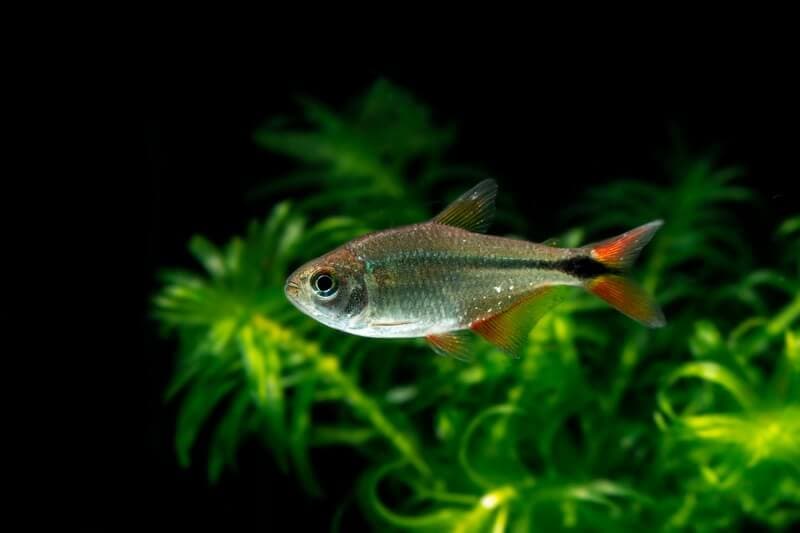
Hyphessobrycon anisitsi, the Buenos Aires tetra, is a robust, active, and strikingly colored tetra from the La Plata River system in Argentina, Paraguay, and southern Brazil. Their silver body with vivid red fins and a black spot at the base of the tail make them visually dramatic, and their cool-water tolerance, active nature, and hardiness make them one of the toughest small tetras available.
Native to the cooler rivers and streams of southern South America, Buenos Aires tetras are adapted to lower temperatures than most tropical tetras. At 65-77 degrees F they thrive; in warmer tropical tanks they become lethargic and short-lived. This cool-water tolerance makes them compatible with goldfish, white cloud mountain minnows, and other cool-water species.
They are also well known for their vigorous plant eating. Buenos Aires tetras will systematically consume most soft-leaved aquarium plants, making them incompatible with planted setups. They are best kept in tanks decorated with hardy, tough plants or in biotope setups with driftwood and rocks.
Basic Overview
Common Misconceptions
"They are compatible with planted tanks." Buenos Aires tetras eat soft-leaved plants systematically. Java fern, anubias, and Amazon swords may survive but most stem plants and crypts will be consumed. They are best in non-planted or minimally planted setups.
"They are tropical fish that need warm water." Buenos Aires tetras are cool-water fish from temperate South America. Keeping them at 78 degrees F+ shortens their lifespan significantly. They thrive at 68-74 degrees F.
"Their fin-nipping reputation makes them problem fish." In a proper school of 8 or more at appropriate temperatures, Buenos Aires tetras are substantially less prone to fin-nipping. Small groups and warm water both increase aggression. A properly schooled group in cool water is a different fish.
"Any tetra companion works with them." They can outcompete and occasionally nip slow-moving long-finned companions. Match them with active, robust cool-water species rather than delicate bettas or slow-moving long-finned fish.
Recommended Setup
- 30+ gallon tank for a school of 8-10
- Fine gravel or sand substrate
- Driftwood, rocks, and caves for decoration (no soft-leaved plants)
- Hardy plants if desired: Java fern attached to driftwood, anubias on rocks (may survive)
- Strong filtration with good flow; active fish produce significant waste
- Good oxygenation with surface agitation
- A secure lid; active jumpers when startled
Diet
Buenos Aires tetras are omnivores with a notable appetite for plant matter. They accept essentially any aquarium food:
- High-quality tropical flakes or small pellets as a staple
- Frozen bloodworms and brine shrimp
- Blanched vegetables: spinach, lettuce, zucchini (satisfies plant-eating tendency)
- Freeze-dried tubifex and krill
- Live foods for enrichment: baby brine shrimp, blackworms
Feed once or twice daily. Providing vegetable matter in the diet may slightly reduce plant predation, though it will not eliminate it. They are enthusiastic, fast feeders that compete aggressively for food at the surface.
Personality
Buenos Aires tetras are bold, energetic, and active fish that fill a tank with movement. In a proper school they are constantly in motion, their red fins flashing as they turn. They are significantly more active and assertive than most tetras.
Their boldness means they adapt quickly to new environments and are rarely shy or hidden. Within hours of introduction, a school of Buenos Aires tetras is typically swimming openly and investigating their tank without reserve.
They are a good choice for keepers who want an active, visually dramatic school in a cool-water setup without the complexity of a tropical planted tank. Their robustness and resilience make them forgiving of minor water quality variations that would affect more delicate species.
Cool-Water Community Pairings
Buenos Aires tetras pair naturally with other cool-water South American species. Rosy barbs are a particularly good match: similar size, similar temperature range, similar activity level, and the red tones complement each other. Peppered corydoras on the bottom complete a natural-looking cool-water South American community.
In a 55-gallon cool-water setup: a school of 10 Buenos Aires tetras in the middle, 8-10 rosy barbs as a second large school, and 8 peppered corydoras on the bottom creates a dynamic, active display that requires no heater in most temperate homes.
Avoid keeping them with long-finned, slow, or warm-water fish. Angelfish, bettas, guppies, and other fish that need 78 degrees F+ are incompatible both in temperature requirements and temperament.
Water Parameters
Buenos Aires tetras come from the cooler rivers of southern South America and are very adaptable:
- pH: 6.0-8.0 (very adaptable)
- Hardness (gH): 5-20 dGH (very adaptable)
- Temperature: 65-77 degrees F
- Ammonia and Nitrite: 0 ppm
- Nitrate: below 20 ppm
Here are some top tips to deal with unwanted parameters:
- Standard tap water in most areas is perfectly suitable for Buenos Aires tetras without modification. They are among the most water-chemistry-tolerant tetras available.
- Keep temperature below 77 degrees F consistently. At 78 degrees F+ they lose color, become lethargic, and their lifespan is meaningfully shortened. In most temperate homes, room temperature without a heater is ideal.
- Weekly 25% water changes maintain good water quality. Their robustness means minor lapses are tolerated, but consistent maintenance produces the best color and health.
- Good oxygenation and surface agitation suit this active, cool-water species. A spray bar or powerhead benefits both water quality and their activity level.