Texas Cichlid Care Guide
A Complete Care Guide for Herichthys cyanoguttatus
Introduction
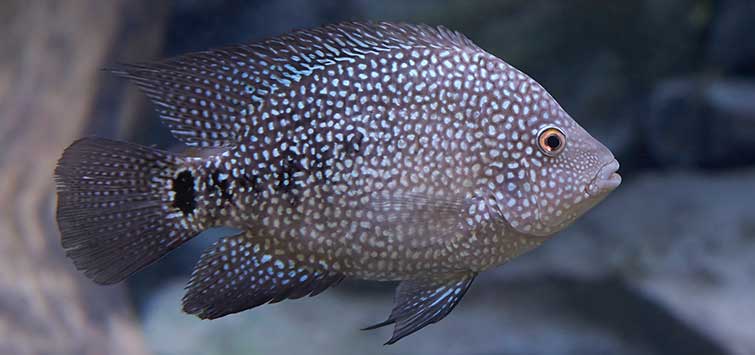
Herichthys cyanoguttatus, the Texas cichlid, is the only cichlid native to the United States, found naturally in the Rio Grande and surrounding drainages in Texas and northern Mexico. Their distinctive pattern of iridescent blue-green spots on a pearlescent grey body, combined with their impressive adult size and bold personality, have made them popular among large cichlid enthusiasts.
Texas cichlids inhabit the warm, slightly alkaline rivers and streams of Texas and Mexico, where they are territorial substrate-spawners that defend large territories. They are adaptable fish that thrive in the relatively hard, alkaline conditions of Texas tap water.
Texas cichlid care is intermediate in difficulty. Their adult size of 10-12 inches, significant aggression (particularly during spawning), and the large tanks required place them in the realm of experienced fishkeepers. Their impressive appearance and personable nature reward the commitment.
Basic Overview
Common Misconceptions
"They are tropical fish." Texas cichlids come from the Rio Grande, which cools significantly in winter. They prefer cooler conditions (68-75 degrees F) than most tropical fish. Keeping them at 78-82 degrees F persistently shortens their lifespan.
"They need the same care as South American cichlids." Texas cichlids are North American cichlids adapted to harder, more alkaline water than Amazon species. They actually prefer the hard alkaline tap water that many South American cichlid keepers try to soften.
"Community tanks are possible with proper management." Texas cichlids are highly aggressive, especially during spawning cycles. In all but very large tanks with robust, equally-matched tank mates, they are best kept alone or as a bonded pair without other tank inhabitants.
"They need warm water to be active." Texas cichlids are active and healthy at cooler temperatures. They are one of the more cold-tolerant cichlids available.
Recommended Setup
- 75+ gallon tank for a single adult
- Heavy filtration: they dig constantly and are messy
- Weighted decor: large smooth rocks and driftwood (they rearrange everything)
- Sand or fine gravel substrate (deep enough for digging)
- No live plants (they will be destroyed)
- Strong, consistent water flow
- Secure lid
Diet
Texas cichlids are omnivores that accept most cichlid foods readily:
- Large cichlid pellets as a primary staple
- Frozen krill and large brine shrimp
- Frozen bloodworms
- Blanched vegetables: peas, zucchini, spinach
- Large earthworms for enrichment
Feed once or twice daily. Texas cichlids are enthusiastic, aggressive eaters. Include plant matter to support digestive health and prevent the constipation that can affect large carnivorous cichlids fed exclusively meaty foods.
Personality
Texas cichlids are bold, intelligent fish with the strong keeper-recognition characteristic of large cichlids. They approach the glass when their owner is present, become familiar with feeding routines, and interact actively with their environment.
Their digging behavior is prolific: Texas cichlids will rearrange substrate and decor extensively and repeatedly. Any tank decoration must be able to survive being nudged, repositioned, or buried. This landscaping behavior is natural and fascinating.
A well-kept Texas cichlid in a large tank is an impressive display fish. Their iridescent blue-green spotting intensifies under good lighting and when the fish is in breeding condition, creating a spectacular visual effect.
Water Parameters
Texas cichlids come from the relatively cool, hard, alkaline Rio Grande system:
- pH: 7.0-8.0
- Hardness (gH): 10-25 dGH (hard water is fine)
- Temperature: 68-75 degrees F
- Ammonia and Nitrite: 0 ppm
- Nitrate: below 20 ppm
Here are some top tips to deal with unwanted parameters:
- Texas cichlids actually prefer hard, alkaline tap water. In hard-water areas, no water chemistry modification is needed.
- Cool temperatures (68-75 degrees F) are important for longevity. This is one of the most commonly overlooked aspects of Texas cichlid care.
- Heavy filtration and regular 30-40% weekly water changes manage the waste production of a large cichlid. Large tanks with powerful filtration are the standard.
- Their hard-water preference means no RO water softening is needed. Texas tap water is often ideal without modification.