Blood Parrot Cichlid Care Guide
A Complete Care Guide for Blood Parrot Cichlids (Hybrid)
Introduction
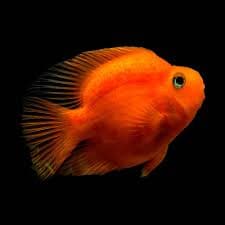
The blood parrot cichlid is a hybrid cichlid created by crossing midas cichlids (Amphilophus citrinellus) and redhead cichlids (Paraneetroplus synspilum) in Taiwan in the 1980s. Their distinctive rounded body, beak-like upturned mouth, and vivid orange-red coloration have made them widely popular despite ongoing debate in the hobby about the ethics of producing intentionally deformed hybrids.
Blood parrots are intermediate to large cichlids reaching 7-8 inches. Their deformed mouth limits their ability to bite aggressively, making them significantly less dangerous to tank mates than most cichlids of comparable size. They are often described as the most personable large cichlid for community setups.
Their care is straightforward. They thrive in neutral to slightly alkaline water, accept a wide range of foods, and are hardy once established. Their main requirement is space and appropriate tank mates that will not exploit the limited mobility of their unusual mouth.
Basic Overview
Common Misconceptions
"Their mouth deformity means they cannot eat properly." Blood parrots can eat effectively despite their unusual mouth shape. They adapt to pellets, frozen foods, and most sinking foods. Their mouth prevents powerful biting but does not prevent normal feeding.
"Dyed blood parrots are a natural color variant." Blood parrots sold as "jellybean" or in vivid purple, blue, or pink colors have been injected with dye, a cruel practice that fades over time and stresses the fish. Natural blood parrots are orange-red to yellow. Avoid purchasing dyed specimens.
"They can be kept with small fish." Blood parrots may not bite effectively, but they are still cichlids that will chase and stress small fish, particularly during spawning. Tank mates should be robust and at least 3-4 inches.
"They are sterile." Males are generally infertile. Females can produce viable eggs if paired with a fertile cichlid male, but most blood parrot pairings do not produce viable offspring.
Recommended Setup
- 55+ gallon for a single adult; 75+ gallons for a pair
- Fine gravel or sand substrate
- Caves and hiding spots: clay pots, PVC caves, rock formations
- Moderate planting; they may dig but rarely destroy established plants
- Good filtration; cichlids produce significant waste
- Moderate flow with good surface agitation
- Open swimming space balanced with territorial division via decor
Diet
Blood parrots are omnivores that accept most aquarium foods. Their rounded mouth works best with smaller particle sizes:
- High-quality cichlid pellets (small to medium size preferred)
- Frozen bloodworms and brine shrimp
- Blanched vegetables: peas, zucchini, spinach
- Color-enhancing foods with astaxanthin (maintains vivid orange coloration)
- Freeze-dried krill and tubifex
Feed once or twice daily. Smaller pellets suit their mouth shape better than large cichlid pellets. Carotenoid-rich foods maintain the vivid orange-red coloration; without them, color gradually fades to pale yellow over months.
Personality
Blood parrots are enthusiastic, curious, and interactive cichlids that quickly recognise their keeper and approach the glass eagerly at feeding time. Their expressive body language, waggling and hovering in place when excited, is endearing and distinctive.
They are less aggressive than most cichlids their size, largely because the deformed mouth limits their ability to inflict damage. This makes them more suitable for mixed cichlid community tanks than typical Central American cichlids, though they will still chase and spar.
During spawning attempts, blood parrots become more territorial and protective. Even if eggs are infertile, both parents will guard the spawn site vigorously. This phase is temporary and behavior returns to normal once the eggs are abandoned.
Suitable Tank Mates
Blood parrots occupy a useful middle ground in the cichlid world: large enough not to be eaten by most medium cichlids, but without the devastating bite of convicts, firemouths, or other aggressive Central Americans. This opens up community options unavailable with more aggressive species.
Good companions include: severums, festivums, giant danios as dither fish, larger tetras (Buenos Aires, Colombian), peaceful barbs (tinfoil barbs), and similarly sized non-aggressive cichlids. Avoid pairing with highly aggressive cichlids like red devils, jack dempseys, or flowerhorns.
In a community with fast, robust non-cichlid fish, blood parrots often thrive. The key is avoiding fish small enough to be bullied and fish aggressive enough to exploit the parrot's limited bite.
Water Parameters
Blood parrots are adaptable to a range of conditions inherited from their parent species:
- pH: 6.5-8.0
- Hardness (gH): 8-20 dGH
- Temperature: 76-84 degrees F
- Ammonia and Nitrite: 0 ppm
- Nitrate: below 20 ppm
Here are some top tips to deal with unwanted parameters:
- Standard neutral to slightly alkaline tap water suits blood parrots well in most areas. No special water treatment is needed.
- Weekly 25-30% water changes are important. Cichlids produce significant waste and nitrate builds quickly without consistent changes.
- Temperature stability is more important than specific values. Fluctuations above 4-5 degrees F trigger immune suppression and increase disease susceptibility.
- Avoid copper-based medications unless specifically needed; monitor dosing carefully as cichlids can be sensitive at high copper concentrations.