Flowerhorn Cichlid Care Guide
A Complete Care Guide for Flowerhorn Cichlids (Hybrid)
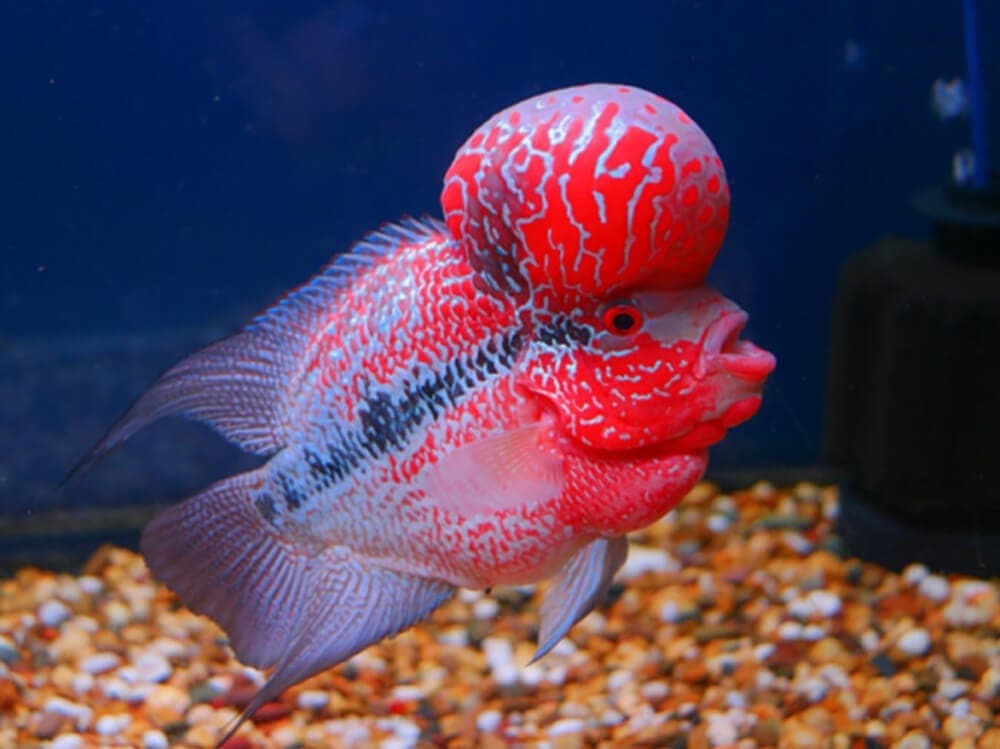
Introduction
Flowerhorn cichlids are a group of hybrid cichlids developed in Malaysia and Taiwan in the 1990s and 2000s through selective breeding of several Central and South American cichlid species. They are known for their extraordinary nuclear colors (brilliant red, orange, and pink with black patterning), their dramatic kok (the nuchal hump on the forehead), and their exceptional intelligence and interactivity.
No wild population of flowerhorns exists; they are entirely a product of captive breeding. Several lines have been developed, including Kamfa, Zhen Zhu, Golden Monkey, and King Kamfa, each with distinct features in head shape, color, and kok development. Despite their hybrid origins, they are widely considered among the most personable fish in the hobby.
Flowerhorns are large (10-16 inches), aggressive, and territorial cichlids that almost always require a species-only tank. Their care is demanding in terms of tank size, filtration, and water quality management, but keepers who invest in appropriate conditions are rewarded with an extraordinarily interactive, almost dog-like fish.
Basic Overview
Common Misconceptions
"They can go in a community tank." Adult flowerhorns are highly aggressive and will attack, injure, or kill virtually any tank mate. Juveniles may temporarily coexist with robust cichlids, but adults require a species-only setup in almost all cases.
"A 40-gallon tank is fine for one." Flowerhorns grow to 10-16 inches and are extremely active. A 75-gallon tank is the genuine minimum for a single adult; 125 gallons is better for a large specimen and makes water quality management significantly easier.
"The kok is a sign of illness." The kok (nuchal hump) is a natural and desirable feature of flowerhorns. Its size and prominence is partly genetic and partly influenced by diet and environment. A large, firm kok is a sign of good health in the hobby.
"They are easy because they are hardy." Flowerhorns are hardy for cichlids but produce significant waste in a large body requiring pristine water quality and robust filtration to prevent the infections and HITH (Hole-in-the-Head disease) they are prone to.
Recommended Setup
- 75+ gallon bare-bottom or fine gravel tank for a single adult
- Bare-bottom is popular: easier to clean, no substrate for waste to settle in
- Minimal decoration: flowerhorns rearrange and destroy most decor
- Robust filtration: canister filter rated for 2-3 times the tank volume
- Strong water flow and excellent surface agitation for oxygenation
- Reliable heater maintaining 80-86 degrees F; use a heater guard to prevent burns
- No plants; flowerhorns uproot and destroy live plants immediately
Diet
Flowerhorns are carnivore-leaning omnivores with strong appetites. Diet quality directly affects kok development and color:
- High-quality cichlid pellets formulated for large cichlids as a staple
- Color-enhancing pellets containing astaxanthin and carotenoids
- Frozen bloodworms, shrimp, and krill
- Live or frozen earthworms (excellent for kok development)
- Freeze-dried krill and ocean plankton
Feed once or twice daily with measured amounts. Flowerhorns are voracious and will always appear hungry; overfeeding causes obesity and rapid water quality decline. Remove uneaten food promptly. High-quality color-enhancing foods noticeably improve the red and orange coloration over time.
Personality
Flowerhorns are the most interactive and personable fish in the freshwater hobby by a significant margin. They recognize their keeper immediately and track movement with evident attention. They approach the glass eagerly when their keeper enters the room, accept hand feeding, and display behaviors that closely parallel those of intelligent vertebrate pets.
They are playful in their own cichlid way, pushing around decorations, rearranging substrate, glass-surfing when they want attention or food, and head-butting the glass in greeting. Many keepers describe the relationship with a flowerhorn as more like keeping a pet than keeping a fish.
Their aggression is directed entirely toward other fish; toward their keeper they are bold, curious, and demonstratively social. A single well-kept flowerhorn in a clean, well-maintained tank is one of the most rewarding animals in the hobby.
Preventing Hole-in-the-Head Disease
Hole-in-the-Head (HITH) disease is the most common serious health issue in flowerhorns and cichlids generally. It presents as pitting or crater-like lesions on the head and along the lateral line. The causes are multifactorial but poor water quality and activated carbon use are the two most strongly associated factors.
Prevention: maintain excellent water quality with frequent water changes (30-40% weekly for flowerhorns given their waste output), avoid activated carbon as a permanent filter media, and ensure a varied, high-quality diet with adequate vitamins.
Early HITH can be treated with large, frequent water changes and metronidazole. Advanced cases may leave permanent scarring even after successful treatment. Prevention through water quality management is far more effective than treatment.
Water Parameters
Flowerhorns are hybrid cichlids descended from Central American species and are relatively adaptable:
- pH: 7.0-8.0
- Hardness (gH): 8-20 dGH
- Temperature: 80-86 degrees F
- Ammonia and Nitrite: 0 ppm
- Nitrate: below 20 ppm (critical; flowerhorns produce enormous waste)
Here are some top tips to deal with unwanted parameters:
- Water changes must be large and frequent: 30-40% weekly at minimum. Flowerhorns produce massive amounts of waste for a single-fish species tank, and nitrate builds rapidly.
- Robust filtration is essential. A canister filter with biological media rated for 2-3x the tank volume is the baseline. Many serious flowerhorn keepers run dual filtration.
- Never use activated carbon as a permanent filter media with cichlids; it is associated with HITH development. Use ceramic biological media, pumice, and sponge instead.
- Warm, stable water is critical. Flowerhorns are very warm-water fish descended from species from warm Central American climates. Temperatures below 78 degrees F suppress their immune system.