Green Terror Cichlid Care Guide
A Complete Care Guide for Andinoacara rivulatus
Introduction
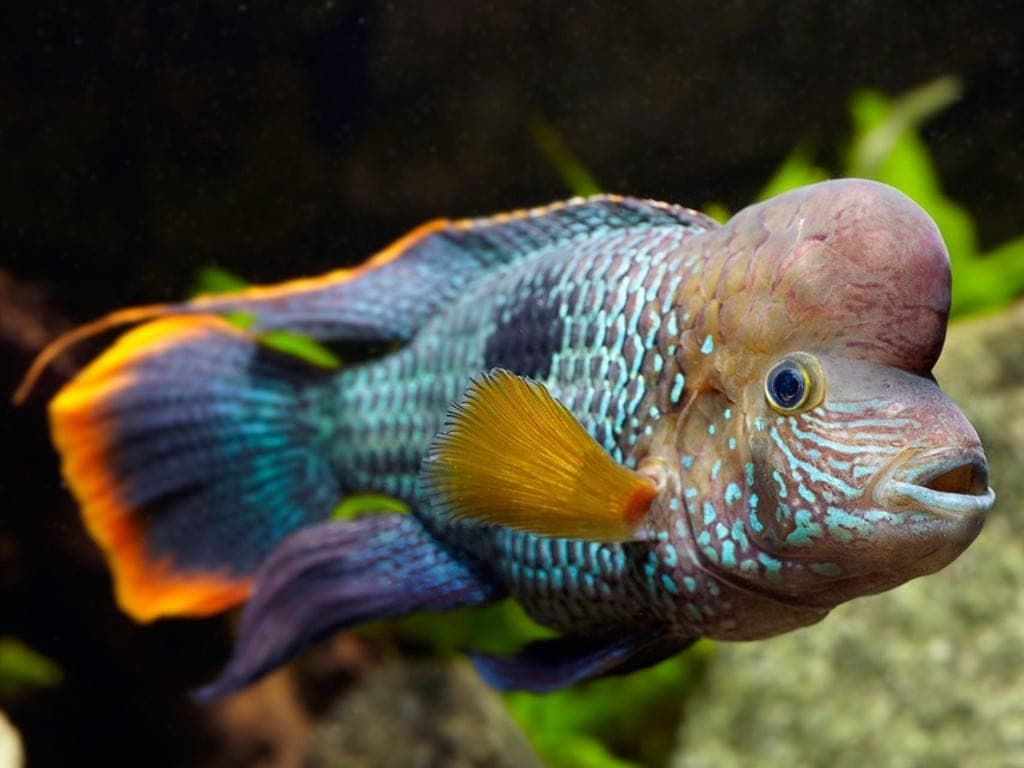
Andinoacara rivulatus, the green terror cichlid, is a spectacular large cichlid from the Pacific coastal rivers of Ecuador and Peru. Males develop an intense emerald-to-turquoise iridescence across their bodies with orange-edged fins and, in large mature specimens, a distinctive nuchal hump on the forehead that adds to their imposing appearance.
Despite the dramatic common name, green terrors are not the most aggressive cichlid available. They are territorial and assertive, particularly during breeding, but they can be maintained in large community setups with appropriate companions. The name reflects their impressive size and physical dominance rather than unstoppable aggression.
Green terrors are a commitment: they grow to 8–12 inches, live 7–10 years, and need large, strongly filtered tanks. For the keeper who provides appropriate conditions, they are among the most visually stunning cichlids in the freshwater hobby.
Basic Overview
Common Misconceptions
"Green terrors need tropical temperatures." Green terrors come from Pacific coastal rivers in Ecuador and Peru at moderate elevations. They prefer cooler water (68–75°F) than most tropical cichlids and can be stressed by consistently warm 80°F+ temperatures.
"They cannot be kept with other fish." In a large enough tank with appropriate companions, green terrors can be kept in cichlid community setups. Their aggression is primarily toward their own species and other similarly sized cichlids competing for territory.
"Green terrors and blue acara are the same fish." They are close relatives but different species. Blue acaras (Andinoacara pulcher) are smaller, more peaceful, and more suitable for community tanks. Green terrors are larger and more assertive.
"The hump is only on captive-bred specimens." The nuchal hump is a natural secondary sex characteristic that develops in mature wild and captive-bred males. It indicates a mature, dominant male in good condition and is not a sign of illness.
Recommended Setup
- 75+ gallon tank for a pair; 120+ gallons for a cichlid community
- Fine gravel or coarse sand substrate; they dig extensively during breeding
- Large rocks and driftwood creating territories and visual barriers
- No live plants unless very large and anchored; they dig and uproot plants during breeding
- Strong canister filtration with high flow capacity
- Good surface agitation and oxygenation
- A cooler tank temperature than most tropicals: 70–75°F is ideal
Diet
Green terrors are predatory omnivores that eat fish, invertebrates, and plant matter in the wild. In the aquarium:
- Large cichlid pellets and sticks as a primary staple
- Frozen krill, mysis shrimp, and silversides
- Frozen bloodworms and large brine shrimp
- Occasional live foods for enrichment: earthworms, feeder shrimp
- Blanched vegetables as a supplemental plant matter component
Feed once daily. Green terrors are powerful fish that eat large amounts; this produces significant waste and requires strong filtration and regular water changes. Remove uneaten food promptly.
Personality
Green terror cichlids are intelligent, curious fish with strong personalities that develop over time. They recognize their keeper and show interest in activity outside the tank. Established, comfortable green terrors are often bold and interactive rather than reclusive.
The male's display behavior is impressive: full coloration extends through the iridescent scales in waves, the nuchal hump becomes more prominent, and the fins are fully erect during territory defense and courtship. A displaying male green terror is one of the most visually stunning sights in the freshwater hobby.
During breeding, both parents are intensely focused on their eggs and fry. The pair cooperates to defend the spawning site against all tank mates, and their coordination and commitment to parental care is remarkable to observe.
Tank Mates
Choosing tank mates for green terrors requires selecting fish large enough to not be eaten and robust enough to handle territorial assertion. In large tanks (120+ gallons), jack dempsey cichlids, severum cichlids, large plecos, and robust catfish species can coexist.
Green terrors are most aggressive toward other green terrors and similar-sized Andinoacara species. Two males in the same tank will fight persistently in all but the very largest aquariums.
A bonded male-female pair in a 75-gallon tank with a large pleco is often the most peaceful and successful green terror setup. The pair bond reduces inter-species aggression by giving the male a focus and outlet for his territorial energy within the established pair relationship.
Water Parameters
Green terrors come from Pacific coastal rivers in Ecuador and Peru, preferring cooler conditions than most tropical cichlids:
- pH: 6.5–8.0 (adaptable)
- Hardness (gH): 5–20 dGH (adaptable)
- Temperature: 68–77°F
- Ammonia and Nitrite: 0 ppm
- Nitrate: below 30 ppm
Here are some top tips to deal with unwanted parameters:
- Keep temperature at the lower end of the tropical range. Green terrors at 75°F are healthier long-term than those maintained at 80°F. In temperate climates, a heater set to 72–75°F may need very little effort to maintain during cooler months.
- Weekly 30–40% water changes are necessary for large cichlids. Invest in a Python siphon or similar water change system to make large-volume changes manageable.
- Strong filtration is non-negotiable for a fish that grows to 12 inches and eats heavily. A canister filter rated for 2–3 times the tank volume provides appropriate biological and mechanical filtration.
- Monitor for hole-in-the-head disease (HLLE), a condition caused by poor water quality and nutritional deficiencies that creates pitting around the head and lateral line. The primary prevention is excellent water quality and a varied, nutritious diet.