Electric Blue Acara Care Guide
A Complete Care Guide for Andinoacara pulcher (Electric Blue variant)
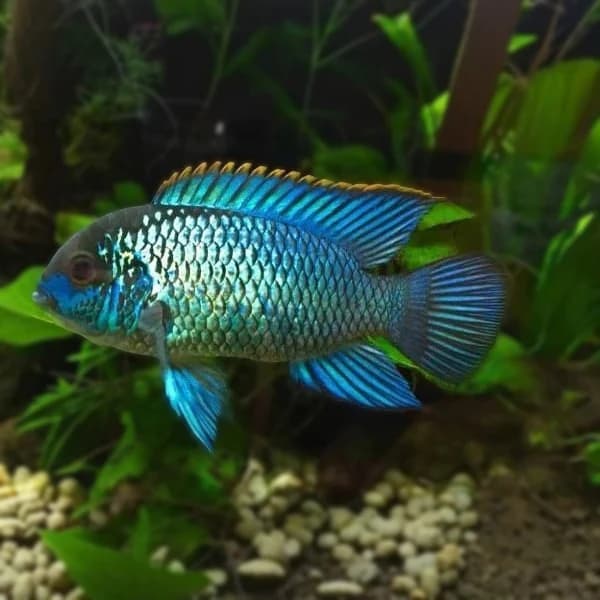
Introduction
The electric blue acara is a selectively bred color form of the blue acara (Andinoacara pulcher) developed in the 2000s, featuring an extraordinary iridescent electric blue coloration that intensifies as the fish matures. They are one of the most visually stunning cichlids available, combining remarkable color with a peaceful enough temperament for community tanks.
Blue acaras are native to Trinidad, Venezuela, and Colombia, inhabiting slow-moving rivers, streams, and standing water with sandy or muddy substrates. The electric blue variant has the same care requirements as the standard blue acara.
Electric blue acaras occupy an exceptional niche: they are genuinely striking cichlids that remain relatively peaceful outside of spawning, reach a manageable 6-7 inches, and can be kept in community tanks with robust, comparably sized fish. They are a top choice for hobbyists who want a visually spectacular cichlid without the challenges of aggressive species.
Basic Overview
Common Misconceptions
"The electric blue color is achieved with dye." The electric blue coloration is entirely natural and genetic, produced through selective breeding. It intensifies naturally with age, good diet, and appropriate conditions. No dye or hormone injection is involved.
"They can be kept with small fish." At 6-7 inches, electric blue acaras will eat small fish that fit in their mouth. Tank mates should be 3+ inches. Nano tetras, small rasboras, and similar fish are at risk.
"They are highly aggressive cichlids." Compared to most South and Central American cichlids of their size, electric blue acaras are relatively peaceful. They will defend their territory during spawning but are not persistent aggressors outside of breeding.
"Standard blue acaras and electric blue acaras are identical." Standard blue acaras have a more subdued blue-green coloration with scale detail. Electric blue acaras have been selectively bred for dramatically increased iridescent blue coverage. Both are the same species but have noticeably different appearances.
Recommended Setup
- 40+ gallon for a bonded pair; 55+ gallons for a pair in a community
- Fine sand substrate; they dig occasionally but are not destructive diggers
- Flat rocks and smooth stones for spawning sites
- Caves and driftwood for territory establishment and hiding
- Hardy plants: Amazon swords, anubias, Java fern (planted in pots to survive occasional digging)
- Good filtration with moderate flow
- Open swimming space balanced with territory-dividing decor
Diet
Electric blue acaras are omnivores that accept a wide range of foods:
- High-quality cichlid pellets as a staple
- Frozen bloodworms, brine shrimp, and krill
- Blanched vegetables: peas, spinach, zucchini
- Color-enhancing foods with astaxanthin for maximum blue intensity
- Live earthworms for enrichment and breeding conditioning
Feed once or twice daily. Carotenoid-rich foods significantly enhance the electric blue coloration. A varied diet with both protein and plant matter produces the best health and appearance.
Personality
Electric blue acaras are active, curious fish that readily recognise their keeper and approach the front glass with interest. They are more interactive than many cichlids and develop strong pair bonds when kept as a bonded couple.
Their electric blue coloration intensifies dramatically when displaying to each other, to potential mates, or when excited about feeding. Under good lighting, the iridescent blue is extraordinary, with individual scales reflecting different shades as the fish moves.
During spawning, both parents become devoted protectors of eggs and fry. They clean a flat stone, spawn on it, and guard the resulting eggs and fry with intensity. This parental phase lasts 2-3 weeks and is fascinating to observe.
Breeding Electric Blue Acaras
Electric blue acaras breed readily in captivity when provided with a flat rock or slate for spawning. Conditioning with live or frozen foods triggers spawning. The female deposits eggs on the cleaned surface and both parents fan and guard them.
Eggs hatch in 48-72 hours and the parents continue to guard the wrigglers in a pit dug in the substrate. Fry become free-swimming after another 48-72 hours. First foods include newly hatched brine shrimp and microworms.
The parental care of electric blue acaras is one of the most rewarding aspects of keeping them. Both parents coordinate their duties with evident purpose, and watching them herd a cloud of free-swimming fry is one of the classic cichlid-keeping experiences.
Water Parameters
Electric blue acaras are adaptable to a range of conditions, reflecting their widespread natural distribution:
- pH: 6.5-7.5
- Hardness (gH): 5-15 dGH
- Temperature: 72-82 degrees F
- Ammonia and Nitrite: 0 ppm
- Nitrate: below 20 ppm
Here are some top tips to deal with unwanted parameters:
- Standard neutral tap water suits electric blue acaras well in most areas. They are more water-chemistry-tolerant than many South American cichlids.
- Weekly 25-30% water changes maintain the water quality important for both health and coloration. Clean, clear water enhances the visual impact of the electric blue.
- Temperature stability around 76-79 degrees F is optimal. They tolerate a wide range but do best in stable conditions in the mid-range.
- Good filtration is important. Cichlids produce significant waste and a well-maintained biological filter is the foundation of long-term health.