Blood Jewel Cichlid Care Guide
A Complete Care Guide for Hemichromis lifalili
Introduction
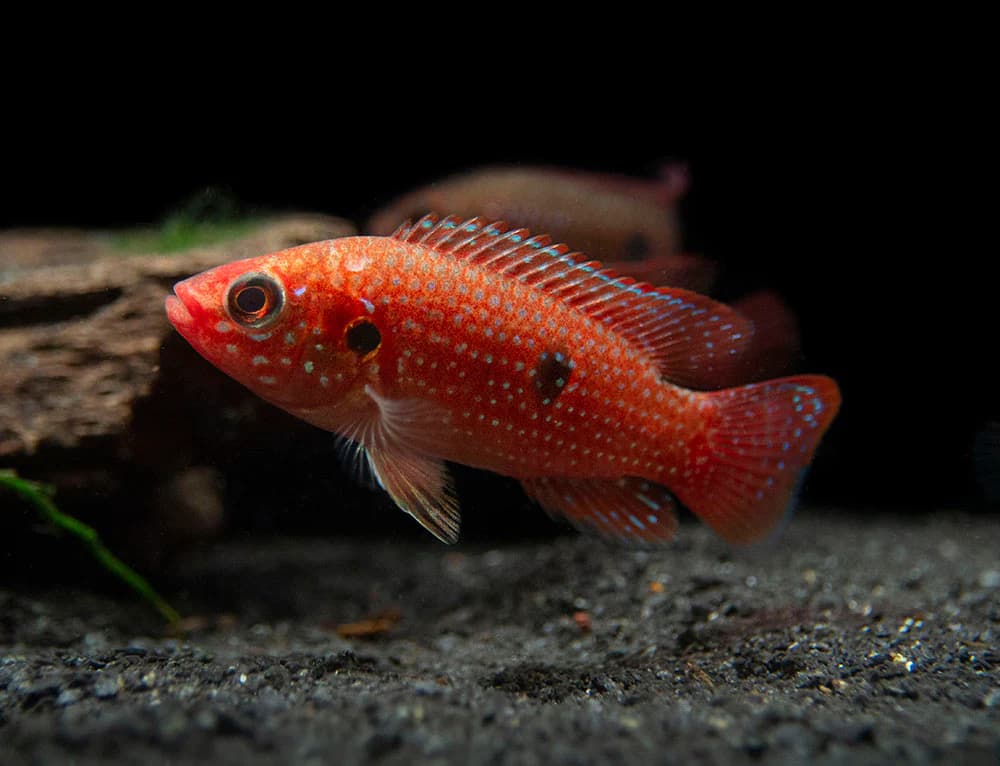
Hemichromis lifalili, the blood jewel cichlid (or lifalili jewel cichlid), is one of the most vividly colored cichlids available. In breeding and dominant condition, their body becomes saturated with intense blood-red coloration accented with iridescent turquoise-blue spots, creating one of the most spectacular color displays in freshwater fish. Even in non-breeding condition, they are strikingly colored fish.
Native to the Congo River basin in Central Africa, blood jewel cichlids inhabit slow-moving rivers and streams with dense vegetation and soft, slightly acidic water. They are a smaller, somewhat more manageable species compared to the more commonly available Hemichromis bimaculatus.
Blood jewel cichlid care is intermediate. Their aggression - particularly during spawning - requires careful tank mate management or species-only keeping. Their extraordinary breeding coloration and devoted parental behavior make them one of the most rewarding cichlids for keepers willing to manage their territorial needs.
Basic Overview
Common Misconceptions
"They can go in a general community." Blood jewel cichlids in spawning condition will attack and kill most community fish. During parental phases, their aggression extends to the entire tank. Plan for either species-only keeping or a large tank with appropriate dither fish.
"The vivid red is present all the time." The most intense blood-red coloration develops during breeding condition and dominance display. Resting fish are still beautifully colored but less intensely red. Spawning coloration is a temporary intensification.
"They are the same as the common jewel cichlid." H. lifalili is a distinct species from H. bimaculatus (common jewel cichlid). H. lifalili is generally considered slightly smaller and somewhat more intensely red-colored in peak condition.
"Small tanks are fine for a single fish." Blood jewel cichlids kept alone in small tanks often develop aggression toward their own reflection or any movement outside the tank. A bonded pair in an appropriately sized tank with sufficient territory channels their energy into each other and their offspring.
Recommended Setup
- 40+ gallon tank for a bonded pair
- Flat stones and slate for spawning surfaces
- Dense planting for line-of-sight breaks
- Sand substrate for natural digging
- Good filtration
- Visual barriers if dither fish are used
Diet
Blood jewel cichlids are omnivores that accept most cichlid foods:
- High-quality cichlid pellets
- Frozen bloodworms
- Frozen brine shrimp
- Blanched vegetables: peas, zucchini
- Live earthworms for breeding conditioning
Feed once or twice daily. Conditioning with live foods before spawning attempts is highly effective. A varied diet maintains the best health and the most vivid coloration outside of active breeding condition.
Personality
Blood jewel cichlids are passionate, devoted fish whose entire life seems organized around their pair bond and the protection of their territory and offspring. In breeding condition, both the male and female transform into saturated crimson fish that are among the most beautiful freshwater fish available.
Their parental behavior is extraordinary: both parents guard eggs on a cleaned flat stone, fan them for oxygenation, move the fry to pits in the substrate, and defend the fry against all threats with total commitment. Observing a pair of blood jewel cichlids in full parental mode is one of the defining cichlid-keeping experiences.
Outside spawning cycles, bonded pairs maintain their territory quietly. They recognize their keeper, approach at feeding time, and become comfortable with regular tank maintenance. Their intelligence and emotional responsiveness to their environment make them deeply engaging long-term fish.
Breeding and Parental Care
Blood jewel cichlids are substrate spawners that form strong pair bonds. A bonded male and female will clean a flat surface (slate, smooth stone, broad plant leaf), spawn on it, and guard the eggs with intense devotion. Both parents are involved in all phases of parental care.
Eggs typically number 200-400 and hatch in 48-72 hours at 78-80 degrees F. The parents move the wrigglers to pre-dug pits in the substrate, continuing to guard and move them as needed. Fry become free-swimming after another 48-72 hours and can be fed crushed fry food or baby brine shrimp.
During the parental phase, the cichlids will attack any tank mate that approaches the fry. In a community tank, this often results in injury or death of tank mates. Species-only keeping or a very large tank with adequate visual separation is the safest approach.
Water Parameters
Blood jewel cichlids come from the warm, soft, slightly acidic Congo River system:
- pH: 6.5-7.5
- Hardness (gH): 5-12 dGH
- Temperature: 72-82 degrees F
- Ammonia and Nitrite: 0 ppm
- Nitrate: below 20 ppm
Here are some top tips to deal with unwanted parameters:
- Slightly soft, slightly acidic water produces the most vivid coloration and supports breeding.
- Weekly 25-30% water changes maintain good conditions. Good water quality intensifies coloration.
- Stable temperature in the 76-80 degree F range is optimal for breeding activity.
- Standard community tank parameters work acceptably; soft acidic water produces peak results.