Salvini Cichlid Care Guide
A Complete Care Guide for Trichromis salvini
Introduction
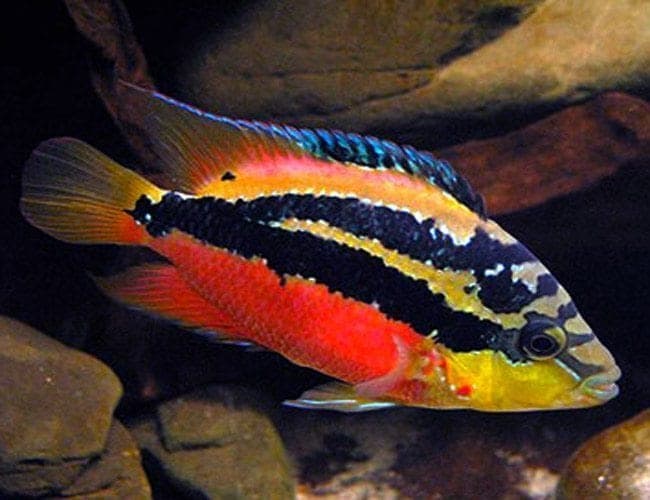
Trichromis salvini, the Salvini cichlid (also called the yellow belly cichlid or tricolor cichlid), is a medium-sized Central American cichlid noted for its vivid yellow and black coloration and considerable aggressive personality. Males develop intensely vivid yellow-green flanks with black lateral spotting; females are particularly striking during spawning with vivid red-orange undersides.
Native to the Atlantic slope rivers of Central America from Mexico through Guatemala and Belize, Salvini cichlids inhabit slow to moderately flowing rivers and lakes with rocky or sandy substrates. They are opportunistic predators and territorial defenders in the wild.
Salvini cichlids are suitable for experienced cichlid keepers. Their aggression - particularly during spawning - is significant and requires careful tank mate selection or dedicated single-species keeping. In appropriate conditions, their striking coloration and active behavior make them rewarding display fish.
Basic Overview
Common Misconceptions
"They are typical mid-sized cichlids." Salvini cichlids are significantly more aggressive than most mid-sized cichlids of comparable size. Their aggression during spawning in particular requires careful planning and large tanks with visual barriers.
"They can be kept in a general community." Salvini cichlids should only be kept with robust, same-sized or larger cichlids. Community fish and small cichlids will be injured or killed.
"Females are calmer than males." Female Salvinis are often more aggressive than males during spawning and fry-guarding phases, with vivid coloration (red belly) signaling high aggression states.
"55 gallons is plenty for a pair long-term." While 55 gallons is the minimum, 75+ gallons with visual barriers provides much better outcomes for a breeding pair. The female needs space to guard the fry while the male has an area away from her aggression.
Recommended Setup
- 55+ gallon tank (75+ preferred for a breeding pair)
- Visual barriers: rock piles, driftwood dividing the tank
- Sandy substrate
- Flat stones or slate for spawning surface
- Robust filtration; cichlids are messy
- Strong water circulation
- No plants unless very robust (java fern on wood may survive)
Diet
Salvini cichlids are omnivores that accept most cichlid foods:
- Large cichlid pellets as a staple
- Frozen bloodworms and krill
- Frozen brine shrimp
- Blanched vegetables: peas, zucchini
- Live earthworms for enrichment
Feed once or twice daily. Salvini cichlids are vigorous, competitive feeders. A varied diet with both protein and plant matter maintains long-term digestive health. During spawning, reduce feeding slightly as parents are focused on guarding rather than eating.
Personality
Outside spawning periods, Salvini cichlids are active, curious, and bold fish that engage with their environment and keeper. They investigate everything in their tank, rearrange substrate and decor freely, and become recognizably familiar with the keeper's presence.
During spawning and fry-guarding, their entire demeanor shifts to intense protective aggression. Both parents coordinate fry guarding, though females lead the defense. The parental behavior of Central American cichlids, including Salvinis, is one of the most fascinating aspects of keeping them.
Their coloration is dynamic and responsive to mood. Males in normal condition are vivid but become even more intensely colored when displaying dominance or courting. Females in breeding condition develop striking red-orange undersides. Color changes are real-time mood indicators.
Water Parameters
Salvini cichlids come from the warm, slightly hard rivers of Central America:
- pH: 6.5-8.0
- Hardness (gH): 8-20 dGH
- Temperature: 74-82 degrees F
- Ammonia and Nitrite: 0 ppm
- Nitrate: below 20 ppm
Here are some top tips to deal with unwanted parameters:
- Salvini cichlids are water-chemistry adaptable. Neutral to moderately alkaline, moderately hard water suits them well and is typical of most tap water.
- Weekly 25-30% water changes are essential in a cichlid tank. Cichlid waste is significant and consistent water changes prevent the nitrate accumulation that causes HLLE and immune suppression.
- Good filtration is essential. Canister filters rated at 5-10x hourly turnover for the tank volume are standard for medium-large cichlid tanks.
- Stable temperatures in the 76-80 degree F range produce optimal health and breeding behavior.