Red Devil Cichlid Care Guide
A Complete Care Guide for Amphilophus labiatus
Introduction
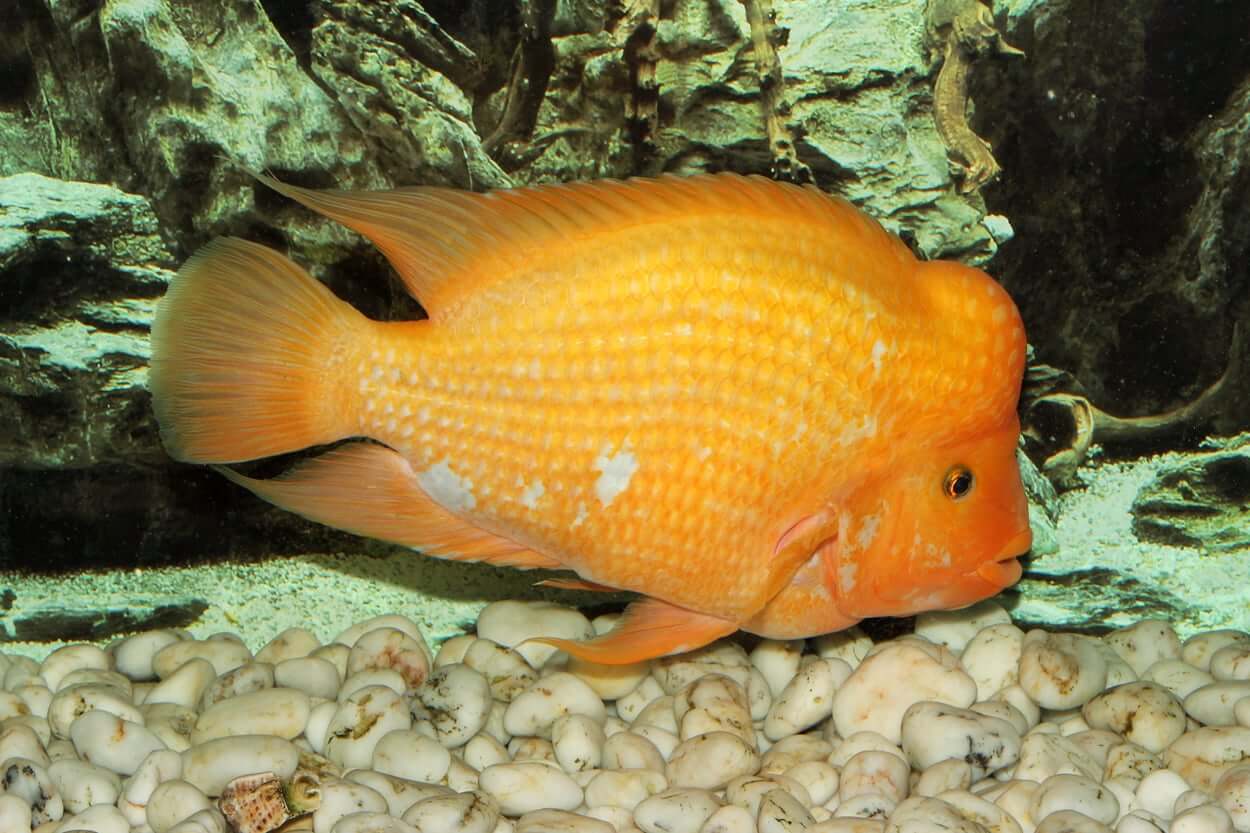
Amphilophus labiatus, the red devil cichlid, is one of the most intensely colored and boldly aggressive large cichlids in the freshwater hobby. Their vivid orange-to-red coloration (though wild fish are often grey), pronounced nuchal hump in mature males, and pugnacious territorial personality have made them a favourite among large cichlid enthusiasts.
Native to Lake Managua and Lake Nicaragua in Central America, red devil cichlids inhabit rocky lake margins and river mouths. They are large, powerful fish that defend enormous territories in the wild and bring that same intensity to the aquarium.
Red devil cichlids are best suited to experienced cichlid keepers. Their adult size of 12-15 inches, extreme aggression toward tank mates, and the specialized large tanks they require make them a commitment. In a suitable setup, they are impressive, personable fish with strong keeper bonds and remarkable personality.
Basic Overview
Common Misconceptions
"Community tank fish can be kept with them." Red devil cichlids will attack and kill virtually any fish added to their tank, including other large cichlids. They are best kept alone (as a single display fish) or as a bonded, proven pair. Even the pair dynamic can be dangerous without adequate space and escape routes for the subordinate fish.
"A 40-55 gallon tank is adequate." Red devil cichlids require a minimum 75-gallon tank for a single adult, and 125+ gallons for a pair. They need space to establish a territory and the water volume to dilute significant waste production. Undersized tanks produce chronically stressed, unhealthy fish.
"The red color occurs naturally in the wild." Wild Amphilophus labiatus are predominantly grey-brown with some yellow. The vivid red, orange, and white color forms seen in the hobby are the result of selective breeding for color. Wild-caught specimens are rarely solid red.
"The nuchal hump is present in all individuals." The pronounced forehead hump (nuchal hump) develops primarily in mature, dominant males, particularly in well-fed individuals in large tanks. It is a sign of good condition and dominance, not present in females or subordinate males.
Recommended Setup
- 75+ gallon tank for a single adult
- Very strong filtration (canister or sump); large cichlids are messy
- Minimal decor: they will rearrange everything
- Smooth, weighted rocks and driftwood
- Avoid live plants; they will be destroyed
- Strong, powerhead-assisted water circulation
- Secure lid; large cichlids can push or jump through light lids
Diet
Red devil cichlids are omnivores with a strong preference for protein-based foods:
- Large cichlid pellets as a staple
- Frozen krill and large shrimp
- Frozen or live large earthworms
- Blanched vegetables: peas, zucchini (important for gut health)
- Feeder fish (occasional, from disease-free sources only)
Feed once or twice daily in amounts consumed within 2 minutes. Red devil cichlids are enthusiastic and aggressive eaters. Avoid overfeeding - their waste production is already significant. Include plant matter in the diet for digestive health despite their carnivorous preference.
Personality
Red devil cichlids are among the most personable and interactive large fish in freshwater keeping. They recognize their keeper distinctly from strangers, approach the glass when their owner approaches, and actively interact during maintenance and feeding. Many keepers describe a bond with their red devil that approaches the relationship with a dog or other pet.
Their aggression is not random cruelty but purposeful territorial behavior. In a solo tank, a red devil is focused on the keeper, the feeding routine, and exploring its space. Their intelligence and curiosity are evident in their constant investigation of anything new in or near the tank.
Males in breeding condition develop the most impressive nuchal humps and most vivid coloration. A mature male red devil cichlid in a large, well-maintained tank, displaying his full color and bearing, is a genuinely impressive aquarium specimen.
Keeping a Single Red Devil
The most successful and stress-free red devil setup is often a single fish in a large tank as the sole inhabitant. This removes all aggression complications while allowing the keeper to fully appreciate the fish's personality, intelligence, and impressive appearance.
A solo red devil in a 75-125 gallon tank will interact extensively with its keeper, become familiar with routines, and display all the behavioral complexity that makes large cichlids so compelling to experienced fishkeepers. The relationship between keeper and fish is one of the primary rewards of keeping this species.
Without tank mates to direct aggression at, solo red devils often direct some territorial energy at their own reflection in the glass, at the keeper's hand during maintenance, or at objects in the tank. This is normal and not a sign of stress - it is simply territorial behavior expressing itself in the absence of other targets.
Water Parameters
Red devil cichlids come from the warm, moderately hard lakes of Central America:
- pH: 6.5-7.5
- Hardness (gH): 8-20 dGH
- Temperature: 75-82 degrees F
- Ammonia and Nitrite: 0 ppm
- Nitrate: below 20 ppm (important for this messy fish)
Here are some top tips to deal with unwanted parameters:
- Large cichlid tanks require twice-weekly or weekly large water changes (30-40%) to manage nitrate from significant waste production. Inadequate water changes cause elevated nitrate, immune suppression, and HLLE (head and lateral line erosion), a common disease in poorly maintained cichlid tanks.
- HLLE (pitting erosion of the lateral line and face) is the signature disease of under-maintained large cichlid tanks. It is prevented and often reversed by very clean water and a varied diet including vegetables.
- Strong biological filtration is essential. A canister filter rated for 2-3 times the actual tank volume is appropriate for the waste load of large cichlids.
- Neutral to slightly alkaline, moderately hard water is ideal. Standard tap water in many areas is appropriate without modification.