Skunk Loach Care Guide
A Complete Care Guide for Yasuhikotakia morleti
Introduction
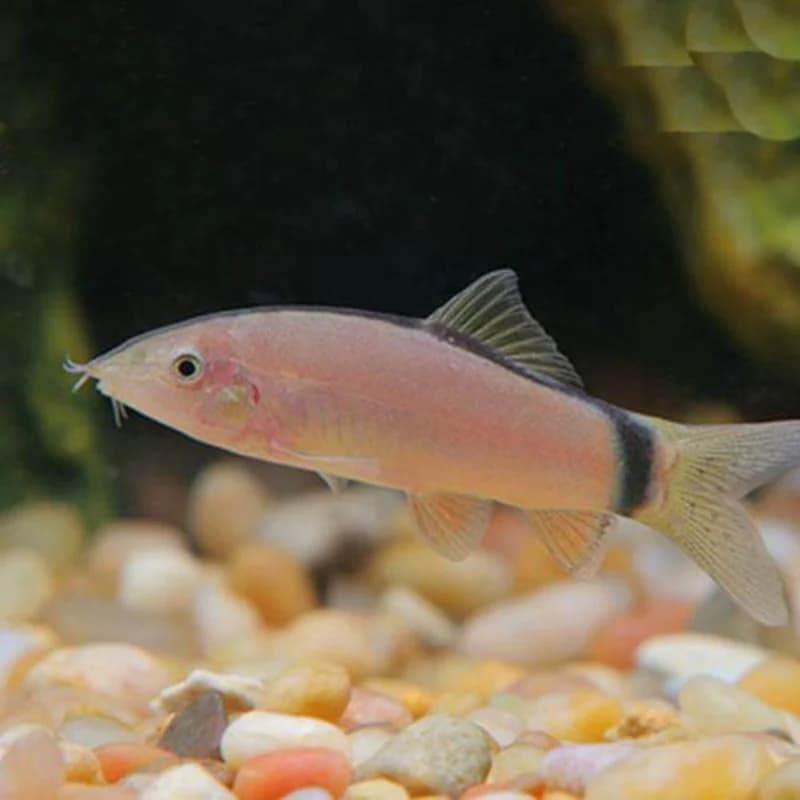
Yasuhikotakia morleti, the skunk loach (also called the hora's loach or cream loach), is a striking loach species identifiable by the distinctive dark stripe running along the top of its body from head to tail, contrasting with its pale cream-to-yellow body. They are energetic, social bottom-dwellers from Southeast Asia.
Native to the Mekong River basin in Thailand, Laos, and Cambodia, skunk loaches inhabit fast-flowing rivers and streams with rocky substrates. They are active, gregarious fish that do best in groups and thrive with strong flow and well-oxygenated water.
Skunk loaches have a reputation for being semi-aggressive toward their own kind and toward other loaches, requiring groups of 4 or more to distribute social aggression. In appropriate groups they are active, entertaining fish with strong individual personalities.
Basic Overview
Common Misconceptions
"They can be kept alone or in pairs." Skunk loaches kept in very small groups direct their aggression intensely at the few tank mates present. In groups of 4 or more, aggression is distributed and no individual is over-targeted. Alone or in pairs, they are chronically stressed.
"They are nocturnal like most loaches." Skunk loaches are more diurnal than many loach species. In groups they are often active during the day, particularly around feeding time and when exploring strong-flow areas of the tank.
"They are gentle community fish." Skunk loaches can be nippy toward slower-moving fish and will chase and harass some tank mates. They do best with robust, active fish that can hold their own. Avoid keeping them with slow, long-finned, or very small fish.
"They will eat pest snails." Skunk loaches may consume very small pest snails but are not reliable snail eliminators. Do not buy them primarily for snail control.
Recommended Setup
- 40+ gallon tank for a group of 4-5
- Fine sand substrate for natural digging behavior
- Caves: smooth rocks, driftwood, PVC pipes (one per fish plus extras)
- Strong flow; they come from fast rivers and appreciate current
- Dense planting along sides and back
- Good oxygenation and high water movement
- Secure lid with no gaps
Diet
Skunk loaches are omnivores that accept most bottom-level foods:
- High-quality sinking pellets or wafers as a staple
- Frozen bloodworms
- Frozen brine shrimp
- Blanched vegetables: zucchini, cucumber, peas
- Small snails (natural food)
Feed once daily in the evening. Ensure food reaches the bottom where skunk loaches naturally feed. They are competitive feeders that hold their own at mealtime. A varied diet with both protein and plant matter maintains good health.
Personality
Skunk loaches are energetic, inquisitive fish with strong individual personalities. In a group of 4-5, a clear social hierarchy develops with recognizable dominant and subordinate individuals. Play behavior, including spiraling and chasing within the group, is common and normal.
Their level of activity is notably higher than many loach species. They investigate every part of their tank, probe substrate and decor with their barbels, and frequently emerge from hiding during daylight hours when kept in groups.
The skunk stripe is visually distinctive and makes them easy to identify in a community tank. Their characteristic color pattern and energetic behavior make them one of the more personality-rich loach species available.
Water Parameters
Skunk loaches come from warm, fast-flowing, well-oxygenated Southeast Asian rivers:
- pH: 6.5-7.5
- Hardness (gH): 5-12 dGH
- Temperature: 77-86 degrees F (warmer than most loaches)
- Ammonia and Nitrite: 0 ppm
- Nitrate: below 20 ppm
Here are some top tips to deal with unwanted parameters:
- Skunk loaches prefer warmer temperatures than many other loach species. Temperature in the 79-84 degree F range is optimal.
- Strong flow and good oxygenation are important. A powerhead or secondary filter output creating current is beneficial.
- Weekly 25-30% water changes maintain good conditions. Fine sand substrate can accumulate waste; stir gently during water changes.
- Avoid copper-based medications. Like all loaches, skunk loaches are sensitive to copper at levels safe for most fish.