Dwarf Chain Loach Care Guide
A Complete Care Guide for Ambastaia sidthimunki
Introduction
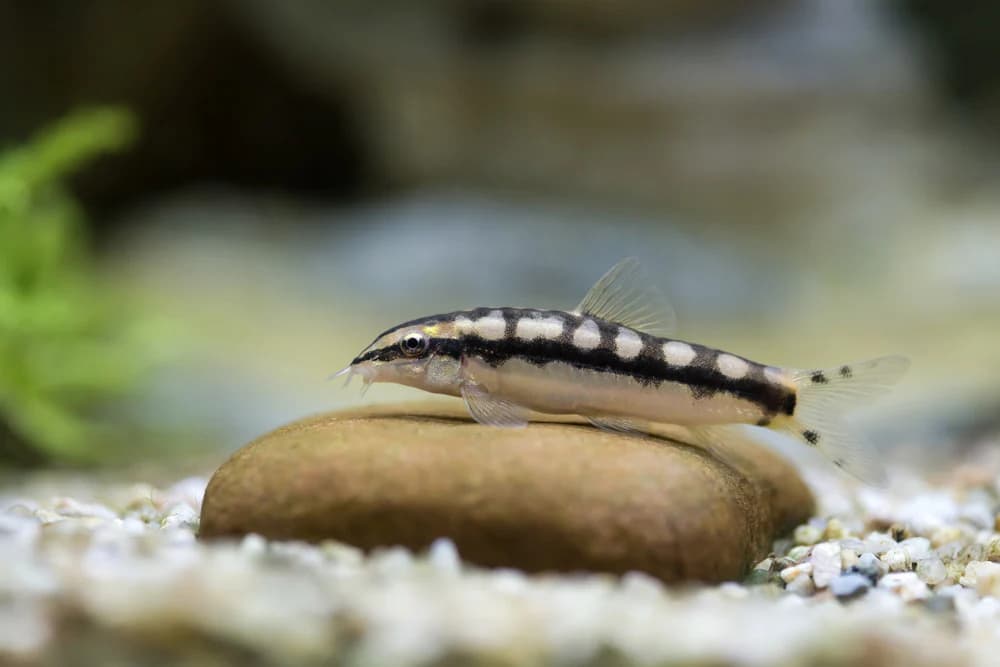
Ambastaia sidthimunki, the dwarf chain loach (also called the chain loach or Sid loach), is the smallest and most nano-tank-friendly loach commonly available in the hobby. Reaching only 2-2.5 inches, their reticulated black-and-gold chain-link pattern, active daytime behavior, and playful social interactions make them one of the most entertaining loach species for smaller planted tanks.
Native to the Mekong River basin in Thailand, the dwarf chain loach was critically endangered in the wild for many years, but is now widely bred in captivity, making captive-bred specimens readily available. They inhabit the rocky, fast-flowing substrates of hill streams in their native range.
Unlike most loaches, dwarf chain loaches are fully diurnal and highly active during the day. In a school of 8 or more, their social interactions, including playful chasing, group resting in piles, and coordinated swimming, are constantly engaging to observe.
Basic Overview
Common Misconceptions
"They can be kept as a pair or trio." Dwarf chain loaches need groups of at least 8 to thrive. In small groups they become stressed, pale, and hide continuously. In larger groups their full behavioral repertoire emerges.
"They are nocturnal like other loaches." Dwarf chain loaches are active during the day, making them ideal display fish. This is one of their key advantages over larger loach species that are rarely seen during daylight hours.
"They will control snails." Dwarf chain loaches may eat very small snails but are not reliable snail control. Larger pest snails are unaffected. Do not purchase them primarily for snail control.
"Small size means any tank is suitable." Despite their small size, dwarf chain loaches are active open-water swimmers that need horizontal tank length. A 30-gallon long tank is preferable to a tall 20-gallon for their swimming behavior.
Recommended Setup
- 30+ gallon long tank for a school of 8
- Fine sand substrate: essential for their characteristic substrate-grazing and resting behavior
- Smooth river stones and driftwood for territory and resting spots
- Dense planting along sides and back
- Moderate to strong flow with good oxygenation
- Secure lid: they can squeeze through small gaps
- Good filtration with pre-filtered intake to protect small fish
Diet
Dwarf chain loaches are omnivores that accept most sinking foods:
- High-quality sinking micro pellets or small wafers as a staple
- Frozen bloodworms (highly preferred)
- Frozen brine shrimp and daphnia
- Blanched vegetables: zucchini, cucumber, peas
- Live blackworms for enrichment
Feed once daily in the evening, though their diurnal activity means they will also feed during the day. Ensure food reaches the bottom; dwarf chain loaches are bottom feeders that may miss food taken at mid-water by other fish.
Personality
Dwarf chain loaches are among the most socially complex and entertaining small fish available. In a group of 8 or more, they develop a sophisticated hierarchy with recognizable individuals, clear friendships (pairs or trios that always rest together), and constant low-level playful interactions.
They rest in pile-ups, tucked into crevices or behind plants with multiple fish on top of each other. This communal resting behavior is characteristic and charming. They emerge together to feed and swim in loose formations that occasionally tighten into coordinated groups.
Their interaction with their keeper is direct: they investigate the glass, approach during maintenance, and quickly learn to associate the keeper with feeding. They are among the most rewarding small fish for long-term keeper satisfaction.
Schooling Dynamics
The social dynamics of a large dwarf chain loach group are genuinely fascinating to observe over time. Individual fish develop recognizable personalities: bold explorers, shy hiders, and social connectors that seem to keep the group together. Pairs and trios form stable social bonds that persist over months.
When a new fish is introduced to an established group, the group takes 1-3 weeks to fully integrate the newcomer. During this period, some chasing and exclusion behavior is normal. In most cases, full integration occurs without permanent injury.
Group size significantly impacts behavior. A group of 4 is noticeably more stressed and less active than a group of 8. A group of 12 in a 40-gallon long is one of the most dynamic displays a single-species nano tank can produce.
Water Parameters
Dwarf chain loaches come from the fast-flowing, well-oxygenated rivers of Southeast Asia:
- pH: 6.5-7.5
- Hardness (gH): 5-12 dGH
- Temperature: 75-82 degrees F
- Ammonia and Nitrite: 0 ppm
- Nitrate: below 20 ppm
Here are some top tips to deal with unwanted parameters:
- Good flow and oxygenation are important. Their fast-water background means they appreciate moderate to strong current and high dissolved oxygen.
- Weekly 25% water changes maintain excellent conditions. Loaches are sensitive to ammonia and nitrite spikes; ensure full biological filtration is established before adding them.
- Fine sand substrate is non-negotiable for their comfort and natural behavior. Gravel or rough substrate prevents the characteristic resting and burrowing behavior.
- Avoid copper-based medications. Dwarf chain loaches are sensitive to copper at concentrations safe for most fish.