Silver Arowana Care Guide
A Complete Care Guide for Osteoglossum bicirrhosum
Introduction
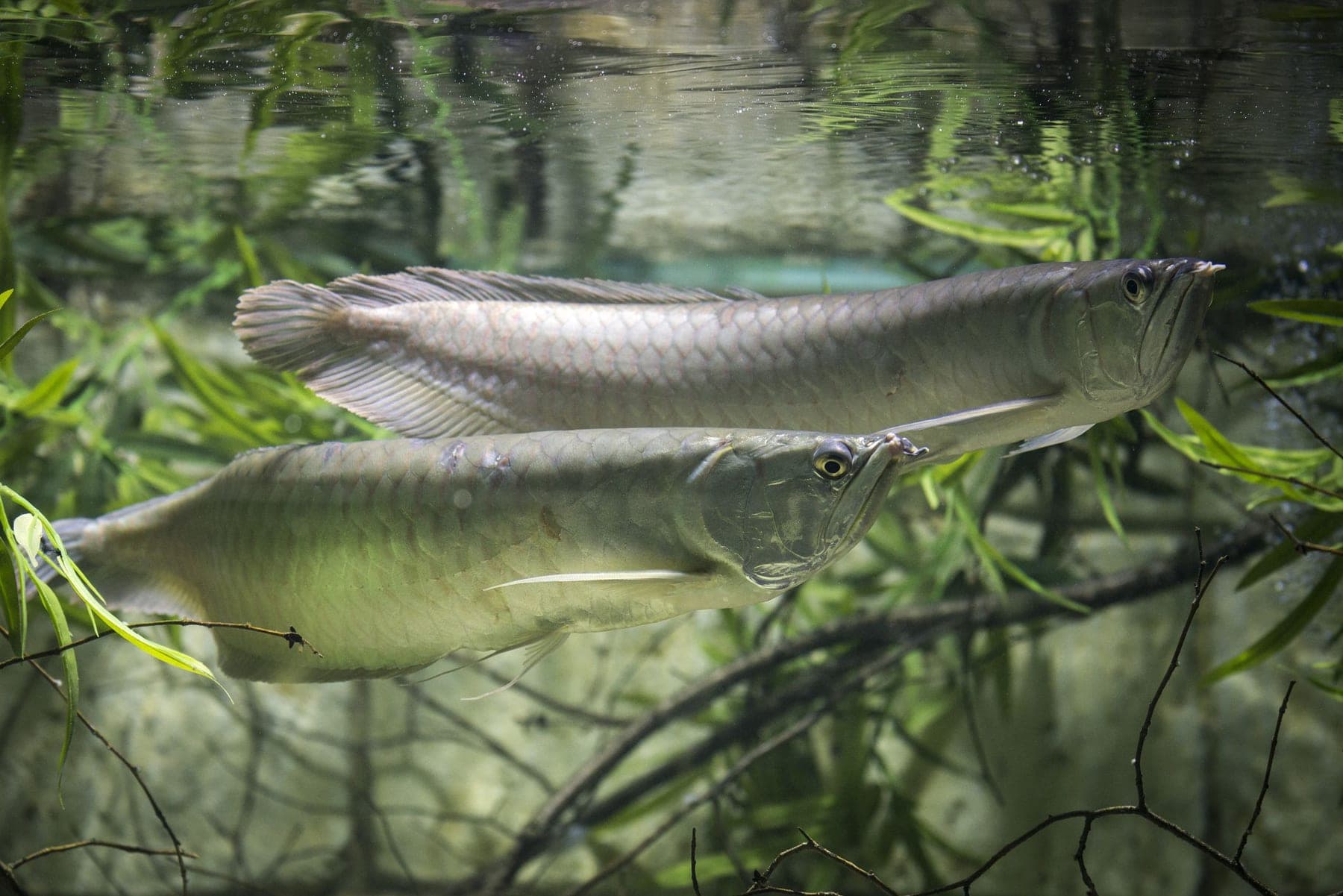
Osteoglossum bicirrhosum, the silver arowana, is one of the most dramatic and commanding freshwater fish available. Their elongated, silver-scaled body, upward-tilted jaw adapted for surface hunting, and prehistoric appearance make them among the most distinctive fish in the hobby. In South American cultures, arowanas are considered symbols of luck and prosperity.
Native to the Amazon River basin and Rupununi and Oyapock river systems in South America, silver arowanas are surface-dwelling predators that hunt insects, birds, bats, and small animals that fall on or rest near the water surface. They are capable of leaping 6 feet or more out of the water to catch prey from overhanging branches.
Silver arowana care is rated advanced due to their adult size (up to 3-4 feet in captivity), the minimum 250-gallon tank they require as adults, and their predatory nature. They are not recommended for beginner aquarists and should only be obtained with a long-term housing plan in place.
Basic Overview
Common Misconceptions
"A 150-gallon tank will be fine as an adult." Silver arowanas grow to 3-4 feet and require a minimum 250-gallon tank as adults, with longer tank length more important than volume. A 250-gallon with a 96+ inch length is appropriate. Undersized tanks cause severe physical and psychological stress.
"They will stay small in a small tank." The "stunted growth" theory is not safe practice. Fish kept in undersized tanks often develop skeletal deformities, organ compression, and reduced immune function long before growth visually slows. Growth is constrained by suffering, not safety.
"They are safe with large fish." Adult silver arowanas will eat any fish they can fit in their mouth, which includes surprisingly large fish given their mouth dimensions. Tank mates must be too large to swallow and robust enough not to be targeted.
"Juveniles can be kept in standard tanks temporarily." While a 6-inch juvenile can be temporarily housed in a 75-gallon tank, arowanas grow very quickly. A juvenile bought at 6 inches will be 12-18 inches within 6-12 months. Planning for adult housing from the start is essential.
Recommended Setup
- 250+ gallon tank for a single adult (larger is better)
- Tank length is critical: 96+ inches (8 feet) minimum for a full-grown arowana
- Very heavy, weighted, lockable lid (arowanas jump with enormous force)
- Large, powerful filtration: canister or sump
- Minimal decor: driftwood, large smooth stones only
- Strong, consistent current
- No small fish in the tank
Diet
Silver arowanas are surface predators that require whole prey items and large meaty foods:
- Large carnivore pellets or sticks (train to accept as the staple)
- Whole frozen shrimp
- Frozen whole fish (smelt, silversides)
- Large earthworms
- Crickets and other insects (good enrichment)
Feed juveniles daily; adults every 2-3 days. Overfeeding adults causes fatty liver disease and obesity. Train arowanas to accept pelleted food by mixing it with live or fresh food gradually, then transitioning. Live feeder fish are unnecessary and risk disease introduction. Arowanas should be able to see food clearly - they hunt primarily by sight from below the surface.
Personality
Silver arowanas are solitary, powerful fish with a calm, regal bearing punctuated by explosive hunting strikes. In a large tank, they cruise the surface methodically, covering the entire length repeatedly in a slow, deliberate patrol.
They become familiar with their keeper and often approach when their owner is near. Their upward-tilted eyes track movement above the water surface, and the keeper's face and movements are recognized. This above-water awareness is a characteristic arowana behavior.
When a prey item (or food) is presented at the surface, the explosive strike is startling even to experienced keepers. They launch themselves clear of the water with remarkable speed and precision. This natural hunting behavior is one of the most dramatic things to observe in freshwater aquariums.
Drop Eye Prevention
Drop eye (or drooping eye) is a deformity in which one or both eyes permanently rotate downward. It is primarily caused by the arowana developing the habit of looking down at the tank floor rather than upward at the surface, which is their natural orientation.
The primary causes of drop eye are: feeding from the bottom, tank decorations that attract the arowana's attention downward, and reflections on the glass. Prevention includes feeding only at the surface, avoiding bottom-level decor, and using a black background to reduce reflections.
Once drop eye develops, it cannot be fully reversed though it can be halted. Some keepers use a bead or floating object on the surface to keep the arowana's attention directed upward. Surgical correction exists but is generally not recommended for aquarium fish.
Water Parameters
Silver arowanas come from the warm, slightly soft, acidic Amazon river system:
- pH: 6.0-7.5
- Hardness (gH): 5-12 dGH
- Temperature: 75-82 degrees F
- Ammonia and Nitrite: 0 ppm
- Nitrate: below 20 ppm
Here are some top tips to deal with unwanted parameters:
- Arowana tanks require massive filtration and very frequent large water changes. A single large arowana produces waste equivalent to a large group of smaller fish. Twice-weekly 30-40% water changes in a 250-gallon tank are standard.
- High water quality is critical for long-term health. HLLE (head and lateral line erosion) is common in arowanas kept in poor water quality. It presents as pitting erosion of the face and lateral line.
- Slightly soft, slightly acidic water suits them best. Neutral tap water is acceptable but softening with RO water is beneficial in hard-water areas.
- Stable temperature in the 78-82 degree F range is optimal. Temperature fluctuations cause immune suppression.