Marbled Hatchetfish Care Guide
A Complete Care Guide for Carnegiella strigata
Introduction
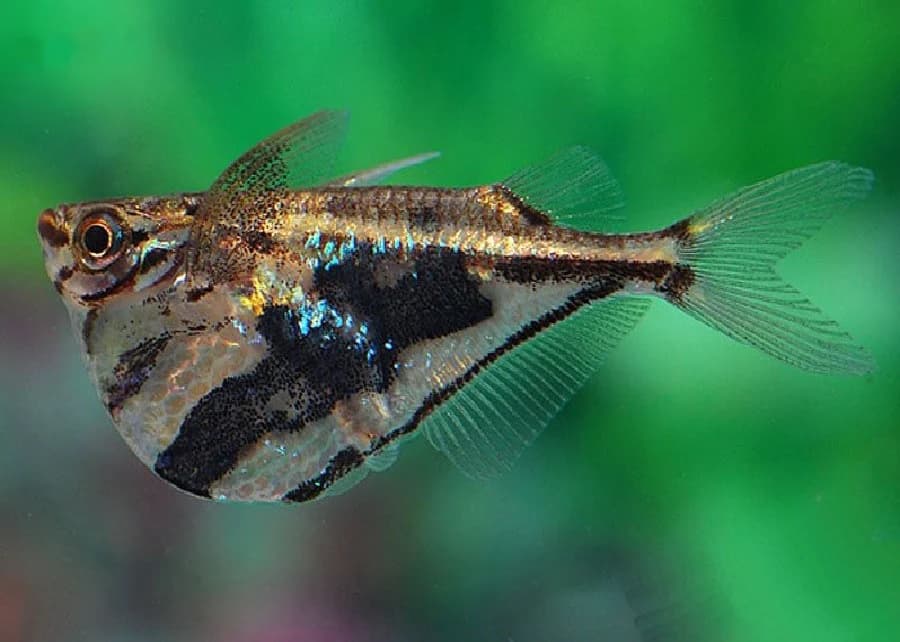
Carnegiella strigata, the marbled hatchetfish, is one of the most unusual-looking freshwater fish in the hobby. Their deep, keel-shaped body (giving them their hatchet silhouette), enormous pectoral fins, and strongly upturned mouth are all adaptations for surface feeding. They are the only group of fish capable of true powered flight, using their oversized pectoral muscles to beat their fins and briefly become airborne when startled.
Native to the Amazon and Orinoco river basins across Colombia, Peru, and Brazil, marbled hatchetfish live exclusively at the water surface in slow-moving, heavily vegetated waters with an abundant layer of floating plants and overhanging vegetation. Their marbled brown and cream pattern provides camouflage against the surface when viewed from below.
They are peaceful, schooling fish that fill a unique surface-dwelling niche in planted community tanks. Their specific needs, including soft, acidic water, a tight lid to prevent jumping, and a calm surface environment, make them a fish for keepers who can provide appropriate conditions.
Basic Overview
Common Misconceptions
"Any lid is fine for preventing escape." Hatchetfish are extraordinary jumpers that can clear a surprising height. Any gap in the lid, including filter and heater ports, must be covered. Even small openings are dangerous.
"They eat from the bottom like other small fish." Hatchetfish are obligate surface feeders. Their strongly upturned mouth physically prevents them from eating effectively at any depth below the surface film. Foods that sink are largely inaccessible to them.
"Hard tap water is acceptable." Marbled hatchetfish are significantly more sensitive to water chemistry than most tetras. Hard, alkaline water causes chronic stress and shortened lifespan. Soft, slightly acidic water is genuinely necessary.
"A group of 3 is fine." Hatchetfish are highly social surface schoolers that need groups of 6 or more to feel secure. Smaller groups show chronic stress behaviors including hiding under floating plants and refusing to feed.
Recommended Setup
- 20+ gallon long tank for a school of 6-8
- A very secure lid with all openings sealed; jumping is the primary cause of death in this species
- Floating plants covering 50-70% of the surface: frogbit, water lettuce, Amazon frogbit
- Dense background planting
- Gentle filtration with minimal surface agitation; strong surface flow scatters their feeding zone
- Soft, slightly acidic water with tannins
- Subdued lighting; floating plants provide natural shading they strongly prefer
Diet
Marbled hatchetfish are surface-feeding insectivores in the wild. All food must float or be delivered to the surface:
- Small floating pellets or nano flakes that remain at the surface film
- Freeze-dried bloodworms and tubifex at the surface
- Frozen bloodworms delivered to the surface before they sink
- Live fruit flies (Drosophila) dropped onto the surface (a natural and enriching food)
- Live or frozen mosquito larvae at the surface
Feed at the surface only. Any food that sinks is largely wasted for hatchetfish. Live fruit flies dropped onto the surface trigger the most natural and enthusiastic feeding behavior and are highly recommended for long-term keepers.
Personality
Marbled hatchetfish are calm, peaceful fish that spend virtually their entire lives at or within a centimeter of the water surface. In a school, they cluster tightly under floating plants, their silver-marbled bodies parallel to the surface as they watch for food from above.
When food appears at the surface, the school comes alive: darting movements, quick turns, and surface strikes in tight formation. They are surprisingly fast and precise feeders despite their unusual body plan.
Their primary defense mechanism, taking flight over short distances using powered beats of their pectoral fins, is rarely seen in a well-maintained tank where the fish feel secure. A school of hatchetfish that never jumps is a school that feels at home.
Compatible Tank Mates
Because hatchetfish occupy only the surface zone, they pair naturally with fish that occupy the middle and bottom water column without competing. Cardinal tetras, ember tetras, and other small South American tetras in the middle, corydoras or dwarf loaches on the bottom, and apistogramma cichlids as a centerpiece all work beautifully with a school of hatchetfish at the surface.
Avoid any fish large enough to eat them or nippy species that will harass them. Tiger barbs, serpae tetras, and any fish that surface-feeds aggressively are incompatible, as they will outcompete the relatively gentle hatchetfish for surface food.
The three-layer combination of hatchetfish at the top, a schooling tetra in the middle, and corydoras on the bottom is one of the most natural-looking and complete South American biotope-inspired community layouts in the hobby.
Water Parameters
Marbled hatchetfish come from the soft, acidic, tannin-rich blackwaters of the Amazon and Orinoco basins:
- pH: 5.5-7.0
- Hardness (gH): 1-8 dGH (soft water essential)
- Temperature: 75-82 degrees F
- Ammonia and Nitrite: 0 ppm
- Nitrate: below 10 ppm (sensitive)
Here are some top tips to deal with unwanted parameters:
- Soft water is a genuine requirement, not a preference. In hard alkaline tap water, hatchetfish decline noticeably over weeks to months. Blend with RO water to bring hardness below 8 dGH.
- Indian almond leaves and driftwood create the tannin-rich surface water they are adapted to. The tannins also have mild antibacterial properties that benefit sensitive fish.
- Weekly 20% water changes are sufficient in a well-planted, lightly stocked tank. Avoid dramatic parameter swings, as soft water has low buffering capacity.
- Nitrate sensitivity is real in this species. Keep nitrate below 10 ppm with consistent water changes and appropriate stocking density.