Clown Knifefish Care Guide
A Complete Care Guide for Chitala ornata
Introduction
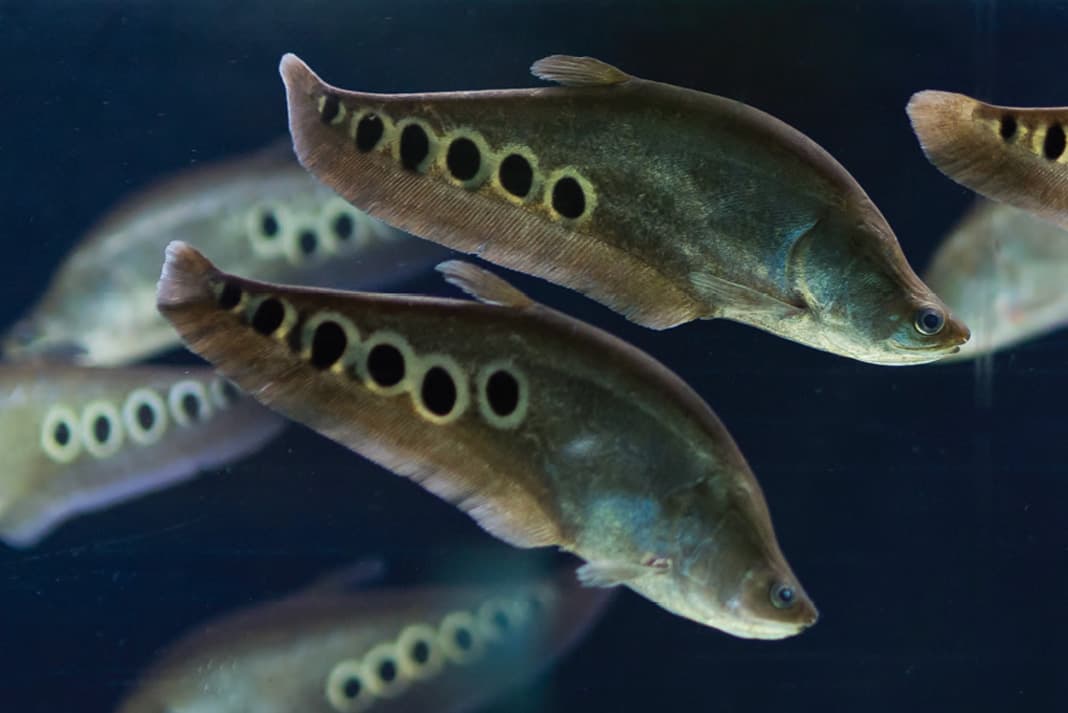
Chitala ornata, the clown knifefish (also called the spotted knifefish), is a large, dramatic predatory fish from Southeast Asia. Their distinctive body plan - a long, knife-shaped form tapering to a pointed tail, with a long undulating anal fin running the length of the underside - combined with the row of black, white-ringed spots on their silver flank makes them one of the most visually striking large fish in the hobby.
Native to Thailand, Cambodia, Laos, and Vietnam, clown knifefish inhabit slow-moving rivers, floodplains, and reservoirs. They are nocturnal predators that use a weak electric field for navigation and prey detection, moving by rippling their anal fin while the body remains relatively still.
Clown knifefish are advanced-level fish that grow to 24-36 inches in optimal conditions and require a very large aquarium. They are frequently sold as small juveniles with no indication of their adult size. Those who provide appropriate long-term housing have a magnificent, long-lived, personable fish.
Basic Overview
Common Misconceptions
"They stay small in small tanks." Clown knifefish grow to 2-3 feet regardless of tank size. Stunting causes organ damage and shortened lifespan. A 200+ gallon tank is a genuine requirement for an adult.
"They will eat flake food." Clown knifefish are obligate meat-eaters. Flake food and pellets are nutritionally inappropriate. They require whole fish, large invertebrates, and meaty foods.
"Small fish are safe with them." Any fish small enough to fit in their mouth will be eaten eventually. Only fish of comparable or larger size are safe companions.
"One is sufficient in any large tank." Multiple clown knifefish in the same tank will fight aggressively as they mature. One per tank unless the setup is extremely large (500+ gallons) with clear territory division.
Recommended Setup
- 200+ gallon tank for an adult; 75 gallons minimum for juveniles up to 12 inches
- Long tank footprint preferred over tall; they need horizontal swimming space
- Large PVC pipe or driftwood caves for hiding
- Minimal decoration to allow free movement of the full body length
- Subdued lighting; they are nocturnal and more active in dim conditions
- Powerful filtration: canister filters rated for 3-4x tank volume
- Tight-fitting, heavy lid; they can and do jump powerfully
Diet
Clown knifefish are carnivores requiring whole-prey or large meaty foods:
- Whole feeder fish (rosies, goldfish) - primary food for large adults
- Large frozen shrimp (whole)
- Large nightcrawlers and earthworms
- Chunks of fish fillet (tilapia, cod)
- Large frozen bloodworms and krill for juveniles
Feed 2-3 times per week for adults; daily for juveniles. Avoid live feeder fish from unknown sources (disease risk). Frozen whole fish or earthworms are safer alternatives. Train juveniles onto frozen foods early; adults conditioned to live feeders can be difficult to switch.
Personality
Clown knifefish are intelligent, surprisingly personable fish that quickly recognise their keeper and become tame with regular handling of their environment. They may investigate hands placed in the water and often take food from forceps or tongs.
At night, they are graceful, fluid swimmers that patrol the full tank length with their characteristic anal-fin propulsion system. The spots on their flank glow in low light, and their movement has an almost hypnotic quality.
In a single-specimen setup in a very large tank, they become bold and visible over time. Kept in poor conditions in undersized tanks, they are shy, reclusive, and decline steadily.
Long-Term Housing Planning
The most important aspect of clown knifefish keeping is planning for the adult animal before purchasing. A 6-inch juvenile in a 75-gallon tank is manageable; the same fish at 28 inches requires a 200+ gallon aquarium that not all homes can accommodate.
Custom or second-hand large aquariums are practical options. A 6-foot, 200-gallon tank is the minimum footprint for a full-grown specimen. Larger public aquarium facilities sometimes accept large specimens for donation, but this should not be relied upon as a plan.
Clown knifefish are legally restricted in some US states (Florida, Nevada, Washington) where they are considered invasive. Check local regulations before purchase.
Water Parameters
Clown knifefish come from the warm, slow-moving rivers of Southeast Asia:
- pH: 6.0-7.5
- Hardness (gH): 5-15 dGH
- Temperature: 75-82 degrees F
- Ammonia and Nitrite: 0 ppm
- Nitrate: below 20 ppm (important; large fish produce enormous waste)
Here are some top tips to deal with unwanted parameters:
- Powerful filtration and frequent large water changes are essential. A 200-gallon tank with a large predatory fish requires 30-40% weekly changes and robust biological filtration.
- Water quality decline is the most common cause of disease in large predatory fish. Hole-in-the-head lesions and bacterial infections trace directly to elevated nitrate and poor water conditions.
- Soft to moderately hard neutral water suits them well. Standard tap water in most areas requires no modification.
- Warm, stable temperatures around 78-80 degrees F are optimal. Fluctuations below 72 degrees F suppress immune function significantly.