Black Ghost Knifefish Care Guide
A Complete Care Guide for Apteronotus albifrons
Introduction
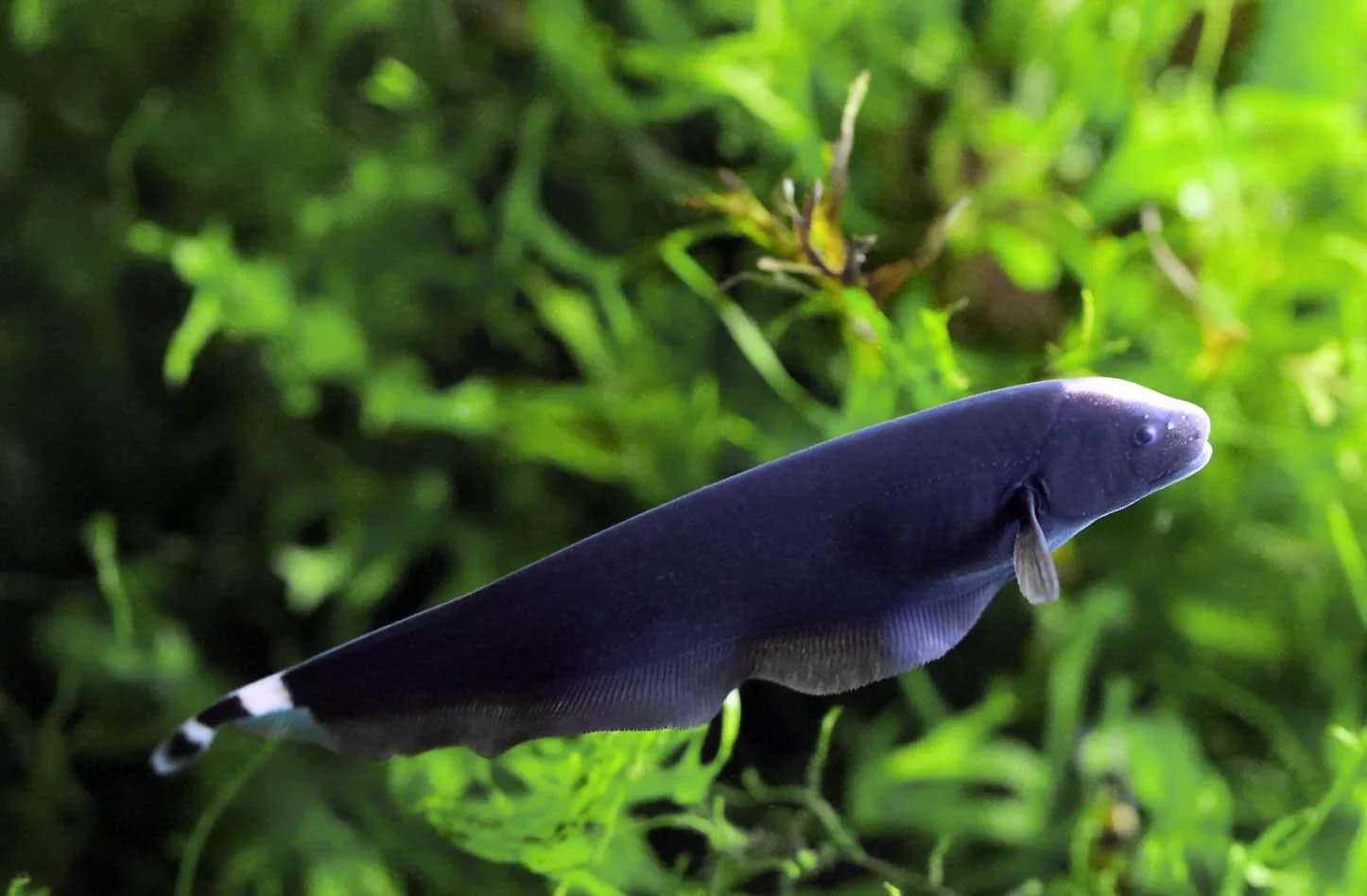
Apteronotus albifrons, the black ghost knifefish, is one of the most distinctive and fascinating freshwater fish available. Their jet-black body with two white rings near the tail, long undulating anal fin used for both propulsion and navigation, and the ability to generate and detect weak electric fields make them unlike any other aquarium fish. They are intelligent, long-lived, and capable of recognising their keeper.
Native to the Amazon and Orinoco river basins, black ghost knifefish inhabit slow-moving, heavily vegetated blackwater streams and flooded forests. They are nocturnal predators that navigate by electrolocation in the dark, feeding on small invertebrates and fish.
Their care is rated intermediate to advanced. They are sensitive to poor water quality, require hiding places large enough for their full body length, and grow to 18-20 inches over several years. Keepers who meet their needs are rewarded with one of the most personable and interactive fish in the freshwater hobby.
Basic Overview
Common Misconceptions
"They stay small in a small tank." Black ghost knifefish grow to 18-20 inches regardless of tank size. Stunting a fish in a small tank causes chronic stress and organ damage, not a smaller adult size.
"They can be kept with other knifefish." Two black ghost knifefish in the same tank will fight using their electric fields and physical aggression. One per tank is the rule unless the aquarium is extremely large with full visual barriers.
"Any hiding spot works." Black ghost knifefish need a tube or cave that fits their full body length. They back into their hiding spot tail-first and must be fully enclosed to feel secure. A hiding spot that is too short or too narrow causes chronic stress.
"They only need feeding at night." While they are most active at night, black ghost knifefish can be trained to accept food during the day over time. Feeding only at night in a community tank means other fish consume all food before the knifefish emerges.
Recommended Setup
- 100+ gallon tank for an adult; 55 gallons minimum for juveniles up to 10 inches
- Full-length PVC pipe or bamboo tube for hiding: sized to the fish's current body length
- Soft sand substrate; they rest on the bottom and graze the substrate surface
- Dense planting and driftwood for additional cover and territory division
- Gentle to moderate filtration with low flow; they dislike strong current
- Dim lighting or a light schedule that includes a period of darkness
- A tight lid; knifefish can jump
Diet
Black ghost knifefish are carnivores in the wild, feeding on small invertebrates, insect larvae, and small fish. They need meaty foods:
- Frozen bloodworms (primary food; highly accepted)
- Frozen brine shrimp and mysis shrimp
- Frozen blackworms
- Sinking carnivore pellets (train them to accept these for convenience)
- Live earthworms for enrichment
Feed after lights out when the fish is most active. Initially, drop food directly into the entrance of their hiding tube. Over time, most individuals learn to associate the keeper with feeding and emerge earlier. Avoid keeping them with fast mid-water feeders that will consume all food before the knifefish emerges.
Personality
Black ghost knifefish are among the most intelligent freshwater fish. They quickly learn to recognise their keeper and will approach the glass at feeding time with clear anticipation. Many individuals accept hand feeding after becoming comfortable in their environment.
At night they are active, purposeful hunters that patrol the full length of the tank. Their movement is uniquely fluid - the long anal fin ripples in both directions for forward, backward, and hovering motion while the body remains nearly motionless.
They are peaceful toward fish that are too large to eat and too different in body shape to be mistaken for rivals. With tank mates of similar body shape or other electrosensing fish, aggression can develop. The best community pairings are with peaceful mid-water schooling fish.
The Electrosensory System
Black ghost knifefish generate a weak electric field using specialised electric organs and navigate and communicate by detecting distortions in this field. This electroreception system is highly sensitive and is the primary way they interact with their environment in the dark.
Because of this sensitivity, it is important to avoid keeping them with other weakly electric fish (such as elephantnose fish or other knifefish), as the overlapping electric fields cause stress and aggression. Avoid placing the tank near sources of electromagnetic interference.
The electric organ discharge (EOD) frequency of each individual is slightly different, which is how they distinguish between themselves. Researchers have found that knifefish can modify their EOD in response to a neighbour's discharge, a behaviour called the jamming avoidance response, one of the best-studied examples of electrosensory processing in vertebrates.
Water Parameters
Black ghost knifefish come from soft, warm, acidic blackwater rivers of South America:
- pH: 6.0-7.5
- Hardness (gH): 2-12 dGH (soft water preferred)
- Temperature: 73-82 degrees F
- Ammonia and Nitrite: 0 ppm
- Nitrate: below 20 ppm
Here are some top tips to deal with unwanted parameters:
- Water quality is critical. Black ghost knifefish are sensitive to ammonia and nitrite spikes and decline rapidly in poor conditions. Establish a fully cycled filter before introducing them.
- Weekly 25-30% water changes are essential. Consistency is more important than hitting specific parameters; stable soft neutral water is better than fluctuating soft acidic water.
- Driftwood and Indian almond leaves create natural tannin-stained conditions that suit them well. No active chemistry management is needed with these additions in most tap water areas.
- Avoid using medications that contain copper or high salt concentrations; knifefish are sensitive to both.