Demasoni Cichlid Care Guide
A Complete Care Guide for Pseudotropheus demasoni
Introduction
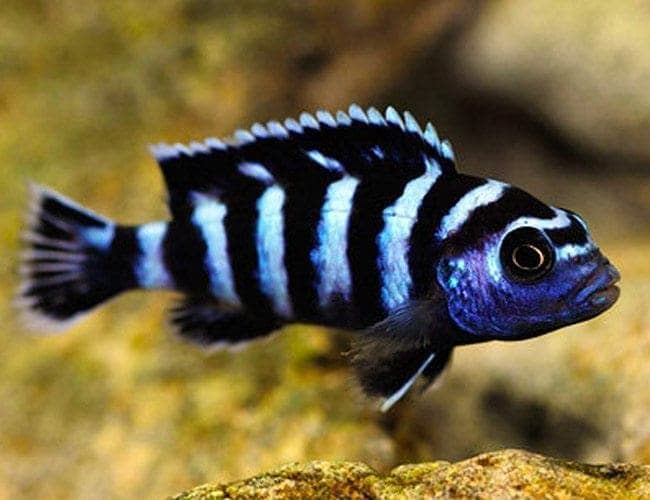
Pseudotropheus demasoni, the Demasoni cichlid, is one of the most visually striking Malawi mbuna cichlids, with vivid alternating black and powder-blue vertical stripes on a compact 3-inch body. Despite their small size, they are among the most aggressive mbuna species in the hobby, requiring a specific and counterintuitive approach to colony management.
Endemic to Pombo Rock in Lake Malawi, Tanzania, Demasoni cichlids are a restricted-range species that live in the rocky shoreline biozone. They are herbivores that graze algae (aufwuchs) from rock surfaces in densely packed territories in the wild.
Their care requires understanding their aggression dynamics. The standard rule is to keep them in large groups (12 or more) to distribute aggression across many individuals. Keeping small groups leads to the dominant male systematically killing the other males and often the females.
Basic Overview
Common Misconceptions
"Small groups are safer because there is less aggression." This is the opposite of the truth for Demasoni. In small groups, the dominant male targets a small number of subordinates relentlessly. In large groups (12+), aggression is spread across many fish and no individual is targeted continuously.
"Their small size means they need a small tank." Demasoni require a 55-gallon minimum not because of size but because of the need for a colony of 12+ and extensive rockwork for territory division. A small tank with a small group is a recipe for casualties.
"They can be kept with peaceful community fish." Demasoni cichlids should be kept in a species-only or mbuna-only setup. They will harass and kill peaceful community fish and are themselves at risk from larger, more aggressive cichlid species.
"Males and females need to be kept in equal numbers." In mbuna keeping, a ratio of 1 male to 3-4 females is recommended to reduce male-on-female harassment during spawning. Equal-ratio groups result in females being over-harassed.
Recommended Setup
- 55+ gallon tank for a colony of 12-15
- Extensive rockwork: dense rock piles reaching near the surface to create territory zones
- Crushed coral or aragonite substrate to maintain alkaline pH
- No plants; Demasoni will destroy soft-leaved plants
- Robust filtration: canister or high-capacity HOB for heavily stocked mbuna tank
- Strong oxygenation and surface agitation
- Good water movement throughout the tank
Diet
Demasoni are herbivores requiring a high-plant, low-protein diet:
- Spirulina flakes or pellets (primary staple)
- Mbuna-specific vegetable pellets
- Blanched vegetables: spinach, zucchini, romaine lettuce
- Algae wafers
- Occasional frozen daphnia or spirulina brine shrimp (small amount)
Avoid high-protein foods. Mbuna cichlids fed high-protein diets (bloodworms, krill, high-protein cichlid pellets) develop Malawi Bloat, a fatal digestive condition. Their gut is designed for plant material. Feed a primarily vegetarian diet with only occasional and small protein supplements.
Personality
Demasoni are bold, active, and intensely territorial fish that are in near-constant motion. Males display to each other persistently, spreading fins and displaying the vivid blue-and-black pattern to establish and maintain dominance hierarchies.
In a properly managed large colony, the constant activity and vivid coloration of a group of Demasoni is one of the most dynamic displays in the cichlid hobby. The challenge of managing their aggression is matched by the visual reward of a healthy, thriving colony.
Individual personalities vary: some males are relentless dominant aggressors; others are more willing to share space. Monitoring the colony for fish that are isolated, hanging at the surface, or showing severe fin damage identifies individuals being over-targeted, who should be removed or the colony composition adjusted.
Colony Management
Managing a Demasoni colony requires understanding that aggression cannot be eliminated, only distributed. The three key principles are: large groups (12+ minimum), extensive visual complexity in rockwork, and appropriate sex ratios (1 male per 3-4 females).
When adding new fish to an established colony, rearrange the rockwork first. This disrupts established territories and allows the new fish to establish a position in the hierarchy without being attacked as an intruder into a claimed territory.
Monitor the colony regularly. A fish that spends extended time near the surface, away from the main group, or shows complete fin damage despite adequate colony size is being singled out by a particularly aggressive dominant male. Remove and rehome either the aggressor or the victim depending on the situation.
Water Parameters
Demasoni come from the hard, alkaline, highly oxygenated waters of Lake Malawi:
- pH: 7.8-8.5
- Hardness (gH): 10-20 dGH
- Temperature: 76-82 degrees F
- Ammonia and Nitrite: 0 ppm
- Nitrate: below 20 ppm
Here are some top tips to deal with unwanted parameters:
- Crushed coral or aragonite substrate automatically maintains the alkaline pH Malawi cichlids require. Without it, pH can drop to levels that stress the fish.
- High oxygenation is important. Lake Malawi water is highly oxygenated and Malawi cichlids require good surface agitation and water movement throughout the tank.
- Weekly 25-30% water changes are essential. Mbuna tanks are heavily stocked and produce significant waste. Consistent water changes prevent the nitrate buildup that suppresses immune function.
- Malawi salt mixes can be added to maintain the correct mineral balance, though in most hard-water tap water areas this is not necessary.