Pictus Catfish Care Guide
A Complete Care Guide for Pimelodus pictus
Introduction
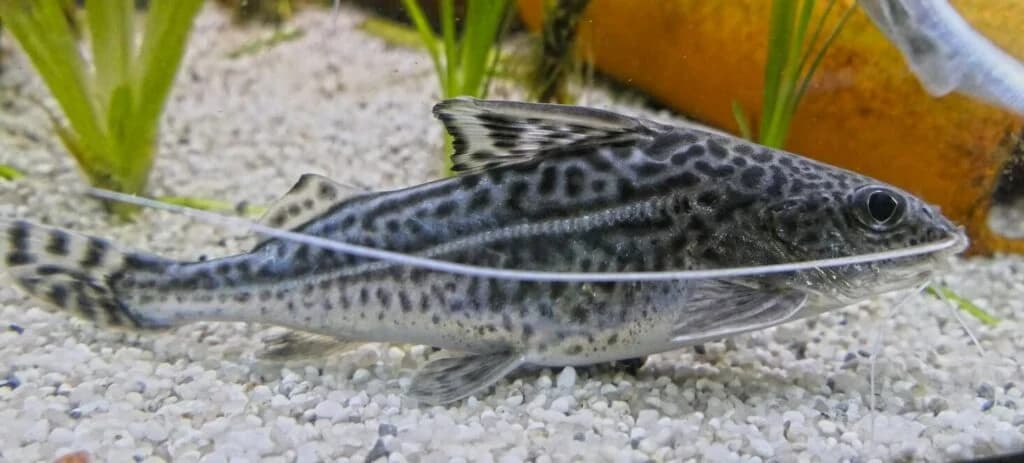
Pimelodus pictus, the pictus catfish (also called the pictus cat or angel catfish), is one of the most attractive and active catfish in the freshwater hobby. Their silver body covered with dense black spots, long flowing barbels, and restless, active nature make them a popular choice for larger community tanks.
Native to the Amazon and Orinoco river basins in South America, pictus catfish inhabit fast-flowing, clear to slightly turbid rivers with rocky and sandy substrates. Unlike many catfish, they are not strictly nocturnal and will swim actively in open water during daylight hours when kept in groups.
Pictus catfish care requires attention to two key points: they are schooling fish that do poorly alone, needing groups of 3 or more, and their adult size of 5 inches means small tetras and other nano fish are at risk of predation. Appropriate tank mate selection is essential.
Basic Overview
Common Misconceptions
"They can be kept alone." Pictus catfish kept alone become stressed, hide continuously, and often refuse food. In groups of 3 or more, they become bold, active, and spend considerable time in open water. Solo keeping is detrimental to their welfare.
"They are safe with neon tetras and small fish." Pictus catfish will eat any fish small enough to fit in their mouth. Small tetras (neons, cardinals, small rasboras) are regularly eaten overnight. Tank mates should be fish of 2+ inches and robust enough not to be bothered.
"Long barbels are decorative only." The extremely long barbels of pictus catfish are sensory organs they use to navigate, detect prey, and communicate. Handle with extreme care: the pectoral spines can become entangled in nets, causing injury to both fish and handler.
"They are bottom-dwellers that stay at the bottom." Pictus catfish are active mid-water and open-water swimmers, particularly in groups. They spend considerable time cruising through open water at all tank levels, unlike the benthic catfish most people expect.
Recommended Setup
- 55+ gallon tank for a group of 3-4
- Open swimming space with caves and hiding spots
- Sand or fine gravel substrate
- Moderate to strong flow to replicate their river habitat
- Driftwood and smooth rocks for territory
- Good filtration and high oxygen levels
- Avoid sharp decor that can damage barbels
Diet
Pictus catfish are carnivores that accept a range of meaty foods:
- Sinking carnivore pellets or wafers as a staple
- Frozen bloodworms
- Frozen brine shrimp
- Frozen krill (chopped)
- Live or frozen earthworms
Feed after lights-out or during the evening hours when activity peaks, though they will also feed during the day in groups. Use sinking foods to ensure they reach the bottom. Pictus catfish are active feeders that compete well at feeding time. They can also catch and eat smaller fish given the opportunity, so monitor tank mate welfare closely.
Personality
Pictus catfish in groups are some of the most active and engaging catfish available. A trio or quartet schooling together, flowing gracefully through the tank with their long barbels trailing, is a striking display that defies the typical image of a bottom-dwelling catfish.
They are curious and investigative, probing every surface with their barbels and learning the layout of their tank thoroughly. Individual fish develop recognizable personalities and patterns of behavior, and a long-established group of pictus cats develops a clear social dynamic.
With appropriate tank mates (large enough not to be eaten, robust enough not to be harassed), pictus catfish are peaceful community inhabitants. They coexist well with large tetras, other South American catfish, cichlids of appropriate size, and most robust mid-water fish.
Handling and Injury Prevention
Pictus catfish have very sharp pectoral and dorsal fin spines that can cause painful wounds and easily become entangled in nets. Never use a net to catch them; instead use a container or bowl to scoop them from the tank. When spines become tangled in net fibers, attempting to pull free causes injury to the fish and can break the spine.
The spines can also hook into the flesh of predatory fish that attempt to eat them, which provides some natural defense. This is occasionally an issue when pictus catfish are kept with larger aggressive fish - their spines can injure the aggressor, but the resulting wounds on the pictus catfish also require monitoring.
When performing tank maintenance, be aware of where the pictus catfish are. Moving equipment or your hands through the tank without visibility risks contact with their spines.
Water Parameters
Pictus catfish come from the fast-flowing, well-oxygenated Amazon tributaries:
- pH: 6.5-7.5
- Hardness (gH): 5-15 dGH
- Temperature: 74-82 degrees F
- Ammonia and Nitrite: 0 ppm
- Nitrate: below 20 ppm
Here are some top tips to deal with unwanted parameters:
- Good flow and high dissolved oxygen are important for pictus catfish. Their fast-water origin means they appreciate moderate to strong current and good surface agitation.
- Weekly 25-30% water changes maintain the water quality they require. In a tank with a group of active, meaty-food-eating catfish, waste production is significant.
- Standard community tank parameters are adequate. They are not as water-chemistry-sensitive as some catfish species.
- Avoid medications with copper. Like most catfish, pictus cats are sensitive to copper-based treatments at doses safe for fish.