Royal Farlowella Catfish Care Guide
A Complete Care Guide for Sturisoma aureum
Introduction
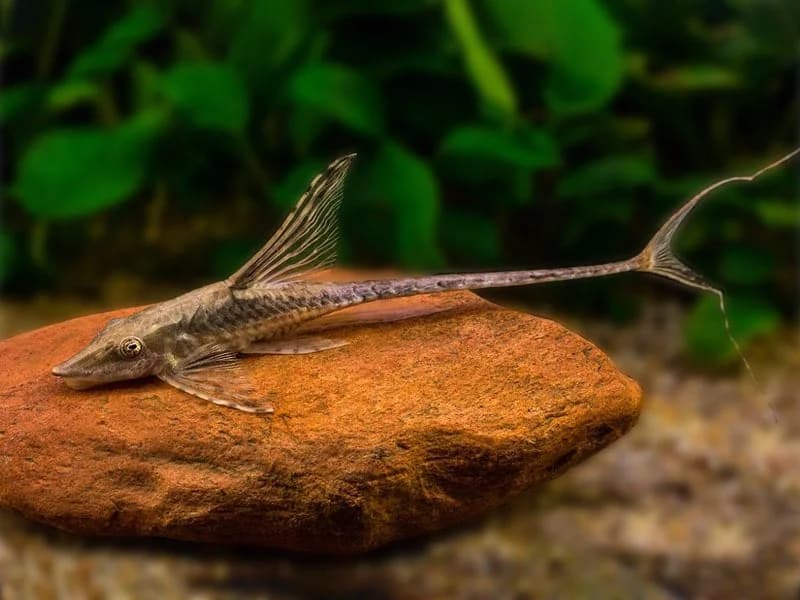
Sturisoma aureum, the royal farlowella catfish (also called the royal whiptail or giant farlowella), is a larger, more robust whiptail catfish from South America. Like the true Farlowella species, they have an extraordinarily elongated body with an armored exterior and a long, pointed rostrum. Males develop prominent bristle-like odontodes on the cheeks and snout, especially vivid during breeding season.
Native to rivers in Colombia, particularly the Magdalena River system, Sturisoma aureum inhabits moderately flowing rivers with rocky and sandy substrates and abundant driftwood. They are more adaptable than true Farlowella acus, tolerating a slightly wider range of conditions.
Royal farlowella care is intermediate. They require good water quality, an appropriate diet of algae and plant matter, driftwood for grazing, and gentle flow. Their larger size (7-8 inches) and distinctive appearance make them impressive display whiptail catfish.
Basic Overview
Common Misconceptions
"They are as delicate as true Farlowella." Sturisoma aureum is more robust and adaptable than Farlowella acus. It tolerates moderate flow and a slightly wider range of water chemistry, making it more accessible for intermediate keepers.
"Algae in the tank is sufficient food." Supplemental feeding with algae wafers, spirulina tablets, and blanched vegetables placed on or near their resting surfaces is essential. Tank algae alone rarely provides adequate nutrition.
"Males are the only ones to develop bristles." Males develop the most prominent bristle-like odontodes on the cheeks and snout, but this difference emerges with maturity and is most pronounced during breeding condition.
"They need strong current." While Sturisoma tolerate moderate flow better than Farlowella, they still prefer gentle to moderate current rather than strong turbulent flow.
Recommended Setup
- 55+ gallon tank
- Abundant driftwood and wood surfaces
- Hardy plants tied to wood or rocks
- Gentle to moderate flow
- Good filtration with gentle output
- Flat rocks or smooth driftwood for egg-laying
- Peaceful community tank mates
Diet
Royal farlowella catfish are primarily herbivorous algae and biofilm grazers:
- Algae wafers placed on resting surfaces
- Spirulina tablets
- Blanched zucchini, cucumber, spinach
- Dried Indian almond leaves for biofilm
- Small amounts of frozen bloodworms occasionally
Feed once daily, placing food on surfaces near where they rest. They are slow, non-competitive feeders that will not find food placed in open water. Target feeding is essential, especially in community tanks with faster-moving fish.
Personality
Royal farlowella catfish are meditative, unhurried fish that move with slow deliberation along driftwood and rock surfaces. Their extraordinary elongated body with bristle-adorned males creates one of the most unusual silhouettes in the freshwater hobby.
Breeding is a rewarding observation: males guard egg clutches deposited on flat wooden surfaces, fanning them continuously with their fins. The transparent eggs are clearly visible on the wood surface, and the male's devotion to egg care is impressive.
Their larger size (compared to true Farlowella) makes them somewhat more visible and less easily overlooked in a community tank, while retaining the peaceful, contemplative character of the whiptail catfish group.
Water Parameters
Royal farlowella catfish come from the warm, slightly soft rivers of Colombia:
- pH: 6.0-7.5
- Hardness (gH): 3-15 dGH
- Temperature: 72-79 degrees F
- Ammonia and Nitrite: 0 ppm
- Nitrate: below 15 ppm
Here are some top tips to deal with unwanted parameters:
- Good water quality with low nitrate is important. Weekly 25-30% water changes.
- Gentle flow is preferred over turbulent current.
- Slightly soft, slightly acidic water is ideal.
- Avoid copper-based medications.