Roseline Shark Care Guide
A Complete Care Guide for Sahyadria denisonii
Introduction
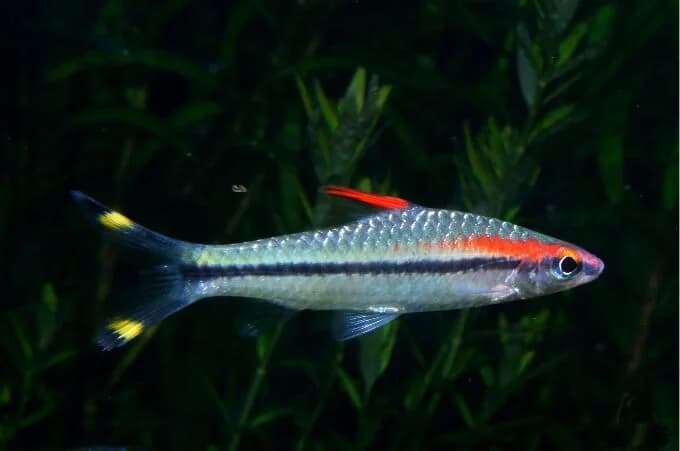
Sahyadria denisonii, the roseline shark (also called Denison's barb or the red-line torpedo barb), is one of the most visually striking freshwater fish available. Their streamlined torpedo body is decorated with a vivid red horizontal stripe from nose to tail and a yellow and black-tipped dorsal fin, creating a combination of colors unmatched by most aquarium fish.
Endemic to the fast-flowing rivers of the Western Ghats mountain range in Kerala, India, the roseline shark is listed as endangered in the wild due to over-collection for the aquarium trade and habitat destruction. Captive-bred specimens are now widely available and should be sourced in preference to wild-caught fish.
Their care is intermediate in difficulty. They require cool water (below 77 degrees F for long-term health), very high oxygenation, strong flow, and a school of at least 6 to display natural behavior. Given appropriate conditions, they are long-lived, active, and spectacular display fish.
Basic Overview
Common Misconceptions
"They are tropical fish that need warm water." Roseline sharks come from cool, fast-flowing mountain streams. Persistent temperatures above 77 degrees F cause chronic stress and significantly reduce lifespan. Keeping them at typical tropical temperatures (78-82 degrees F) is one of the most common care errors.
"A school of 3 is fine." Roseline sharks are active schooling fish that become stressed and shy in small groups. A minimum of 6, and preferably 8-10, is needed to see their full behavioral repertoire and reduce individual stress.
"Standard filtration is adequate." These fish come from highly oxygenated mountain torrents. They require very strong flow and high dissolved oxygen. A powerhead, wavemaker, or multiple filter outputs creating significant current throughout the tank is important.
"Wild-caught specimens are preferable." The wild population is endangered. Captive-bred roseline sharks are widely available, often hardier, and acclimated to aquarium conditions. Always source captive-bred.
Recommended Setup
- 75+ gallon tank for a school of 6
- Strong flow throughout the tank: powerheads, wavemakers, or multiple filter outputs
- High oxygenation: surface agitation essential
- Hardy plants (anubias, java fern, vallisneria)
- Smooth rocks and driftwood
- Open mid-water swimming space
- Secure lid (they are powerful jumpers)
Diet
Roseline sharks are omnivores that accept most aquarium foods readily:
- High-quality flake or small pellets as a staple
- Frozen bloodworms
- Frozen brine shrimp
- Blanched vegetables: zucchini, spinach
- Algae wafers
Feed twice daily. Roseline sharks are active, competitive feeders that accept food at all levels of the water column. A varied diet including both protein and plant matter maintains good health. Color-enhancing foods with astaxanthin help maintain the intensity of the red stripe.
Personality
Roseline sharks in an appropriate group are some of the most dynamic schooling fish available. They move quickly and purposefully through the tank, often swimming against the current generated by powerheads. A school of 8-10 roseline sharks in a large, current-filled tank is an extraordinary display.
Their active nature means they cover the entire tank constantly, making them visible and engaging from any viewing angle. Unlike shy fish that hide, roseline sharks are consistently present and active during daylight hours.
They are peaceful with all appropriate tank mates and do not fin-nip. Their only community tank limitation is that they need cool water, which restricts co-habitation with warm-water tropical species. Good tank mates include other cool-water tolerant fish.
Temperature and Longevity
The single most important factor in roseline shark longevity is temperature. In the wild, the rivers of the Western Ghats are fed by cool mountain sources and rarely exceed 74-75 degrees F. In aquariums maintained at standard tropical temperatures (78-82 degrees F), roseline sharks often live only 2-3 years rather than the 5-8 years achievable in appropriate conditions.
In rooms that maintain ambient temperatures of 68-75 degrees F, no heater may be needed. In warmer rooms, a cooling fan directed at the water surface, an aquarium chiller, or air conditioning to maintain room temperature can help keep the tank in the appropriate range.
Roseline sharks that are maintained at correct temperature will show more vivid coloration, higher activity, stronger immune function, and significantly longer lifespans than those kept too warm. Temperature is the most impactful single variable in their care.
Water Parameters
Roseline sharks come from the cool, fast-flowing, well-oxygenated rivers of the Western Ghats:
- pH: 6.5-7.8
- Hardness (gH): 5-15 dGH
- Temperature: 65-77 degrees F
- Ammonia and Nitrite: 0 ppm
- Nitrate: below 20 ppm
Here are some top tips to deal with unwanted parameters:
- Temperature below 77 degrees F is non-negotiable for long-term health and normal lifespan. This is the most critical parameter for this species.
- High dissolved oxygen from surface agitation and strong flow is essential. Inadequate oxygen causes lethargy and immune suppression.
- Weekly 25-30% water changes maintain good conditions. Active, fast-moving schooling fish in a large group produce significant waste.
- Neutral to slightly alkaline water reflects the mineral-rich mountain river water of their natural range. Soft, acidic water is less ideal than for Amazon species.