Iridescent Shark Care Guide
A Complete Care Guide for Pangasianodon hypophthalmus
Introduction
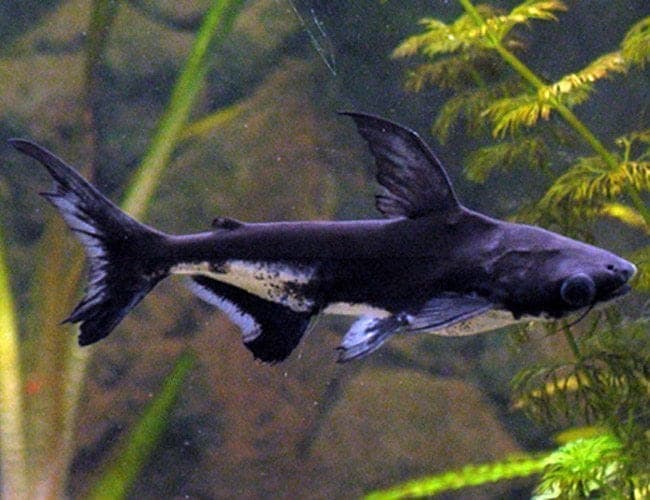
Pangasianodon hypophthalmus, the iridescent shark (also called the Siamese shark or sutchi catfish), is a large catfish from Southeast Asia that is one of the most frequently mis-sold fish in the aquarium trade. Juvenile iridescent sharks at 3-4 inches are attractive, active, schooling fish. However, they grow to 3-4 feet in captivity, making the vast majority of home aquariums entirely unsuitable for adult specimens.
Native to the Mekong and Chao Phraya river basins in Southeast Asia, iridescent sharks are primarily a food fish species in their native range, farmed extensively for consumption. In the wild, they undertake long migrations and reach 4-5 feet in length.
Iridescent sharks are only appropriate for fishkeepers with access to very large aquariums (300+ gallons) or indoor ponds. They should not be purchased for typical home aquariums. Their needs are included here as an educational resource for keepers who already have them.
Basic Overview
Common Misconceptions
"They will stay small in a small tank." This is the most critical and most commonly believed misconception. Iridescent sharks do not stay small. A 4-inch juvenile will reach 12-18 inches within the first year and 3+ feet within 3-4 years. Stunting in small tanks causes organ damage and suffering.
"They are appropriate for home aquariums." The vast majority of home aquariums cannot house adult iridescent sharks. They are only appropriate for large indoor ponds or public aquarium facilities. The purchase of juvenile iridescent sharks for standard home tanks is strongly discouraged.
"They are like other catfish." Iridescent sharks are open-water schooling fish that need massive horizontal swimming space. They are not bottom-dwelling catfish that can be kept in smaller tanks. They are highly sensitive to stress and will injure themselves panicking against tank walls.
"They can be kept alone." Iridescent sharks are schooling fish that are significantly more stressed alone or in pairs. Groups of 3-4 minimum are needed to reduce individual stress levels, which compounds the tank size requirement enormously.
Recommended Setup
- 300+ gallon indoor pond or tank for a small group of adults
- Open swimming space: these fish need to move freely and at speed
- Minimal decor to reduce collision risk when startled
- Very strong, high-volume filtration
- Large, smooth substrate
- Secure containment: they are powerful jumpers when panicked
Diet
Iridescent sharks are omnivores that accept most large aquarium foods:
- Large sinking pellets as a staple
- Frozen fish pieces
- Blanched vegetables in large quantities
- Frozen large shrimp
- Earthworms
Feed once daily in amounts consumed within a few minutes. Large iridescent sharks produce enormous quantities of waste and require very powerful filtration and frequent large water changes. As with any large schooling fish, their collective waste production is substantial.
Personality
Iridescent sharks are extremely skittish fish that will panic violently at sudden movements, loud sounds, or anything perceived as a threat. A frightened group of large iridescent sharks in a tank is capable of injuring themselves on the walls or equipment.
In a very large, stable, low-disturbance environment with a consistent routine, iridescent sharks gradually become calmer and more manageable. They never fully lose their skittishness but experienced keepers minimize disturbance and maintain predictable routines.
Their iridescent scales produce a beautiful shimmering effect under aquarium lighting. In an appropriately scaled setup, a school of large iridescent sharks moving in synchrony is an impressive display.
Water Parameters
Iridescent sharks come from the large, warm, slightly soft rivers of Southeast Asia:
- pH: 6.5-7.5
- Hardness (gH): 5-15 dGH
- Temperature: 72-79 degrees F
- Ammonia and Nitrite: 0 ppm
- Nitrate: below 20 ppm
Here are some top tips to deal with unwanted parameters:
- Massive water change regimes are required for adult iridescent sharks. In 300+ gallon setups, 20-30% weekly is the minimum. Pond setups often use flow-through or continuous water exchange.
- Very powerful biological filtration is essential. The waste production of large catfish demands industrial-scale filtration.
- Stable water parameters are especially important given their skittishness. Sudden parameter changes add stress on top of their already heightened startle response.
- Standard Southeast Asian river parameters suit them: slightly soft, neutral to slightly acidic water.