Giant Danio Care Guide
A Complete Care Guide for Devario aequipinnatus
Introduction
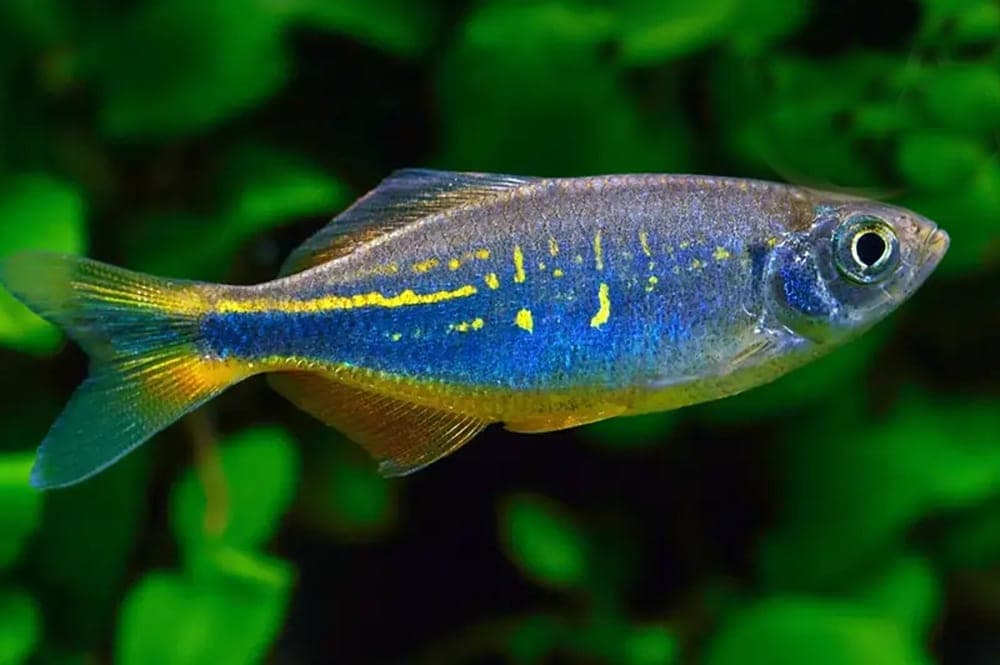
Devario aequipinnatus, the giant danio, is exactly what its name promises: a danio scaled up to a genuinely impressive size. Reaching 4 inches, with iridescent blue-and-gold horizontal stripes and a torpedo-shaped body built for speed, giant danios in a large school are one of the most dynamic displays in the freshwater hobby.
Native to fast-flowing rivers and streams of India, Nepal, and Sri Lanka, giant danios are active, bold, and extremely hardy fish. They tolerate a wide range of temperatures and water conditions and are recommended as dither fish (fast, bold fish that reduce the skittishness of other species) in setups with nervous or territorial fish.
Their size, speed, and schooling behavior make them a natural fit for large community tanks where smaller danio species would be dwarfed. They are tough, undemanding, and endlessly active.
Basic Overview
Common Misconceptions
"Giant danios are just large zebrafish." Giant danios are a completely different genus (Devario vs. Danio) and grow to 4 inches, making them genuinely large fish rather than a scaled-up version of their smaller relative.
"A small tank is fine since they are fast." Giant danios are active, open-water swimmers that need length more than volume. A 55-gallon long tank (48 inches) is a genuine minimum for a school; 75 gallons gives them proper space.
"They are fin nippers." Giant danios are not known as fin nippers. Their activity level may stress slow-moving, long-finned fish, but this is due to their energy rather than deliberate aggression.
"They prefer warm tropical conditions." Giant danios are cool-water fish that prefer 64–74°F. They tolerate warmer temperatures but do best, and live longest, at the cooler end of their range.
Recommended Setup
- 55+ gallon long tank for a school of 8–10
- Fine gravel or sand substrate
- Long, open swimming space in the middle; decorations along sides and back
- Hardy, fast-growing plants: Vallisneria, hornwort, Java fern
- Strong filtration with significant flow; they appreciate current
- Good surface agitation and oxygenation
- A very secure lid; giant danios are powerful, active jumpers
Diet
Giant danios are omnivores that feed on insects, small invertebrates, and plant matter in the wild. They accept virtually anything:
- High-quality tropical flakes or medium pellets as a staple
- Frozen bloodworms, brine shrimp, and daphnia
- Freeze-dried tubifex and krill
- Live foods for enrichment: earthworms, blackworms, brine shrimp
- Spirulina flakes for plant component
Feed once or twice daily. Giant danios are enthusiastic, fast feeders that consume food quickly. In a community tank, ensure bottom fish also receive food; the giant danios will take most of it before it sinks if not managed.
Personality
Giant danios are restless, energetic fish that are in near-constant motion throughout the tank. They school tightly when startled and loosely at other times, their iridescent stripes catching the light as they turn. In a large school in a suitably sized tank, they create a shimmering, kinetic display.
As dither fish, they have a specific role: their boldness and constant movement signals to nervous or shy fish that the environment is safe, reducing hiding behavior in species like discus, cichlids, and other fish that respond to the behavior of companions.
They are tough, forgiving, and tolerant of a wide range of conditions, making them excellent candidates for both experienced keepers and those still developing their fishkeeping skills.
Dither Fish Role
Giant danios are among the most recommended dither fish in the hobby. A dither fish is a bold, active species that, through its uninhibited behavior, communicates to more nervous tank mates that there is no danger present. This reduces hiding behavior in species that would otherwise spend most of their time concealed.
They work particularly well with large cichlids (oscars, discus, angels) and large shy fish like bala sharks, where their constant movement creates an environment of activity that helps the more nervous species feel secure.
They are equally useful in naturally timid species setups: large, nervous plecos and shy catfish species emerge more readily from hiding in tanks with active dither fish swimming openly in the midwater above them.
Water Parameters
Giant danios come from the fast-flowing, well-oxygenated rivers of South and Southeast Asia:
- pH: 6.0–8.0 (very adaptable)
- Hardness (gH): 5–19 dGH (very adaptable)
- Temperature: 64–77°F
- Ammonia and Nitrite: 0 ppm
- Nitrate: below 20 ppm
Here are some top tips to deal with unwanted parameters:
- Giant danios tolerate standard tap water in virtually any area without modification. They are among the most parameter-tolerant fish in the hobby.
- Weekly 25% water changes are sufficient for a well-filtered tank. Their hardiness means minor lapses in maintenance cause less harm than they would for more sensitive species.
- Keep temperature below 77°F for best long-term health. While they survive warmer conditions, their lifespan is meaningfully longer in the 68–74°F range.
- Strong flow and surface agitation suit them well and reflect their fast-water native habitat. A powerhead or spray bar directed across the surface benefits both oxygenation and their activity level.