Pearl Danio Care Guide
A Complete Care Guide for Danio albolineatus
Introduction
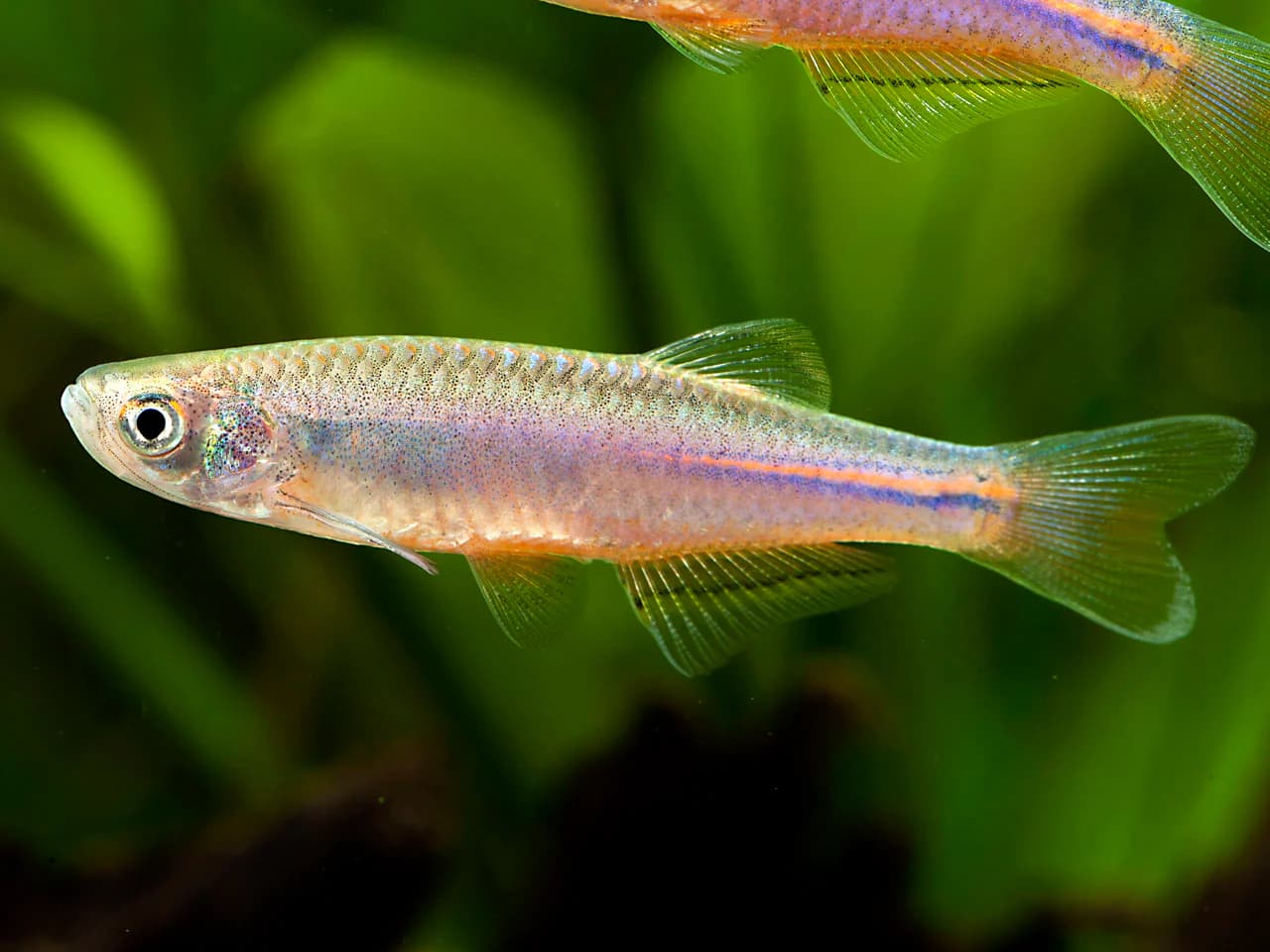
Danio albolineatus, the pearl danio, is a subtly beautiful schooling fish from Southeast Asia. Their translucent peach-to-pink body with a faint iridescent blue or green lateral stripe and fine pearlescent scales give them a soft, glowing appearance that rewards close observation. They are considerably less flashy than zebrafish or leopard danios but have their own quiet elegance that suits natural planted setups.
Native to fast-moving hill streams and rivers across Myanmar, India, Thailand, and Laos, pearl danios are hardy, active fish adapted to cool, well-oxygenated water. Their preference for cooler temperatures makes them suitable companions for other cool-water species and planted tanks without high tropical temperatures.
They are active, peaceful, and undemanding fish that school tightly in open water and fill the middle and upper zones of a community tank with constant movement. Their hardiness, adaptability, and peaceful temperament make them an excellent choice for a wide range of setups.
Basic Overview
Common Misconceptions
"They are boring compared to zebrafish." Pearl danios have a different kind of beauty: the pearlescent, soft iridescent quality of their scales in a large school under appropriate lighting is genuinely lovely. They are subtle rather than flashy.
"Warm tropical tanks are fine." Pearl danios prefer cooler water (64-75 degrees F) and live significantly longer at the cooler end of their range. In tanks running at 78 degrees F+, their lifespan is shortened.
"They can be kept in small numbers." Pearl danios are social schooling fish that display stress behaviors (erratic swimming, hiding) in groups below 6. A school of 10-12 is ideal.
"They stay in one part of the tank." Pearl danios are active open-water swimmers that explore the full length of the tank. They need horizontal swimming space more than volume.
Recommended Setup
- 20+ gallon long tank for a school of 8-10
- Fine gravel or sand substrate
- Open swimming space in the middle with planting along sides and back
- Hardy cool-water plants: Java fern, hornwort, Vallisneria, anubias
- Strong filtration with moderate to strong flow; they enjoy current
- Good surface agitation and oxygenation
- A secure lid; pearl danios are active jumpers
Diet
Pearl danios are omnivores that feed on small insects, invertebrates, and plant matter in the wild. They are undemanding eaters:
- High-quality tropical flakes or small pellets as a staple
- Frozen bloodworms, brine shrimp, and daphnia
- Freeze-dried tubifex and cyclops
- Live foods for enrichment: baby brine shrimp, micro worms
- Spirulina flakes for plant component
Feed once or twice daily with small amounts. Pearl danios are active feeders that consume food quickly and enthusiastically. Their hardiness means they tolerate occasional missed feedings without health consequences.
Personality
Pearl danios are lively, social fish that are in near-constant motion during their active periods. They school loosely during calm periods and tightly when startled, their pearlescent scales catching light at different angles as the school turns.
In a large school in a suitably sized long tank, pearl danios create a shimmering, constantly moving display that is quietly mesmerizing. Their activity level and bold behavior makes them natural dither fish for more nervous community tank inhabitants.
They are curious and interactive, often clustering near the front glass when their keeper approaches. In a well-maintained setup, they remain active and healthy for years with minimal intervention.
Cool-Water Community Options
Pearl danios prefer cooler temperatures that open up community options unavailable in standard tropical tanks. They pair beautifully with white cloud mountain minnows, peppered corydoras, rosy barbs, and weather loaches in an unheated or lightly heated tank at 68-74 degrees F.
This cool-water community approach is practical for keepers in temperate climates who do not want the expense and energy consumption of heating a large tank year-round. A 40-gallon unheated tank in a temperate home can maintain 65-72 degrees F naturally.
In temperate climates, an outdoor pond during summer months works well for pearl danios and their cool-water companions, providing natural temperature fluctuation and live food from the water surface that produces exceptional color and condition.
Water Parameters
Pearl danios come from the cool, fast-flowing hill streams of Myanmar and surrounding regions:
- pH: 6.0-8.0 (very adaptable)
- Hardness (gH): 5-19 dGH (very adaptable)
- Temperature: 64-77 degrees F
- Ammonia and Nitrite: 0 ppm
- Nitrate: below 20 ppm
Here are some top tips to deal with unwanted parameters:
- Standard tap water in virtually any area suits pearl danios without modification. They are among the most water-chemistry-tolerant danio species.
- Keep temperature below 77 degrees F for best long-term health and lifespan. Their lifespan is meaningfully longer in the 65-74 degree F range than in warmer water.
- Weekly 25% water changes are sufficient in a well-filtered tank. Strong filtration with biological media handles the waste from an active school effectively.
- Good surface agitation and oxygenation suits their fast-water background. A spray bar or powerhead directed to create moderate current benefits their health and activity level.