Red Eye Tetra Care Guide
A Complete Care Guide for Moenkhausia sanctaefilomenae
Introduction
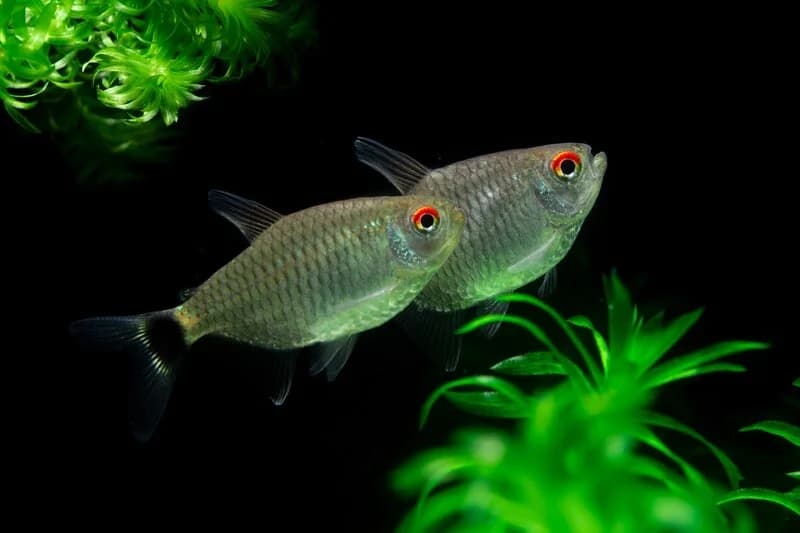
Moenkhausia sanctaefilomenae, the red eye tetra, is a hardy and active schooling tetra notable for its vivid red iris and the prominent black band near the tail. It is larger and more robust than most tetras at nearly 3 inches, and its active, bold nature makes it an excellent centerpiece schooling fish for medium to large community tanks.
Native to the Paraguay River basin and surrounding drainages in Paraguay, Brazil, and Bolivia, red eye tetras inhabit slow-moving rivers, lakes, and flooded forest margins. They are adaptable to a range of water conditions and are one of the hardiest tetras available.
Red eye tetras are easy to care for and beginner-friendly. Their hardiness, size, and active behavior make them a good choice for fishkeepers who want a schooling fish with more presence than smaller tetras.
Basic Overview
Common Misconceptions
"They are safe with all community fish." Red eye tetras are active fin-nippers that should not be kept with bettas, angels with long fins, or slow-moving fish with flowing fins. Keep them with similarly active, robust fish.
"They need special water conditions." Red eye tetras are unusually adaptable and tolerate a very wide range of water chemistry, from soft acidic to moderately hard and alkaline. They are among the hardiest tetras available.
"A school of 4 is fine." Groups of 8+ are significantly better for behavior and welfare. Smaller groups are shyer and more likely to nip at other fish.
"Their red eyes are a disease indicator." The vivid red iris is a natural, healthy characteristic of the species, not a sign of disease. Pale or faded eye color is the disease indicator - bright red eyes confirm healthy specimens.
Recommended Setup
- 30+ gallon tank for a school of 6-8
- Open mid-water swimming space
- Hardy plants (anubias, java fern) or artificial plants
- Moderate flow
- Fine gravel or sand substrate
- Good filtration
Diet
Red eye tetras are omnivores that readily accept most community foods:
- High-quality flake or small pellets
- Frozen bloodworms
- Frozen brine shrimp
- Frozen daphnia
- Blanched vegetables occasionally
Feed twice daily in moderate amounts. Red eye tetras are enthusiastic eaters that readily accept most foods. A varied diet maintains the best health and most vibrant eye coloration.
Personality
Red eye tetras are bold, energetic fish with a more assertive personality than smaller tetra species. In a school of 8 or more they create a lively, constantly moving display. Their size gives them presence that smaller tetras lack.
Males display actively to each other and to females, with fin-spreading and circling behavior that adds behavioral interest beyond simple schooling. Their vivid red eyes and the black tail band make them visually distinctive even from a distance.
Their hardiness and tolerance of a wide range of conditions make them one of the most reliable community tetras for aquarists who want a schooling fish with minimal water chemistry requirements.
Water Parameters
Red eye tetras are highly adaptable to a wide range of water conditions:
- pH: 6.0-8.0 (very adaptable)
- Hardness (gH): 5-25 dGH (very adaptable)
- Temperature: 72-82 degrees F
- Ammonia and Nitrite: 0 ppm
- Nitrate: below 25 ppm
Here are some top tips to deal with unwanted parameters:
- Red eye tetras tolerate harder, more alkaline water than most South American tetras. They are one of the few tetras suitable for harder tap water areas without water softening.
- Standard weekly 25% water changes and consistent maintenance are all that is required.
- They are more temperature-tolerant than most tropical fish. They handle brief temperature variations without the sensitivity of more delicate species.
- Good oxygenation and moderate filtration are the only technical requirements. They are genuinely easy fish.