Diamond Tetra Care Guide
A Complete Care Guide for Moenkhausia pittieri
Introduction
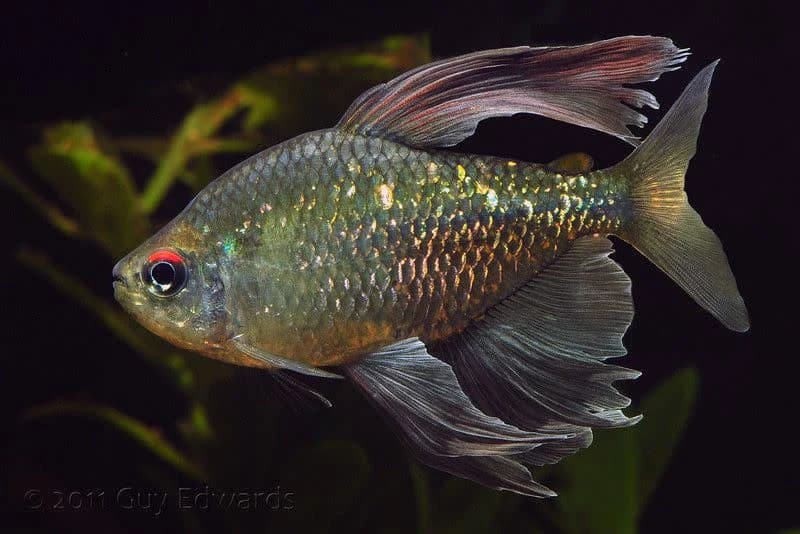
Moenkhausia pittieri, the diamond tetra, is one of the most spectacular tetras in terms of pure sparkle. Their scales reflect and refract light so intensely under bright lighting that individual fish appear to be encrusted with diamonds, giving the entire school a scintillating, living-glitter quality that is unlike any other freshwater fish. Males additionally develop highly extended dorsal, anal, and ventral fins as they mature, adding elegance to the display.
Native to Lake Valencia and surrounding rivers in northern Venezuela, diamond tetras inhabit slow-moving, well-vegetated waters in their native range. Unlike many tetras, Lake Valencia is relatively hard and alkaline by South American standards, making diamond tetras more adaptable to typical tap water than their blackwater-dwelling relatives.
They are peaceful, moderately sized (2.5 inches), and long-lived tetras that are underused in the hobby relative to their visual impact. A school of 12 or more diamond tetras in a well-lit planted tank is one of the most impressive freshwater displays available.
Basic Overview
Common Misconceptions
"They look dull in the fish store." Diamond tetras in the fluorescent-lit, often stressed conditions of a fish store are pale shadows of what they become in a well-lit, established planted tank with dark substrate. Their iridescence requires good lighting and established health to develop fully.
"They need blackwater conditions like most South American tetras." Diamond tetras come from Lake Valencia, which is significantly harder and more alkaline than typical Amazon blackwater. They adapt well to neutral to slightly alkaline tap water without special soft-water treatment.
"The extended fins are a genetic defect." The elongated dorsal and anal fin rays that develop on mature males are entirely natural and a sign of health and age, not deformity. A fully finned mature male diamond tetra is a genuinely beautiful fish.
"They are just sparkly neon tetras." Diamond tetras are significantly larger (2.5 inches), more reflective, and more impressively finned than neon tetras. They are a different species with different care requirements and a distinct visual impact.
Recommended Setup
- 30+ gallon planted tank for a school of 8-12
- Dark fine sand or planted substrate for maximum contrast
- Green background planting: Amazon swords, crypts, large stem plants
- Open swimming space in the midwater for schooling display
- Bright lighting to maximize iridescence; diamond tetras reward good lighting more than almost any other tetra
- Moderate to gentle filtration
- Driftwood and some tannin for naturalistic appearance
Diet
Diamond tetras are omnivores that accept a wide range of foods. Diet quality visibly affects their iridescence and fin development:
- High-quality tropical flakes or small pellets as a staple
- Frozen bloodworms and brine shrimp (important for color and fin development)
- Frozen daphnia and cyclops
- Live foods for enrichment: baby brine shrimp, micro worms
- Spirulina flakes for plant component
Feed once or twice daily. A varied, high-quality diet directly affects the brightness of their iridescence and the development of male fin extensions. Carotenoid-rich foods (brine shrimp, krill) enhance pigmentation. Protein-rich foods support fin development.
Personality
Diamond tetras are active, social schooling fish that use the full middle zone of the tank. In a large school under good lighting, the collective sparkle of the school in motion is extraordinary: as the school turns, waves of iridescence ripple through it as each fish catches the light at a slightly different angle.
Males display to each other constantly with spread fins and lateral displays, which both improves their individual visual impact and encourages them to develop more fully extended fins over time. A well-maintained group of 12 males will develop significantly more impressive finnage than isolated individuals.
They are peaceful with all community fish that are not small enough to be threatened by mild fin-nipping. In appropriate school sizes they are excellent, reliable community tank residents.
Lighting for Maximum Iridescence
Diamond tetras are one of the species most affected by lighting quality and direction. Their iridescence comes from layers of guanine crystals in their scales that reflect and refract light. The quality of the lighting determines how visible this effect is.
Bright lighting at a slightly angled direction creates the best iridescence display. Overhead LED lighting at full brightness with a dark substrate provides maximum contrast and allows the reflective scales to sparkle. Dim or diffused lighting produces a fish that appears ordinary silver.
The combination of bright lighting, dark substrate, green plants, and a school of 12+ fully developed diamond tetras is one of the highest-impact low-cost aquarium displays available. The per-fish cost is modest; the collective visual impact of a large school in good conditions is exceptional.
Water Parameters
Diamond tetras come from Lake Valencia in Venezuela, which is harder and more alkaline than typical Amazon water:
- pH: 6.5-7.8 (adaptable; tolerates slightly alkaline water)
- Hardness (gH): 5-15 dGH (more tolerant of hard water than most Amazon tetras)
- Temperature: 72-82 degrees F
- Ammonia and Nitrite: 0 ppm
- Nitrate: below 20 ppm
Here are some top tips to deal with unwanted parameters:
- Standard neutral-to-slightly-alkaline tap water is suitable for diamond tetras in most areas. Unlike many South American tetras, they do not require soft acidic water as a genuine necessity.
- Weekly 25% water changes maintain the water quality needed for peak iridescence. Clean water is particularly important for species whose appearance depends on light reflecting cleanly off their scales.
- While they tolerate harder water, some tannin addition from driftwood or Indian almond leaves still benefits them aesthetically. The combination of slight tannin with bright lighting and dark substrate produces the most visually dramatic result.
- Temperature stability in the 74-79 degree F range is optimal. They tolerate a wide range but do best with stable conditions in the middle of their tolerance band.