Emperor Tetra Care Guide
A Complete Care Guide for Nematobrycon palmeri
Introduction
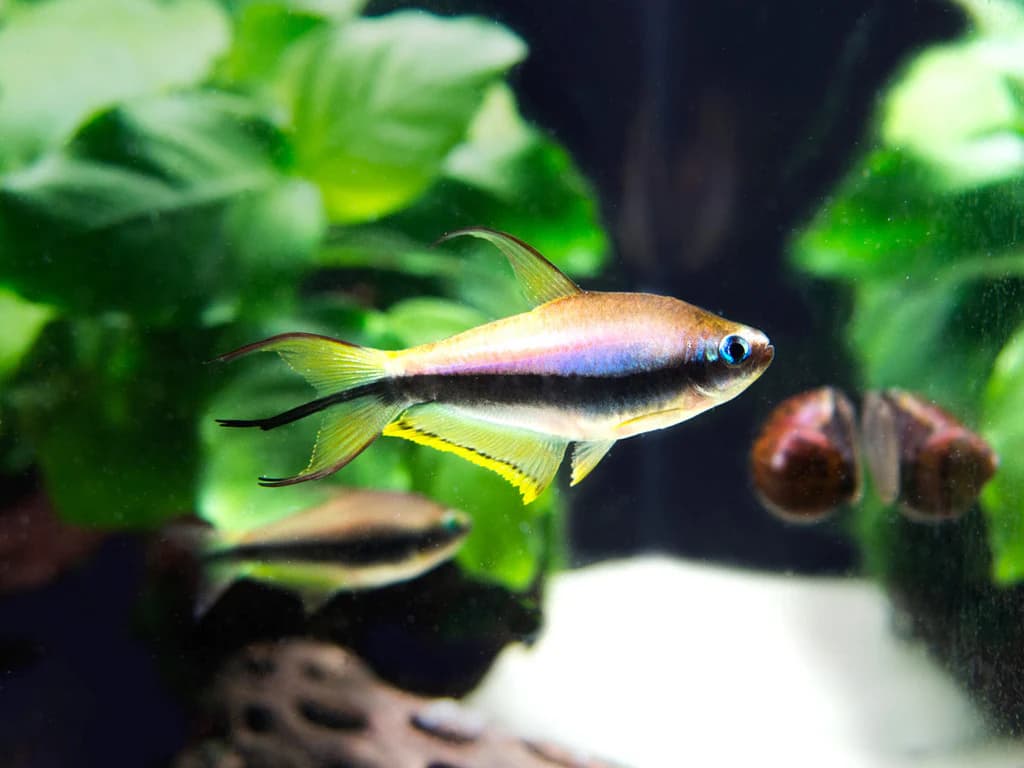
Nematobrycon palmeri, the emperor tetra, is one of the most distinctively shaped and colored tetras available. Males develop an elongated, trident-shaped tail with extended central rays, and display vivid purple-blue iridescence along their flanks with striking blue eyes. The species is named for its regal bearing - males hold themselves erect and display with a confidence unusual in small tetras.
Native to the San Juan and Atrato river drainages in Colombia, emperor tetras inhabit slow-moving, heavily vegetated rivers and flooded forests with soft, acidic water. They are found at mid-water levels in areas of dense plant growth.
Emperor tetras are rated easy to moderate in care and make excellent community fish. Their peaceful temperament, manageable adult size of around two inches, and striking appearance make them a premium choice for planted community tanks.
Basic Overview
Common Misconceptions
"They school tightly like neon tetras." Emperor tetras school loosely rather than in the tight formations of cardinal or neon tetras. Males in particular occupy individual micro-territories and display to each other within the group. This open, confident behavior is characteristic of the species.
"Males will fight seriously." Male emperor tetras display intensely to each other, spreading fins and circling, but serious injury is rare in a tank with adequate space and plants to break line of sight. Multiple males in a 20+ gallon planted tank is fine.
"They need blackwater conditions." While they come from soft, acidic Colombian rivers, emperor tetras are adaptable to a wide range of water conditions. Neutral pH with moderate hardness is perfectly acceptable for long-term health, making them suitable for typical community tank parameters.
"The trident tail is present in both sexes." The extended central tail rays and trident shape are a male characteristic. Females have a rounded tail and are slightly less colorful, lacking the intense iridescence of mature males.
Recommended Setup
- 20+ gallon tank for a group of 6-8
- Dense planting: tall background plants, mid-ground stems, some floating plants
- Gentle to moderate flow
- Soft, diffused lighting; floating plants help diffuse light and replicate natural canopy
- Dark substrate to enhance color contrast
- Driftwood and leaf litter for natural aesthetics and slight tannin addition
- Secure lid
Diet
Emperor tetras are omnivores that readily accept most standard aquarium foods:
- High-quality micro pellets or crushed flake as a staple
- Frozen bloodworms (occasional treat)
- Frozen brine shrimp
- Frozen daphnia
- Live or frozen micro worms
Feed twice daily in small amounts. Emperor tetras are not demanding about food and readily accept most small aquarium foods. A varied diet that includes both dry staple foods and occasional frozen or live foods maintains good health and vibrant coloration.
Personality
Emperor tetras are confident, elegant fish that carry themselves with a poise unusual in small tetras. Males display to each other constantly, erecting fins and circling with their vivid blue eyes and iridescent flanks on full display. These displays are visual and rarely escalate to physical contact.
They are compatible with virtually all peaceful community fish. Unlike some tetras, they do not fin-nip and can be safely kept with long-finned bettas, angelfish, and other flow-finned species. Their own flowing tails make them appealing targets for fin-nipping species, so avoid combining with nippy tank mates.
Emperor tetras become increasingly bold over time in a well-maintained tank. They are among the tetras most likely to approach the front glass, investigate the keeper, and feed from the surface rather than staying mid-water.
Breeding Emperor Tetras
Emperor tetras breed willingly in soft, slightly acidic water at around 78 degrees F. The male courts the female with elaborate fin displays, and eggs are scattered among fine-leaved plants or spawning mops. The parents do not care for the eggs and will eat them given the opportunity.
Spawning typically occurs in the morning. Eggs are small, slightly adhesive, and hatch in 24-30 hours. The fry are tiny and require infusoria or commercial fry food for the first week before graduating to newly hatched brine shrimp.
For successful breeding, move a conditioned pair to a separate breeding tank with Java moss or fine-leaved spawning plants, soft acidic water, and dim lighting. Remove the parents after spawning. The fry are initially sensitive but grow quickly.
Water Parameters
Emperor tetras come from Colombian rivers and are adaptable to a range of aquarium conditions:
- pH: 5.5-7.5 (optimal 6.5-7.0)
- Hardness (gH): 2-15 dGH
- Temperature: 73-81 degrees F
- Ammonia and Nitrite: 0 ppm
- Nitrate: below 20 ppm
Here are some top tips to deal with unwanted parameters:
- Emperor tetras are water-quality tolerant and do not require the specific soft-water conditions of more demanding species. Standard community tank parameters (neutral pH, moderate hardness) are fine for long-term health.
- Good water quality produces the most vivid coloration, particularly the blue iridescence of males. Weekly 25% water changes maintain the conditions for peak color.
- Temperature toward the upper end of their range (78-81 degrees F) tends to intensify color and breeding activity. Lower temperatures slow metabolism and activity but are not harmful.
- Avoid large, sudden water changes. Consistent, regular maintenance is preferable to infrequent large changes that cause parameter swings.