Glowlight Tetra Care Guide
A Complete Care Guide for Hemigrammus erythrozonus
Introduction
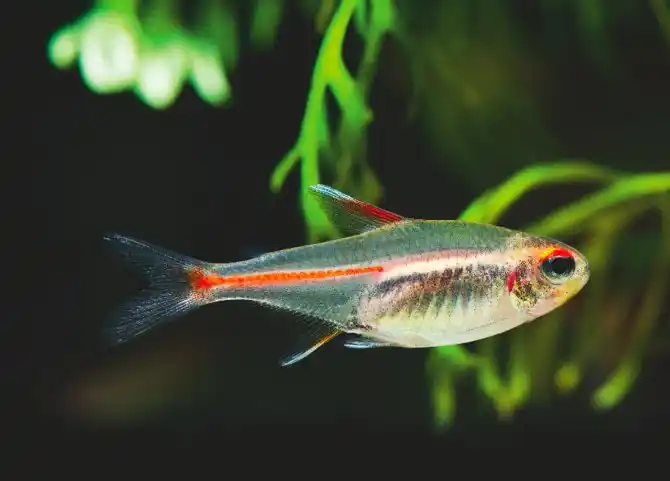
Hemigrammus erythrozonus, the glowlight tetra, is a classic community aquarium fish beloved for the vivid neon-orange to red horizontal stripe running the full length of their body. Under good lighting, this stripe has an almost luminescent quality that gives the species its common name. They are peaceful, hardy, and one of the best schooling tetras for beginner and experienced aquarists alike.
Native to the Essequibo River in Guyana, South America, glowlight tetras inhabit slow-moving, heavily vegetated rivers and streams with soft, acidic, tannin-stained water. In the wild they form large schools in shaded, densely planted areas near the riverbank.
Glowlight tetras are easy to care for and suitable for community tanks of 15 gallons and above. Their peaceful temperament, attractive coloration, and hardiness make them one of the most reliable and recommended community tetras.
Basic Overview
Common Misconceptions
"The orange stripe fades over time." Fading of the glowlight stripe is a sign of stress, poor water quality, or incorrect diet - not an inevitable aging process. In good conditions with a varied diet, the stripe remains vivid throughout the fish's life. Improving conditions will restore the stripe in faded specimens.
"A school of 4-5 is adequate." While glowlight tetras will survive in small groups, they are much more active and vibrant in groups of 8 or more. In larger schools, their natural schooling behavior emerges and the combined visual effect of multiple vivid stripes is far more striking.
"They need blackwater conditions." Glowlight tetras are adaptable to a range of water conditions and do not require blackwater chemistry for long-term health. Neutral pH and moderate hardness is acceptable, though soft, slightly acidic water produces the most vibrant coloration.
"They are exactly like neon tetras in care." Glowlight tetras are hardier and more temperature-tolerant than neon tetras. They are less susceptible to neon tetra disease and tolerate a wider range of water conditions, making them a better choice for beginners than their more commonly sold relatives.
Recommended Setup
- 15+ gallon tank for a school of 8-10
- Dense planting or open planted community setup
- Dark substrate to enhance the stripe contrast
- Gentle to moderate flow
- Soft to moderate lighting
- Driftwood or leaf litter optional but beneficial for natural aesthetics and tannins
Diet
Glowlight tetras are omnivores that readily accept most standard community foods:
- High-quality small flake or micro pellets as a staple
- Frozen bloodworms (occasional treat)
- Frozen brine shrimp
- Frozen daphnia
- Live or frozen micro worms
Feed twice daily in small amounts. A varied diet including occasional frozen or live foods maintains the most vibrant stripe coloration. Color-enhancing foods with carotenoids or astaxanthin help maintain the orange-red intensity.
Personality
Glowlight tetras are active, sociable, and confident community fish. In a group of 8 or more, they school in loose formations through the planted tank, with the combined effect of multiple vivid stripes creating a dynamic, eye-catching display.
They are completely peaceful with all similarly sized or smaller community fish, shrimp, and snails. They will not bother larger fish either, making them appropriate for community tanks that include a wide range of species.
Under warm-spectrum lighting directed at the tank, the orange-red stripe develops an almost fluorescent intensity. The combination of their classic tetra body shape, the vivid stripe, and active schooling behavior makes them one of the most satisfying community fish to maintain.
Water Parameters
Glowlight tetras come from the soft, slightly acidic rivers of Guyana:
- pH: 6.0-7.5
- Hardness (gH): 2-15 dGH
- Temperature: 74-82 degrees F
- Ammonia and Nitrite: 0 ppm
- Nitrate: below 25 ppm
Here are some top tips to deal with unwanted parameters:
- Glowlight tetras are more water-quality tolerant than many tetras. Standard community tank conditions (neutral pH, moderate hardness) produce long-term healthy fish.
- For the most vivid stripe, soft, slightly acidic water (pH 6.5-7.0, low hardness) and excellent water quality are beneficial. The stripe intensifies noticeably in ideal conditions.
- Weekly 25% water changes maintain the water quality important for health and long-term coloration. Consistent maintenance is more important than specific chemistry targets.
- Temperature in the 76-80 degree F range is optimal. They tolerate a wider range but do best in stable mid-range conditions.