Paradise Fish Care Guide
A Complete Care Guide for Macropodus opercularis
Introduction
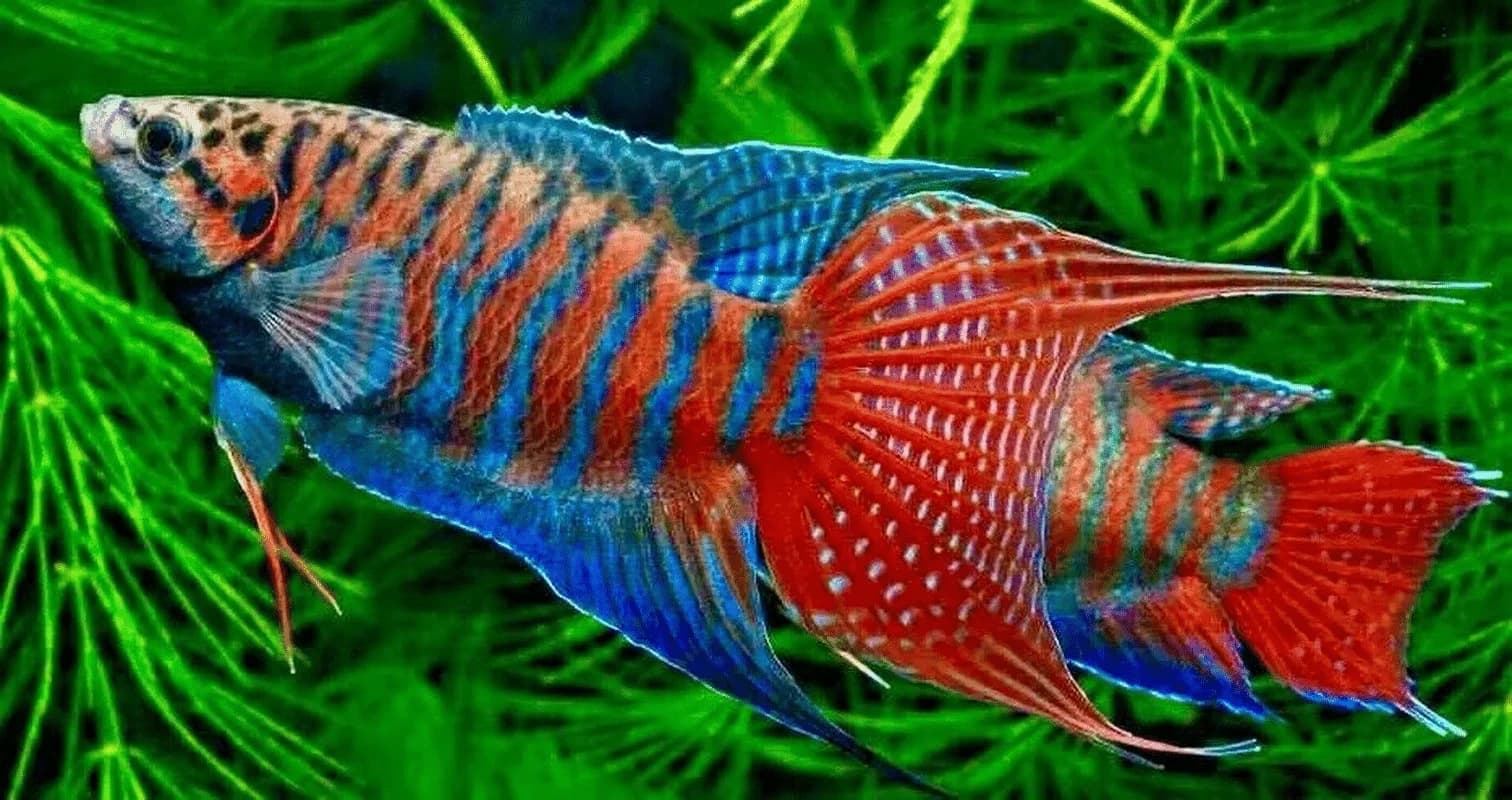
Macropodus opercularis, the paradise fish, is one of the first ornamental fish ever kept in European aquariums, introduced in 1869, making it a genuine historical species in the hobby. Males are brilliantly colored with alternating blue and red-orange stripes, flowing fins, and extensions on the tail that rival the betta in visual impact.
Native to East Asia, including China, Taiwan, Vietnam, Korea, and Japan, paradise fish inhabit rice paddies, slow streams, ditches, and ponds, including areas that freeze in winter. This cold tolerance distinguishes them from most other labyrinth fish and makes them suitable for unheated tanks in temperate climates.
Paradise fish are aggressive and territorial toward each other and toward other fish, particularly those with long fins or similar coloring. They are best kept one per tank or in carefully managed setups. Their hardiness, cold tolerance, and stunning appearance make them worth the management challenges.
Basic Overview
Common Misconceptions
"Paradise fish are like bettas and have the same care." Paradise fish are significantly more aggressive than most betta morphs, are larger, and are much more cold-tolerant. They are a different species with distinct requirements, though they share the labyrinth fish breathing organ.
"They can be kept in pairs." Two male paradise fish will fight severely. Two females can sometimes coexist. A male-female pair may work in a larger tank, but the male often harasses the female aggressively outside of spawning season.
"They need tropical temperatures." Paradise fish thrive in cooler water than most tropical fish and are one of the few ornamental fish that can be kept successfully in an unheated tank in a temperate climate home.
"Their aggression makes them impossible for community tanks." With careful planning and fast-moving tank mates, community setups are possible. The key is avoiding long-finned, slow fish and selecting robust companions that can easily escape harassment.
Recommended Setup
- 20+ gallon tank for a single male
- Dense planting provides cover and breaks line of sight
- Floating plants are particularly valuable for this surface-oriented labyrinth fish
- Caves and hiding spots for tank mates if any are kept
- No heater required in most temperate homes; temperature range 65–77°F is ideal
- Gentle filtration; labyrinth fish prefer still to mildly moving water
- A tight lid with minimal gaps; they jump readily
Diet
Paradise fish are carnivores that hunt insects, small fish, and invertebrates in the wild. They are eager, undemanding feeders:
- High-quality tropical flakes or carnivore pellets as a staple
- Frozen bloodworms and brine shrimp
- Frozen mosquito larvae (a natural prey item)
- Live foods: fruit flies, crickets, small earthworms
- Freeze-dried tubifex and blackworms
Feed once or twice daily. Paradise fish are enthusiastic and undemanding eaters that will readily accept most foods offered. Avoid overfeeding; their active metabolism in cool water can lead to obesity if fed excessively.
Personality
Paradise fish are confident, assertive, and visually impressive fish. Males flare their fins, intensify their colors, and display aggressively at any perceived rival, including their own reflections. The display behavior is one of the most dramatic in the freshwater hobby, with the fish puffing up to appear as large as possible.
Despite their aggression toward other fish, they are generally interactive with their keepers and learn to associate the person at the tank with feeding. Some become quite bold and approach the glass readily.
Their cold tolerance means they are active even in cooler water that would make most tropicals sluggish. In a cool room in winter, a paradise fish tank remains lively and colorful when other tanks might contain slow, inactive fish.
Breeding Paradise Fish
Paradise fish are bubble nest builders like bettas. The male constructs a bubble nest at the surface beneath floating plants and courts the female with elaborate displays. Spawning involves a typical labyrinth fish embrace, with eggs rising to be collected in the nest by the male.
The male guards the nest aggressively and should be separated from the female after spawning, as he will attack her. He will tend the nest and the fry until they are free-swimming, at which point he should also be removed as he may eat the fry.
Fry are tiny and need infusoria or liquid fry food initially, transitioning to baby brine shrimp as they grow. They develop rapidly and begin to show color within 2–3 months.
Water Parameters
Paradise fish are among the most adaptable of all aquarium fish in terms of water parameters:
- pH: 6.0–8.0 (very adaptable)
- Hardness (gH): 5–30 dGH (very adaptable)
- Temperature: 61–82°F
- Ammonia and Nitrite: 0 ppm
- Nitrate: below 30 ppm
Here are some top tips to deal with unwanted parameters:
- Paradise fish tolerate a wider range of water conditions than virtually any other ornamental fish. Standard tap water in most areas is perfectly suitable without modification.
- Weekly 25% water changes are sufficient maintenance. Their hardy constitution means they handle beginner water management mistakes better than most species.
- Cooler temperatures (65–72°F) are preferred for long-term health and longevity. Warmer temperatures increase activity but may shorten lifespan.
- The air gap between the water surface and the lid must be kept humid and warm. Labyrinth fish breathe surface air; cold, dry air above the surface can cause respiratory problems, particularly in winter.