Nerite Snail Care Guide
A Complete Care Guide for Neritina spp.
Introduction
Nerite snails are among the most popular and useful invertebrates in the aquarium hobby. Unlike many snails that can reproduce explosively in freshwater tanks, nerite snails require brackish or marine water to complete their reproductive cycle, meaning they will never overrun a freshwater aquarium.
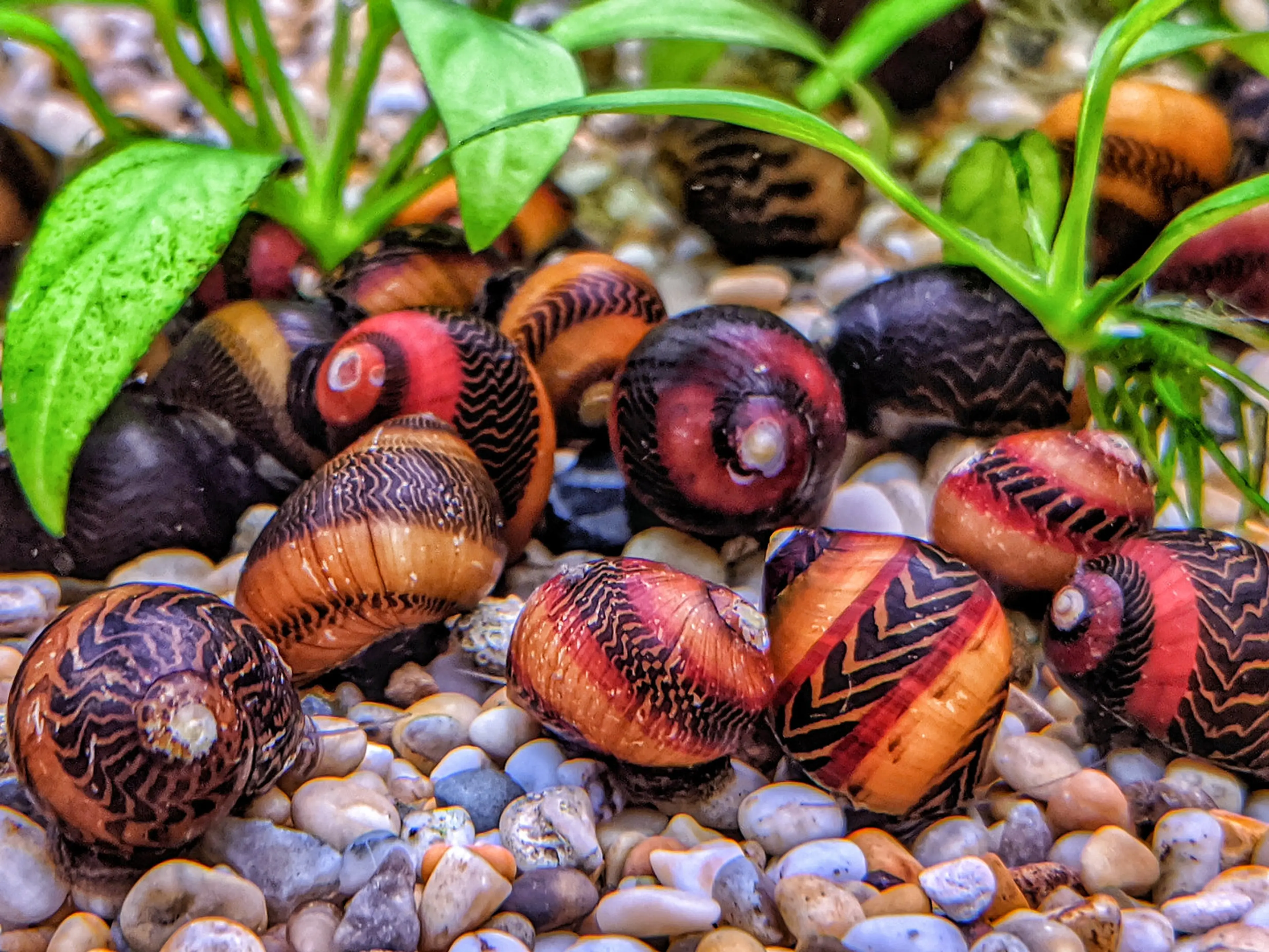
Available in a variety of striking patterns and colors, including the zebra nerite (black and gold stripes), tiger nerite (orange with black streaks), and olive nerite (smooth dark olive-green), each nerite brings both visual appeal and practical algae-cleaning ability to any freshwater tank.
They are excellent cleaners of glass, substrate, and decor, methodically consuming green algae, diatoms, and biofilm. They are peaceful, hardy, and coexist with virtually any community fish.
Basic Overview
Common Misconceptions
"Nerite snails will breed and overrun my tank." They cannot complete their life cycle in freshwater. Females lay white eggs on hard surfaces (which can be mildly unsightly) but the eggs will not hatch in freshwater conditions. No population explosion will occur.
"They eat all algae." Nerites are exceptional at green film algae, green dust algae, and diatoms (brown algae). They do not effectively eat black beard algae, hair algae, or green spot algae (the hardest spots on glass that require a razor blade).
"They will eat my plants." Nerite snails do not eat healthy plant tissue. They consume the algae growing on plant leaves, which is beneficial. A nerite cleaning algae off your plant leaves is exactly what they are supposed to do.
"One nerite is enough to clean any size tank." One nerite per 5–10 gallons is a rough guide for algae control. A 55-gallon tank with algae issues needs 5–10 nerites to make a meaningful impact.
Recommended Setup
- 5+ gallon cycled tank with stable water parameters
- Any standard freshwater substrate
- Algae-covered surfaces: glass, smooth rocks, driftwood, plant leaves
- Adequate calcium in the water; nerites need calcium for healthy shell growth
- A secure lid with minimal gaps; nerites are extraordinary escape artists and will leave a tank through any opening
- Avoid copper-based medications; lethal to all invertebrates
- Moderate lighting to support natural algae growth for grazing
Diet
Nerite snails are primarily algae grazers that feed on biofilm and soft algae growth throughout the tank. In a well-established tank with healthy algae, they largely feed themselves. When algae is scarce:
- Algae wafers (place near or under them)
- Blanched zucchini or cucumber slices
- Sinking shrimp or snail pellets
- Blanched spinach or lettuce (remove after a day to prevent fouling)
Nerites are relatively light feeders. In a tank with adequate algae growth, supplemental feeding is rarely needed. In a very clean, algae-free tank, feed supplementally 2–3 times per week. Their continued active movement is the best sign they are finding enough food.
Personality
Nerite snails are surprisingly active and engaging tank inhabitants. They explore the entire tank methodically, climbing the glass, traversing driftwood, and inspecting every leaf. Watching them turn themselves right-side up when they fall, using their muscular foot, is oddly satisfying.
They are completely peaceful and show no aggression toward any other aquarium inhabitant. Fish that might investigate or occasionally peck at them generally lose interest quickly once they encounter the hard shell.
One quirk worth knowing: nerites occasionally climb out of the water completely and graze on the damp glass above the waterline. This is normal behavior and not a sign of distress, as long as the area is humid and they are not actually escaping the tank.
Shell Health and Calcium
A nerite snail's shell health is directly related to the calcium content of the tank water. In soft, acidic water, shells gradually erode, developing pitting and white patches on older areas of the shell. This is purely cosmetic but is a sign that calcium levels could be higher.
To support healthy shells, ensure some hardness in the water (GH of 8+ dGH is helpful). In soft water tanks, add a piece of cuttlebone, crushed coral in the filter, or a small amount of limestone rock to gradually increase calcium availability.
New shell growth is visible as a lighter band of color at the edge of the shell opening. As long as new growth is occurring and the snail is active and eating, the snail is healthy regardless of older shell appearance.
Water Parameters
Nerite snails are adaptable and hardy but benefit from stable, moderately hard water:
- pH: 7.0–8.5 (slightly alkaline preferred for shell health)
- Hardness (gH): 8–18 dGH (moderate to hard)
- Temperature: 72–82°F
- Ammonia and Nitrite: 0 ppm
- Nitrate: below 20 ppm
Here are some top tips to deal with unwanted parameters:
- In soft, acidic tanks, add a small piece of cuttlebone or a bag of crushed coral in the filter to increase calcium and buffering capacity. This prevents shell erosion.
- Avoid adding copper-based medications to any tank containing nerites. Even low concentrations of copper are lethal to invertebrates.
- Weekly water changes of 20–25% maintain water quality without dramatically shifting parameters. Nerites tolerate stable soft water but do best with moderate hardness.
- If a nerite closes its operculum (trapdoor) and does not move for several days, check water parameters. A sniff test (they smell strongly when dead) is the simplest way to confirm whether they are alive or not; this is normal snail keeping.