Lambchop Rasbora Care Guide
A Complete Care Guide for Trigonostigma espei
Introduction
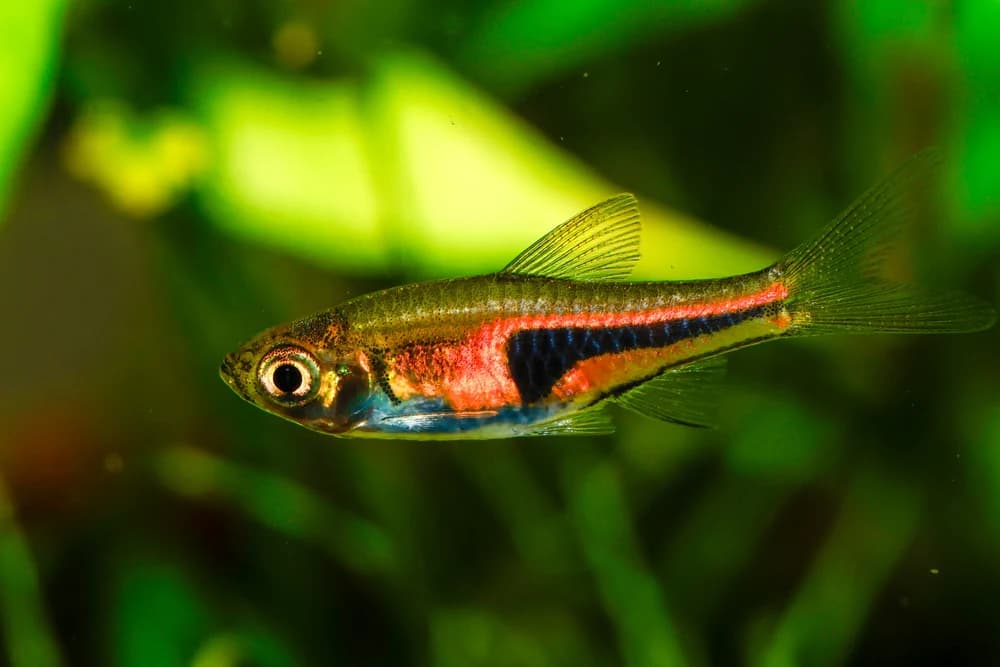
Trigonostigma espei, the lambchop rasbora (also called the Espei rasbora), is a close relative of the popular harlequin rasbora but with a slimmer body and a thinner, more refined black marking that runs from the midsection to the tail. Their copper-to-orange body and the distinctive black lambchop-shaped patch give them a more elegant, understated appearance than their harlequin relative.
Native to Thailand, Cambodia, and Laos, lambchop rasboras inhabit slow-moving, heavily vegetated, tannin-rich blackwater streams and rivers. Their preference for soft, acidic, dark water means they look most stunning and live longest in a blackwater planted setup.
They are peaceful, schooling fish perfectly suited to community nano and medium planted tanks. Their small size (1.25 inches), calm temperament, and striking coloration make them a favorite among planted tank enthusiasts worldwide.
Basic Overview
Common Misconceptions
"They are the same as harlequin rasboras." Lambchop rasboras are slimmer-bodied, slightly smaller, and have a thinner, more refined black marking than the harlequin. They also tend to prefer softer, more acidic water.
"A small group is sufficient." Like all schooling rasboras, lambchops are most comfortable and most visually stunning in groups of 10 or more. A school of 15+ in a planted tank creates a shimmering display.
"They can go in any community tank." Their small size means they must only be kept with other peaceful small fish. Any fish large enough to eat them (generally over 3 inches) is a potential predator.
"Hard, alkaline tap water is fine." Lambchop rasboras come from soft, acidic blackwater and display best and live longest in similar conditions. Hard alkaline water causes chronic low-level stress and dulled coloration.
Recommended Setup
- 15+ gallon planted tank for a school of 8–12
- Dark fine sand or Aquasoil substrate for color contrast
- Tannin-rich blackwater environment: Indian almond leaves, driftwood, dried botanicals
- Dense planting: Java moss, crypts, Rotala, stem plants
- Floating plants to create a natural canopy
- Gentle filtration; sponge filter preferred
- Dim, warm-spectrum lighting for best color display
Diet
Lambchop rasboras are micro-predators and omnivores that eat small invertebrates and organic matter in the wild. Small food particle size is important:
- Micro pellets or crushed nano flakes as a staple
- Frozen baby brine shrimp (ideal size and nutrition)
- Frozen cyclops and daphnia
- Micro worms (live)
- Infusoria in mature planted tanks
Feed small amounts once or twice daily. Standard flakes must be crushed to appropriate particle size. Regular live and frozen food supplements produce significantly better color in this species.
Personality
Lambchop rasboras are elegant, calm schooling fish that move with fluid grace through the middle water column. In a large school against a backdrop of green plants and dark substrate, the copper-orange coloration and synchronized movement of the school is deeply satisfying to observe.
They are completely peaceful and show no aggression toward any tank mate they cannot accidentally swallow. Like their harlequin relatives, they school most tightly when slightly nervous and spread out loosely when fully comfortable.
Their smaller size and preference for soft, tannin-rich water makes them particularly beautiful in a blackwater setup where the warm tones of their coloration glow against the dark, tea-colored water.
Tank Mates
Lambchop rasboras are ideal companions for other blackwater nano species. Natural pairings include chili rasboras, ember tetras, celestial pearl danios, sparkling gouramis, and apistogramma dwarf cichlids that can tolerate sharing space without predating on the small rasboras.
Dwarf shrimp are excellent companions in terms of temperament, and adult shrimp are safe. Shrimp fry may occasionally be eaten, but in a heavily planted tank many will survive.
Corydoras pygmaeus or other nano corydoras species provide a natural bottom-level companion without the size mismatch risk of larger corydoras.
Water Parameters
Lambchop rasboras come from the soft, acidic blackwater streams of mainland Southeast Asia:
- pH: 5.5–7.0 (soft, slightly acidic ideal)
- Hardness (gH): 1–8 dGH (soft water)
- Temperature: 75–82°F
- Ammonia and Nitrite: 0 ppm
- Nitrate: below 10–20 ppm
Here are some top tips to deal with unwanted parameters:
- Indian almond leaves, catappa bark, and driftwood naturally create the tannin-stained, soft, acidic water that brings out the best in lambchop rasboras.
- In hard tap water areas, blend with RO water (50–70% RO) to bring hardness into range. The color difference between hard-water and soft-water specimens of the same species can be striking.
- Weekly 15–20% water changes in a planted tank keep parameters stable. Avoid large sudden changes in a soft-water blackwater setup, as the buffering capacity is low and changes affect pH more dramatically.
- Dim, warm-spectrum lighting (4000–5500K) renders their copper-orange coloration most vividly. Bright white light washes them out and causes stress in a species adapted to shaded, tannin-darkened water.