Keyhole Cichlid Care Guide
A Complete Care Guide for Cleithracara maronii
Introduction
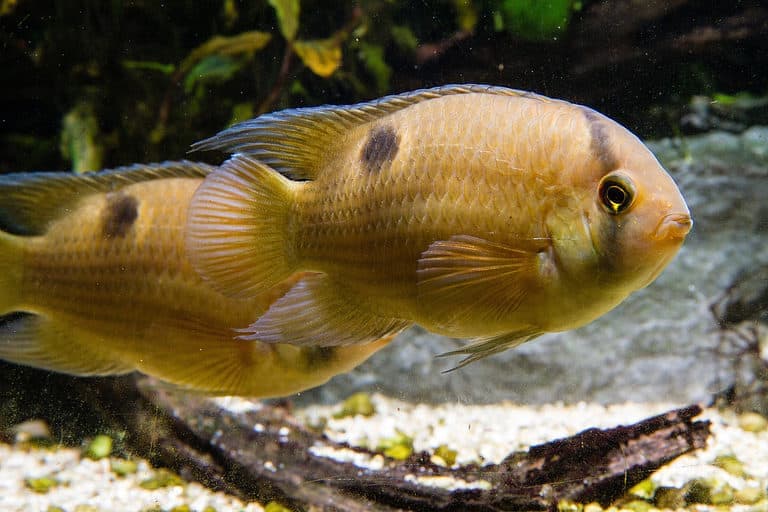
Cleithracara maronii, the keyhole cichlid, is arguably the most peaceful cichlid in the freshwater hobby. Named for the black "keyhole" marking on their flank that resembles an old-fashioned keyhole, they are small (4–5 inches), calm, and gentle fish that can be kept in community tanks with much smaller fish without any risk.
Native to the Orinoco River delta and coastal rivers of Trinidad and Guyana, keyhole cichlids inhabit slow-moving, heavily vegetated waters. Their cryptic coloration of warm beige and tan with the black keyhole marking makes them masters of blending into a planted background.
They are ideal for aquarists who want a cichlid species in a planted community tank but need something that will not disturb plants, harass smaller fish, or require a dedicated cichlid-only setup. Keyhole cichlids are as close to a true community cichlid as the hobby has to offer.
Basic Overview
Common Misconceptions
"They are boring because they are so peaceful." Keyhole cichlids have fascinating parental behaviors, complex communication with each other, and a dignified, calm presence that rewards patient observation. Their gentleness is a feature, not a shortcoming.
"They are too timid to be enjoyable." In a well-planted tank with hiding spots, keyhole cichlids settle down to become visible, confident fish. They are shy initially but not permanently reclusive.
"Their dull coloring makes them uninteresting." Keyhole cichlids have warm, nuanced coloring that is beautifully suited to natural planted aquarium aesthetics. Under warm-spectrum lighting, their golden-beige scales with the contrasting black marking are genuinely attractive.
"Any cichlid tank mates work with them." Because keyhole cichlids are so peaceful, they are often bullied by more assertive cichlids. They should be kept with peaceful fish, not with typical Central American cichlids or aggressive Malawi species.
Recommended Setup
- 30+ gallon planted tank for a pair
- Fine sand or smooth substrate; they dig minimally but prefer soft substrate
- Dense planting: Java fern, anubias, Amazon swords, crypts
- Caves and driftwood for shelter and potential spawning sites
- Gentle filtration with low to moderate flow
- Floating plants to create subdued lighting; they are more confident in dimmer light
- Leaf litter and driftwood for tannins and natural appearance
Diet
Keyhole cichlids are omnivores that feed on small invertebrates, plant matter, and organic detritus in the wild. They are undemanding eaters:
- High-quality cichlid pellets or tropical flakes as a staple
- Frozen bloodworms, brine shrimp, and daphnia
- Blanched vegetables: zucchini, peas, spinach
- Frozen or live earthworms for conditioning
- Spirulina-based foods for plant component
Feed once or twice daily. Keyhole cichlids are not aggressive feeders and may be outcompeted at feeding time by faster tank mates. Target feeding near their territory ensures they receive adequate nutrition.
Personality
Keyhole cichlids are dignified, calm fish with a quiet charisma. They move deliberately through the tank, inspecting plants and substrate with evident curiosity. Pairs communicate through subtle color changes, body posture, and movement patterns that become increasingly readable with observation.
They are one of the few cichlid species genuinely safe to keep with very small fish. Their prey instincts are subdued to the point that they routinely ignore fish that other cichlids would immediately eat, making them uniquely versatile.
Their parental behavior, when they breed, is tender and attentive. Both parents care for eggs and fry, but the intensity of defense is mild compared to most cichlids, adding to the sense that these are the most gentlemanly of all cichlid species.
Compatible Tank Mates
Because keyhole cichlids are so peaceful, the community tank possibilities are exceptional. They can be kept with cardinal tetras, neon tetras, ember tetras, small rasboras, corydoras, dwarf shrimp (adults), and virtually any other peaceful small-to-medium community fish.
Avoid aggressive species that will bully them: tiger barbs, serpae tetras in small numbers, and any cichlid with typical cichlid aggression. The keyhole cichlid's extreme passivity means it will not defend itself adequately against determined aggression.
A beautiful combination: keyhole cichlids as the centerpiece pair, a school of cardinal tetras in the midwater, pygmy corydoras on the bottom, and nerite snails for algae control. All species share compatible water parameters and temperaments.
Water Parameters
Keyhole cichlids come from the soft, warm rivers of northern South America:
- pH: 6.0–7.5
- Hardness (gH): 2–15 dGH
- Temperature: 72–82°F
- Ammonia and Nitrite: 0 ppm
- Nitrate: below 20 ppm
Here are some top tips to deal with unwanted parameters:
- Soft, slightly acidic water produces the best color and health. Driftwood and Indian almond leaves are beneficial and require no chemistry management.
- Weekly 25% water changes are all that is needed in a well-planted, moderately stocked tank.
- Temperature stability in the 76–80°F range is ideal. They tolerate a wide range but do best with consistent conditions.
- Avoid very hard, alkaline water. In harder tap water areas, blending with a proportion of RO water or adding driftwood improves conditions significantly.